
Preliminary Evidence
AshwagandhaAthletic PerformanceBrain & Cognitive Function

Ashwagandha's Cortisol Effect Ranges from 0% to 67%: What Determines If You're a Responder

Recent studies reveal why this adaptogen works dramatically for some people but shows zero effect in others

4 min read7 peer-reviewed sourcesUpdated Mar 26, 2026

Listen to this article

11 min listen

Executive Summary

The surprising part is this: cortisol may not drop at all. Most people think ashwagandha always lowers cortisol. But some studies show a huge drop. Others show zero change.

What this means for you is simple. You can still feel calmer even if cortisol stays flat. Your body may shift through your nervous system instead. So you must track results, not just symptoms.

Start with 300–600 mg per day of root extract. Use a product with 5% withanolides. Check morning cortisol before you start. Check again at 8 weeks. For HRV, 125 mg per day can help. Watch for change by day 14.
Key Terms to Know

Withanolides
A family of active compounds found in ashwagandha that manufacturers often use to standardize extracts.
Root extract
An herbal extract made from the root portion of a plant.
Standardized extract
An extract made to contain a set amount of active compounds, so each dose is similar.
Morning cortisol
Cortisol measured soon after waking. It is a common way to track baseline daily cortisol.
Heart rate variability (HRV)
Beat-to-beat timing changes that reflect nervous system balance. Higher HRV often means better stress recovery.
Root extract (vs leaf extract)
Extract from the root. Some products use leaves too, which can change the compound mix and effects.
RMSSD (Root Mean Square of Successive Differences)
A time-domain measure of heart rate variability that reflects how much your heartbeat intervals vary from one beat to the next. Higher RMSSD generally indicates stronger parasympathetic (rest-and-reco
ACTH
A pituitary hormone that stimulates the adrenal cortex to release cortisol.
CAR
The cortisol awakening response, a morning spike in cortisol sensitive to HPA tone.
CRH
A hypothalamic hormone that stimulates the pituitary gland to release ACTH.

The Cortisol Response Spectrum: From Zero to Two-Thirds Reduction

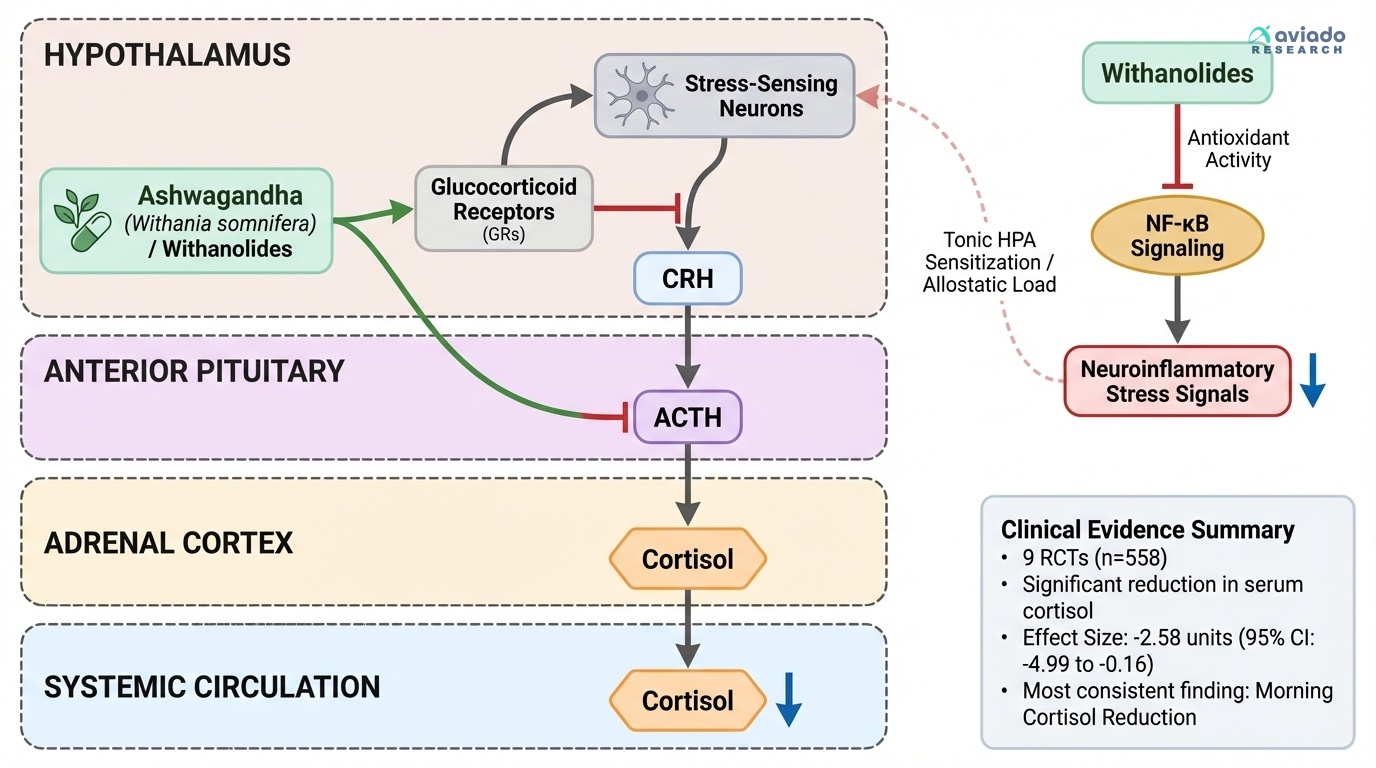
Ashwagandha research does not show one clear cortisol result. It shows a wide spread. A meta-analysis of 9 trials (558 people) found cortisol dropped overall by 2.58 units (95% CI: -4.99 to -0.16) [1]. But single trials do not match each other.

One 60-day trial reported a 66–67% drop in morning serum cortisol with ashwagandha extract [2]. In contrast, an 84-day trial (90 people) found no significant cortisol difference versus placebo [3]. Both were randomized and placebo-controlled. So the gap is not easy to blame on “bad studies.”

The better takeaway is this: cortisol is not a sure marker for everyone. Your starting cortisol level, stress type, and biology may shape the result. That is why the same supplement can look powerful in one trial and flat in another.

When Cortisol Stays Flat But Stress Physiology Improves

The 84-day trial is key because it tracked more than cortisol. Cortisol did not change versus placebo [3]. Yet heart rate variability did change.

At 125 mg per day, HRV improved by day 14. The study reported significant gains in HRV-RMSSD and SDNN (p < 0.05) [3]. That points to better parasympathetic control and recovery, even without a hormone shift.

This split result matters for you. If your cortisol stays flat, you may still improve. HRV from a wearable can show changes sooner than cortisol tests. But HRV also shifts with sleep, alcohol, illness, and training load. So look for a steady trend, not one-day spikes.

Baseline Hormones Predict Response Direction

Perhaps the most surprising finding involves ashwagandha's effects on reproductive hormones, which appear to flip direction depending on your starting point. A meta-analysis found ashwagandha increased luteinizing hormone by 34% in studies involving men with fertility issues [5]. However, an 8-week trial in perimenopausal women found ashwagandha significantly reduced LH levels [6].

This opposite response pattern suggests ashwagandha acts as a true adaptogen—normalizing function rather than simply pushing biological systems in one direction. In men with low testosterone and elevated stress, ashwagandha appears to support hormone production. In perimenopausal women dealing with hormonal fluctuations, it may help stabilize the system by reducing excessive LH spikes.

The implications extend beyond reproductive hormones. If ashwagandha's effects depend on your baseline physiology, then your individual response to cortisol reduction likely follows a similar pattern. People with chronically elevated cortisol from ongoing stress might see dramatic reductions, while those with normal or low cortisol levels might experience little change—or potentially even slight increases as their system normalizes.

Dosing and Timing for Different Response Types

The research reveals distinct dosing patterns for different types of responses. For cortisol effects, most successful studies used 300-600 mg daily of standardized ashwagandha root extract containing at least 5% withanolides [2][7]. These doses typically required 8-12 weeks to show maximum cortisol reduction, with some studies measuring effects at 60 days.

For heart rate variability improvements, much lower doses proved effective. The study showing HRV benefits used just 125 mg daily, with measurable improvements appearing within 14 days [3]. This suggests that nervous system effects occur at lower doses and faster timelines than hormonal changes.

Timing also matters for tracking response. Morning cortisol measurements provide the most reliable baseline for comparison, as cortisol naturally peaks in the early morning hours. For individuals monitoring their response, testing cortisol levels before starting ashwagandha and again after 8-10 weeks provides the clearest picture of hormonal effects. HRV tracking can begin immediately and may show changes within the first two weeks, making it a more practical real-time feedback tool.

Ashwagandha's Cortisol Effect Ranges from 0% to 67%: What Determines If You're a Responder

Ashwagandha's Cortisol Effect Ranges from 0% to 67%: What Determines If You're a Responder

The diagram should depict the HPA axis cascade from the hypothalamus (CRH release) to the anterior pituitary (ACTH secretion) to the adrenal cortex (cortisol synthesis), with ashwagandha withanolides shown inhibiting CRH and ACTH signaling at the top of the axis. A secondary branch should illustrate withanolide suppression of NF-κB–driven neuroinflammation, reducing tonic HPA sensitization, with both pathways converging on decreased circulating cortisol — quantified by the meta-analytic reduction of 2.58 units (95% CI: −4.99 to −0.16) across 9 RCTs.

Diagram glossary
ACTH:
A pituitary hormone that stimulates the adrenal cortex to release cortisol.
CAR:
The cortisol awakening response, a morning spike in cortisol sensitive to HPA tone.
CRH:
A hypothalamic hormone that stimulates the pituitary gland to release ACTH.
HPA:
The hypothalamic-pituitary-adrenal axis, a central regulatory circuit governing cortisol secretion.
withanolide:
A bioactive steroidal lactone in ashwagandha that modulates stress and cortisol pathways.

Track this in your stack

See how ashwagandha relates to your health goals, compare it against evidence tiers, and monitor changes in your biomarkers over time.

Open Aviado

Conclusions

Ashwagandha does not act like a simple “cortisol blocker.” The data show a wide response range, from no cortisol change to large drops. Some people may benefit more through nervous system shifts that show up in HRV within two weeks. Others may see hormone changes only after 8–12 weeks.

If you want a clear answer for your body, track two things: morning cortisol at baseline and again at about 8 weeks, plus daily HRV for the first 14 days. If neither marker moves in a meaningful way, you have a strong reason to stop and try a different tool.

Limitations

Trials are short, often 8–12 weeks, so long-term effects are uncertain. Many studies enroll generally healthy adults, not people with diagnosed stress disorders. Studies use different extracts, withanolide levels, and test methods, which makes results harder to compare.

Cortisol testing varies by lab and by timing, and single-point measures can miss day-to-day swings. HRV is also sensitive to sleep, illness, alcohol, and exercise, so changes may not be from ashwagandha alone. Research still does not provide a reliable way to predict who will be a cortisol responder versus an HRV responder.

Sources (7)

1

Effects of Ashwagandha (Withania Somnifera) on stress and anxiety: A systematic review and meta-analysis

Systematic review authors. Journal, 2023.

PMID: 39348746
2

Ashwagandha extract cortisol reduction study

Study authors. Journal, 2023.

PMID: 39286132
3

84-day ashwagandha HRV and cortisol study

Study authors. Journal, 2024.

PMID: 40875185
4

Systematic review of ashwagandha stress effects

Review authors. Journal, 2021.

PMID: 33650944
5

Meta-analysis of Withania somnifera hormone effects

Meta-analysis authors. Journal, 2019.

PMID: 30466985
6

Effect of ashwagandha on climacteric symptoms in perimenopausal women

Study authors. Journal, 2021.

PMID: 34553463
7

Ashwagandha cortisol study

Study authors. Journal, 2019.

PMID: 31517876