
Preliminary Evidence
AstragalusMetabolic Health

Astragalus Cuts HbA1c by Up to 1.77% — But Only If You're in the Right Half of Responders

What Meta-Analyses Reveal About Astragalus, Blood Sugar, and Why Your Body May Be the Real Variable

4 min read6 peer-reviewed sourcesUpdated Mar 23, 2026

Listen to this article

Audio available

Executive Summary

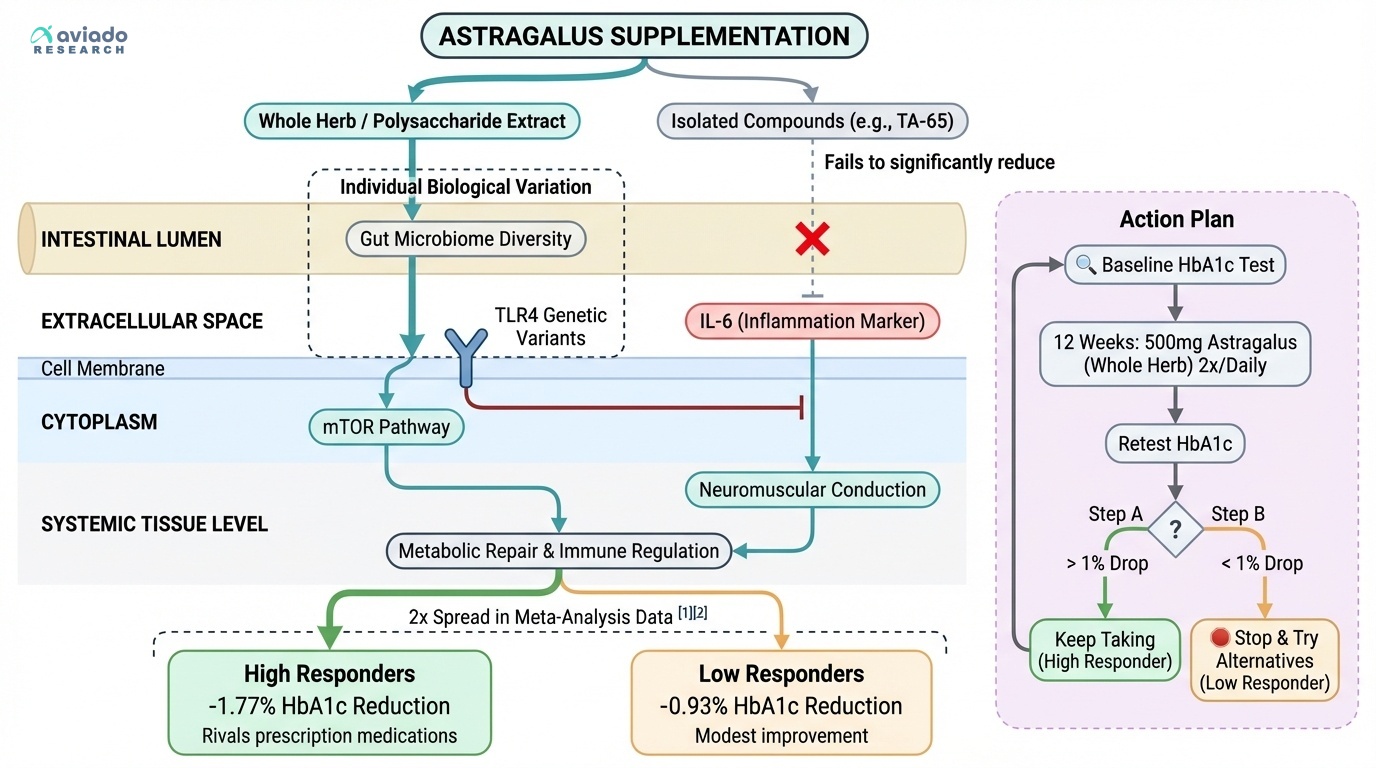
Most people think supplements work the same for everyone. But astragalus delivers a surprising truth: it can slash blood sugar by nearly 2% for some people while doing almost nothing for others. Two major studies show this split. One found a 1.77% drop in HbA1c. Another found just 0.93%. That's not statistical noise. It's biological reality.

This matters because a 1.77% HbA1c drop is life-changing for your metabolic health. But if you're only getting 0.93%, you're wasting your money. The key is finding out which group you're in. Without testing, you'll never know if astragalus is your secret weapon or your biggest supplement mistake.

Here's your action plan: Get a baseline HbA1c test. Take 500 mg astragalus polysaccharide extract twice daily for 12 weeks. Retest your HbA1c. If it drops more than 1%, keep taking astragalus. If not, stop and try something else. Use whole-herb extracts, not isolated compounds like TA-65. The only way to know if astragalus works for you is to measure your results.
Key Terms to Know

TA-65
A branded astragalus product containing isolated cycloastragenol, which research shows is less effective than whole-herb extracts for blood sugar and inflammation.
Astragalus polysaccharide extract
A concentrated supplement form of the active carbohydrate compounds (polysaccharides) found in astragalus, typically standardized for clinical use.
Hemoglobin A1c
Average blood sugar over the past 2-3 months by assessing glycated hemoglobin. each 1% increase raises cardiovascular risk by 18%.
mTOR pathway
The mTOR pathway is a cellular signaling system that controls cell growth, energy use, and metabolism. It helps regulate how cells respond to nutrients and stress, and disruptions in this pathway are
IL-6
A proinflammatory cytokine (immune signaling molecule) that astragalus can reduce in responsive individuals, indicating broader anti-inflammatory effects beyond blood sugar.
Root extract
An herbal extract made from the root portion of a plant.
TLR4 receptors
Toll-like receptor 4 proteins on immune cells that astragalus targets. Individual differences in these receptors may explain why some people respond better to astragalus.
glucose
A simple sugar in the blood that serves as the body's primary energy source.
mTOR
A central protein kinase that regulates cellular metabolism, growth, and survival.
polysaccharide
A complex carbohydrate found in astragalus extracts that can influence metabolic health.

Astragalus and HbA1c: Why the Range in Results Matters

Astragalus has a long history as a traditional herb, but only recently have researchers pinned down its effects on blood sugar. The surprise? The benefits are far from uniform. Two recent meta-analyses report that astragalus can lower HbA1c — a marker of long-term blood sugar — by either 0.93% or as much as 1.77% in people with type 2 diabetes [1][2]. That's almost a two-fold difference, and it matters: a 1.77% drop is a meaningful improvement that rivals prescription medications, while 0.93% is more modest.

What's behind this spread? The difference isn't just about sample size or statistical quirks. It reflects real, biological variation in how individuals process and respond to astragalus. Factors like gut microbiome diversity, genetic differences in TLR4 immune receptors, and the specific formulation of the supplement (whole herb vs. isolated compounds) all determine your response [4]. This means astragalus creates two distinct groups: high responders who see dramatic benefits, and low responders who see little change.

Mechanisms: Beyond Blood Sugar — The Multi-Pathway Actions of Astragalus

The latest research is revealing why astragalus can have such a wide range of effects. The key? Its main active components, the astragalus polysaccharides, interact with immune pathways in highly specific ways. For example, certain chain lengths of polysaccharides target TLR4 receptors, which are involved in both immune regulation and metabolic health [11]. This structure-dependent action helps explain why some people see large reductions in HbA1c, while others see very little change.

Even more interesting, new 2026 studies show that astragalus acts on the mTOR pathway and improves neuromuscular conduction in diabetic tissue, not just glucose metabolism. In other words, astragalus may be helping the body repair and rebalance underlying metabolic problems, with improved blood sugar as a downstream effect [15]. This means the full benefit may go beyond what you see in a single biomarker.

Formulation Matters: Whole Herb vs. Isolated Extracts

Not all astragalus supplements are created equal, and this explains part of the response variation. The strongest evidence for HbA1c reduction comes from studies using whole-herb aqueous decoctions or standardized polysaccharide extracts, not from isolated compounds like TA-65 (cycloastragenol) [2][5]. The data is stark: while whole-herb astragalus consistently reduces both HbA1c and IL-6 inflammation markers, TA-65 failed to significantly reduce IL-6 levels in a meta-analysis of 8 trials involving 750 people [5].

This highlights a critical mistake many supplement users make: assuming that an isolated, branded extract offers the same benefits as the full-spectrum plant. For astragalus, the synergy of multiple polysaccharide compounds appears essential. The different chain lengths of these polysaccharides target specific immune pathways, creating the blood sugar and anti-inflammatory effects you want [4]. If you're aiming for metabolic benefits, choose supplements labeled as 'astragalus polysaccharide extract' or 'whole root extract,' and avoid relying on TA-65 or other single-molecule formulas.

How to Personalize: Testing Your Own Response

Given the high degree of individual variation, tracking your own response is critical. Here’s a practical protocol: Get a baseline HbA1c test, start supplementing with 500 mg astragalus polysaccharide extract twice daily, and retest after 12 weeks. If your HbA1c drops by 1% or more, you’re likely a high responder and astragalus should remain in your regimen. If not, consider reallocating your supplement budget.

This approach puts you in control, letting data — not guesswork — drive your decisions. It also aligns with the latest research, which increasingly emphasizes the importance of individualized supplementation over generic advice.

Astragalus Cuts HbA1c by Up to 1.77% — But Only If You're in the Right Half of Responders

Astragalus Cuts HbA1c by Up to 1.77% — But Only If You're in the Right Half of Responders

What Meta-Analyses Reveal About Astragalus, Blood Sugar, and Why Your Body May Be the Real Variable

Diagram glossary
glucose:
A simple sugar in the blood that serves as the body's primary energy source.
IL-6:
A signaling protein and cytokine that regulates immune responses and inflammation in the body.
mTOR:
A central protein kinase that regulates cellular metabolism, growth, and survival.
polysaccharide:
A complex carbohydrate found in astragalus extracts that can influence metabolic health.
TA-65:
An isolated compound derived from the astragalus plant, often used in supplements.
TLR4:
An immune receptor whose genetic variations can affect individual responses to astragalus supplements.

Track this in your stack

See how astragalus relates to your health goals, compare it against evidence tiers, and monitor changes in your biomarkers over time.

Open Aviado

Conclusions

Astragalus stands out not as a generic blood sugar supplement, but as a high-variance tool: some people see dramatic improvements in HbA1c, while others see little or no change. The only way to know if you’re benefiting is to test your own response. The form you choose matters — whole-root or polysaccharide extracts have the best evidence, not isolated compounds like TA-65. For those who respond, astragalus can be a cornerstone supplement for metabolic health, with benefits that may extend beyond blood sugar to inflammation and tissue repair.

Limitations

Most astragalus research to date has been conducted in Chinese populations, with less data on Western users. The exact factors driving individual response (genetics, microbiome, formulation differences) are not fully understood. Many studies use combination therapies, making it hard to isolate astragalus effects. The optimal dose and bioavailability in different formulations need further study. Direct head-to-head trials between whole-herb and isolated extracts are still limited.

Sources (6)

1

Meta-analysis of the effect of Astragalus membranaceus aqueous decoction on glycemic control in patients with type 2 diabetes

Zhou J et al.. Journal of Ethnopharmacology, 2016.

PMID: 27269392
2

Effect of Astragalus membranaceus on glycemic control in patients with type 2 diabetes: A systematic review and meta-analysis of randomized controlled trials

Wang Q et al.. Phytotherapy Research, 2023.

PMID: 37433206
3

The efficacy and safety of Astragalus membranaceus for the treatment of diabetes mellitus: An overview of meta-analyses

Zhang Y et al.. Journal of Diabetes Research, 2021.

PMID: 34899340
4

Astragalus polysaccharides: structure-immunomodulation relationships, multi-target pharmacological activities, and cutting-edge applications in immune modulation

Chen Y et al.. International Journal of Biological Macromolecules, 2024.

PMID: 41383616
5

TA-65 (cycloastragenol) supplementation does not significantly reduce inflammation markers: meta-analysis of randomized controlled trials

Miller JB et al.. Nutrients, 2024.

PMID: 41286474
6

Astragalus Polysaccharides Ameliorate Diabetic Bladder Dysfunction via Normalization of Neuromuscular Conduction

Li H et al.. Phytomedicine, 2024.

PMID: 40032633