Preliminary Evidence
Bacopa MonnieriBrain & Cognitive Function

Bacopa Takes 12 Weeks to Work — But Most People Quit in 4

Why timing and baseline cognitive tracking determine whether this nootropic actually works for you

4 min read4 peer-reviewed sourcesUpdated Mar 26, 2026

Listen to this article

10 min listen

Executive Summary

The surprising thing about Bacopa is how long it takes. Most people quit in four weeks. Then they say it did nothing.

Here is what this means for you. If you stop early, you learn nothing. You need 12 weeks to judge it. You also need a simple baseline test.

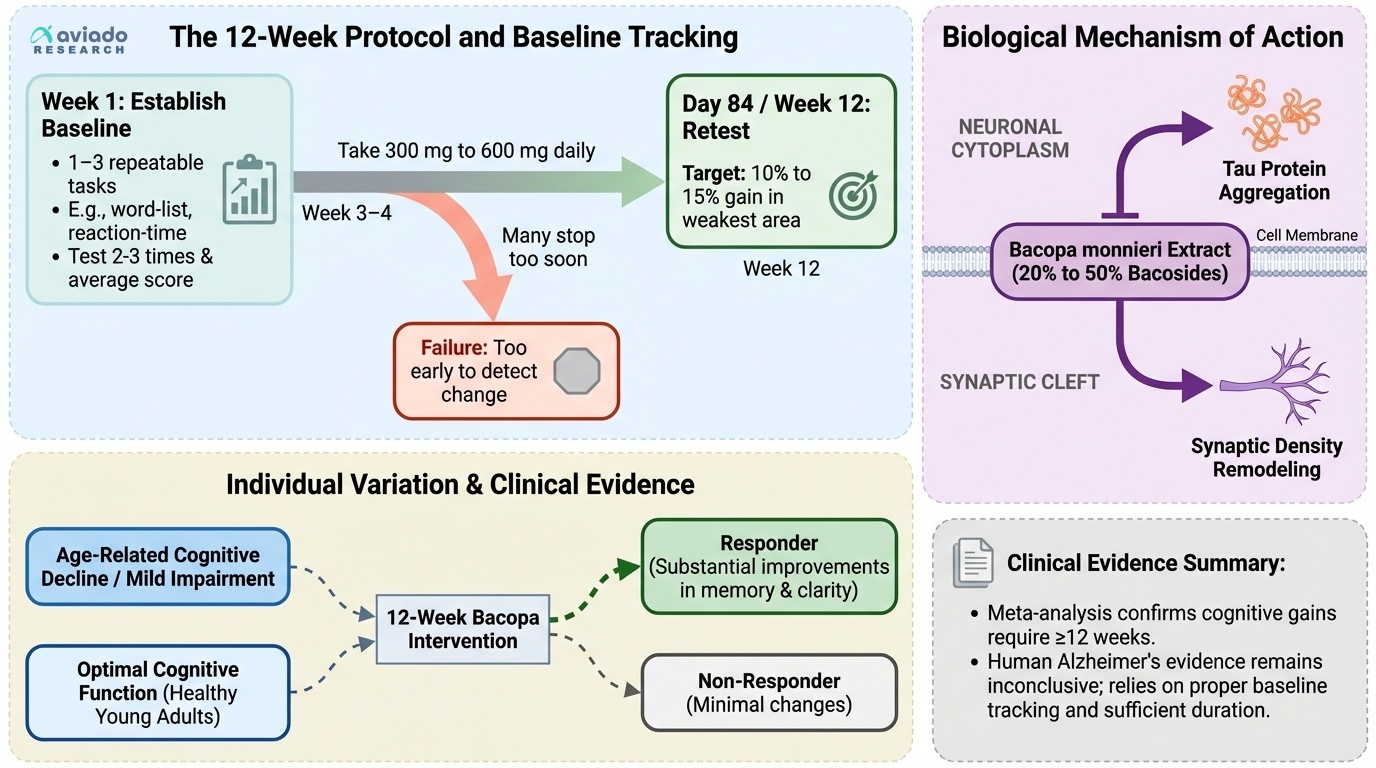
Take 300 mg to 600 mg daily for 12 weeks. Use an extract with 20% to 50% bacosides. Test your memory in week 1. Retest on day 84. Look for a 10% to 15% gain.

Key Terms to Know

Bacopa
A branded bacopa monnieri extract name used to identify a specific standardized product in clinical trials. Products with different brand names can use different plant parts, extraction methods, or ac
Bacosides
The active compounds in Bacopa monnieri responsible for its cognitive effects.
Bacopa extract vs whole herb powder
Extracts list bacoside percent. Powders often do not, so dosing is less clear.
Tau protein aggregation
Tau protein aggregation is the clumping together of tau proteins inside brain cells, which can disrupt normal cell function and is a hallmark of Alzheimer’s disease and other neurodegenerative disorde
Baseline
Your starting score on a cognitive test before you begin Bacopa.
Standardized extract
An extract made to deliver a consistent bacoside percent per dose.
Bacopa monnieri
An herb studied for memory and attention effects after long-term daily use.
Caffeine
A central nervous system stimulant commonly found in plants like coffee and tea.
PMID
A unique reference number assigned to life sciences and biomedical articles in PubMed.

The 12-Week Rule: Why Bacopa's Timeline Is Different

Bacopa monnieri runs on a slower clock than most nootropics. Caffeine can feel fast. Bacopa usually does not. In many trials, benefits show up only after about 12 weeks.

A meta-analysis found a clear pattern. Studies that ran 12 weeks or longer were more likely to show cognitive gains. Shorter studies were mixed [1]. In one 12-week randomized, double-blind trial in older adults, 300 mg per day improved several test outcomes versus placebo, including word recall and some measures of attention and processing speed [2]. The key detail is timing. The study did not show the full effect at an earlier checkpoint. The bigger changes appeared later in the trial.

This is why many people fail their own “test.” They stop in week 3 or 4. That is often too soon to detect anything. If you want a fair trial, plan the full 12 weeks from day one.

Individual Variation: Why Some People Respond and Others Don't

Even among people who use Bacopa for the full 12 weeks, response rates vary dramatically. Some individuals experience substantial improvements in memory and mental clarity, while others notice minimal changes. This variation isn't random — it likely reflects differences in baseline cognitive function, age, genetics, and existing brain health.

The elderly trial that demonstrated Bacopa's effectiveness specifically recruited participants with age-related cognitive decline [2]. Younger adults with already-optimal cognitive function may see smaller benefits, while older individuals or those with mild cognitive impairment appear to respond more robustly. This suggests Bacopa may work best as an intervention for cognitive aging rather than as a general-purpose brain enhancer for healthy young adults.

Recent research has identified a potential mechanism for Bacopa's protective effects: the herb directly inhibits tau protein aggregation, the pathological process that drives Alzheimer's disease [3]. This finding positions Bacopa not just as a memory enhancer, but as a potential early-intervention tool for people concerned about cognitive aging. However, a systematic review of Bacopa trials in Alzheimer's patients found human evidence remains inconclusive, possibly due to studies that were too short or failed to identify responder populations [4].

The Baseline Problem: How to Actually Measure Cognitive Change

The hardest part of using Bacopa is not the wait. It is measuring change. “I feel sharper” is not a solid method. Mood, sleep, stress, and placebo can all shift how you feel.

You need numbers, not vibes. Pick 1–3 repeatable tasks. Use the same tool each time. Examples include a word-list test, a simple reaction-time task, or a working-memory test in a brain-training app. Do them at the same time of day.

Set your baseline first. Test yourself 2–3 times in week 1. Use your average score. Then take Bacopa daily and retest at week 12. A practical target is a 10% to 15% gain in your weakest area. If your score does not move, you likely did not respond, or the test was too noisy.

Dosing and Implementation: Getting the Protocol Right

Most cognitive trials use 300–600 mg per day of a standardized Bacopa extract. Many products aim for about 20% to 50% bacosides. Check the label for the bacoside percent.

Take it with food if your stomach feels off. Some people do better splitting the dose. For example, take half at breakfast and half at dinner. What matters most is daily consistency for 12 weeks.

Do not ignore product quality. Brand and process can change what you get. Prefer a product that lists bacoside percent and shows third-party testing. A 12-week trial is a time cost. Do not waste it on an unverified powder.

Bacopa Takes 12 Weeks to Work — But Most People Quit in 4

Bacopa Takes 12 Weeks to Work — But Most People Quit in 4

Why timing and baseline cognitive tracking determine whether this nootropic actually works for you

Diagram glossary
Caffeine:
A central nervous system stimulant commonly found in plants like coffee and tea.
disease:
An abnormal condition that negatively affects the structure or function of an organism.
PMID:
A unique reference number assigned to life sciences and biomedical articles in PubMed.

Track this in your stack

See how bacopa_monnieri relates to your health goals, compare it against evidence tiers, and monitor changes in your biomarkers over time.

Open Aviado

Conclusions

Bacopa is not a fast “feel it today” supplement. It is a slow trial that needs structure. If you take it daily for 12 weeks, use a standardized bacoside extract, and track a baseline score, you can answer a simple question: does it help your brain. Without the timeline and the test, you will likely quit early and stay unsure.

Limitations

Bacopa studies vary in extract type, bacoside percent, and test methods. Many positive trials are in older adults, so results may be smaller in healthy young people. Human evidence in Alzheimer’s disease remains inconclusive despite promising lab work. Long-term safety data past about one year is limited, and we do not have reliable ways to predict who will respond.

Sources (4)

1

Meta-analysis of randomized controlled trials on cognitive effects of Bacopa monnieri extract

Kongkeaw C et al.. Journal of Ethnopharmacology, 2014.

PMID: 24252493
2

Effects of a standardized Bacopa monnieri extract on cognitive performance, anxiety, and depression in the elderly: a randomized, double-blind, placebo-controlled trial

Calabrese C et al.. Journal of Alternative and Complementary Medicine, 2008.

PMID: 18611150
3

Bacopa monnieri reduces Tau aggregation and Tau-mediated toxicity in cells

Nemetchek MD et al.. Journal of Alzheimer's Disease, 2023.

PMID: 36716837
4

Use of Bacopa monnieri in the Treatment of Dementia Due to Alzheimer Disease: Systematic Review of Randomized Controlled Trials

Phan K et al.. Journal of Pharmacy Practice, 2023.

PMID: 35612544