
Moderate Evidence
CortisolStress & CortisolHormone Balance

Best Supplements for Cortisol (Stress Hormone): What the Evidence Actually Shows

12 min read8 peer-reviewed sourcesUpdated Mar 20, 2026

Listen to this article

Audio available

Executive Summary

Here's a surprising fact: of the dozens of supplements marketed to lower cortisol, only one has strong proof it works. People spend billions on stress-relief products each year. Most of those products rest on weak or early-stage science.

Ashwagandha (an herbal adaptogen) stands alone at the top. A review of 12 clinical trials found it reliably lowers cortisol by a meaningful amount. Vitamin C may help blunt cortisol spikes after hard workouts. Phosphatidylserine (a brain-cell fat) and L-theanine (a tea amino acid) show promise but need more research. Everything else in the evidence base is either impractical, cortisol-raising, or too early to trust.

If you want to try the best-proven option, take ashwagandha root extract at 600 mg per day, split into two 300 mg doses with meals. Look for products standardized to at least 5% withanolides. Give it 8 to 12 weeks. For exercise-related cortisol spikes, add 500–1,000 mg of vitamin C plus 400 IU of vitamin E around training. For gentle daily calm, try 200–400 mg of L-theanine. No supplement replaces sleep, exercise, and stress management — build those first.
Key Terms to Know

HPA Axis
The body's central stress response system connecting the brain to adrenal glands. Chronic activation leads to elevated stress hormones and negative health effects.
Meta-Analysis
A statistical technique combining results from multiple studies to find overall patterns.
RCT
The gold standard for clinical research.
GABA
The brain's primary inhibitory neurotransmitter, promoting calm and relaxation. Low levels linked to anxiety and sleep problems.
Adaptogen
Herbs that help the body adapt to stress and maintain homeostasis.
Neurotransmitter
Chemical messengers that transmit signals between neurons.
Oxidative Stress
Cellular damage caused by reactive oxygen species (free radicals) overwhelming antioxidant defenses.

The Quick Answer

If you want to lower cortisol with a supplement, ashwagandha (an herbal adaptogen) is the clear winner. It is the only option backed by a meta-analysis of 12 randomized trials involving over 1,000 people. No other supplement comes close.

Here is the full ranking:

⭐⭐⭐ Tier 1 — Strong Evidence: 1. Ashwagandha — Lowers cortisol by an average of 4.13 ng/mL across 12 trials and over 1,000 participants.

⭐⭐ Tier 2 — Moderate Evidence: 2. Vitamin C — Blunts cortisol spikes after exercise, especially when combined with vitamin E. 3. Phosphatidylserine (a brain-cell phospholipid) — Reduces cortisol response to stress in 4 consistent trials, but needs more research. 4. L-Theanine (a tea amino acid) — May help during acute stress, but cortisol-specific evidence is limited. 5. Oxytocin (intranasal) — Research compound, not a practical supplement. Mixed results overall.

Not Recommended for Cortisol Lowering: 6–7. GHRP-6 and GHRP-2 — These research peptides raise cortisol by 148–180%.

⭐ Tier 3 — Preliminary Evidence: 8. DSIP — Far too little data to draw any conclusions.

The bottom line: ashwagandha is the only supplement with reliable evidence for lowering cortisol. Everything else is either less proven, works only in specific contexts, or is not available as a consumer product.

Understanding Cortisol

Cortisol is often called the "stress hormone," but that label is too simple. Your body needs cortisol. It wakes you up in the morning, fuels you during workouts, and helps control blood sugar and inflammation. Cortisol is not the enemy.

The problem starts when cortisol stays high for too long. Chronic stress — from work pressure, poor sleep, overtraining, or anxiety — can keep cortisol elevated day after day. Over time, this leads to real health problems.

What chronically high cortisol does: - Disrupts sleep, especially your ability to fall asleep at night - Increases belly fat storage - Weakens your immune system - Raises blood sugar levels - Breaks down muscle tissue - Worsens anxiety and mood

How cortisol is measured: Salivary cortisol is the most common method in supplement studies. It is easy to collect and reflects "free" (active) cortisol — the form that actually affects your cells. Blood cortisol is also used but includes both bound and free cortisol, making it a less precise marker of what your body is actually experiencing.

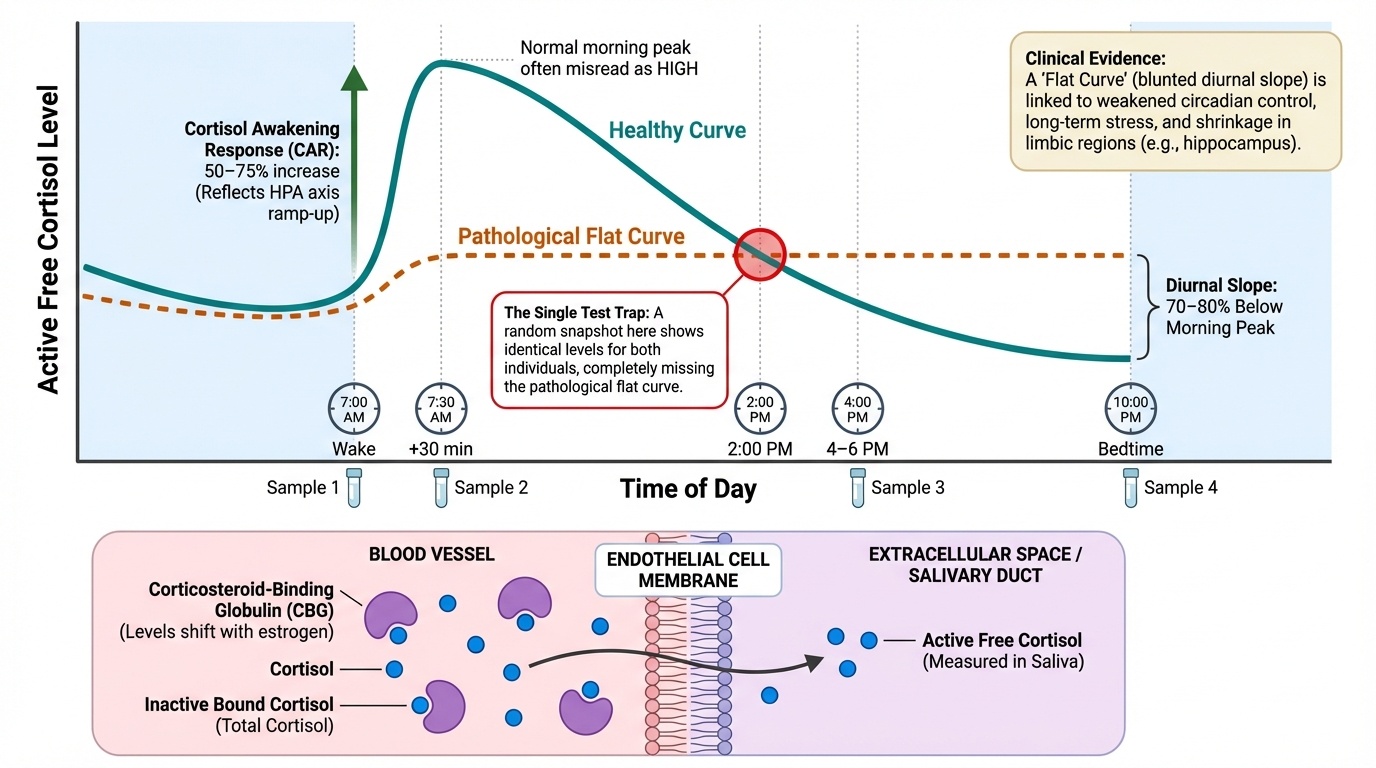
Normal cortisol patterns: Cortisol follows a daily rhythm called the diurnal curve. It peaks in the early morning (around 6–8 AM) and drops to its lowest point around midnight. A healthy pattern shows a steep morning rise and a gradual decline through the day. Disrupted patterns — like a flat curve or elevated evening cortisol — signal chronic stress and are linked to metabolic and mood problems.

Why supplements are only part of the picture: No supplement can replace the cortisol-lowering power of consistent sleep (7–9 hours), regular exercise, social connection, and stress management techniques like meditation or deep breathing. Supplements offer an extra edge, but they work best on top of these foundations — not instead of them.

#1: Ashwagandha — The Clear Leader

Ashwagandha (Withania somnifera) is an herb used in Ayurvedic medicine for thousands of years. In the last decade, it has become the most rigorously studied natural supplement for stress — and the evidence is strong enough to set it apart from everything else on this list.

What the research shows: A 2025 meta-analysis pooled 12 randomized controlled trials with over 1,000 participants. The result: ashwagandha reduced serum cortisol by an average of 4.13 ng/mL — a clinically meaningful drop. No other supplement has this caliber of evidence for cortisol reduction.

Trials tested ashwagandha in chronically stressed adults, healthy volunteers, and people with anxiety. The cortisol-lowering effect held up across all these groups. Most studies used daily doses between 300 mg and 600 mg of a standardized root extract for 8 to 12 weeks.

How it works: Ashwagandha's active compounds — called withanolides — appear to calm the HPA axis, the brain-body system that controls cortisol release. It may also mimic GABA (the brain's calming neurotransmitter), promoting relaxation. Some research suggests it reduces the activity of cortisol-producing enzymes in the adrenal glands.

Dosing: Take 600 mg per day of a root extract standardized to at least 5% withanolides. Split into two 300 mg doses with meals to reduce stomach upset. Higher doses up to 1,000 mg have been tested safely. Allow 8 to 12 weeks before judging results.

Who benefits most: - Adults with chronic stress and elevated cortisol - People with stress-related sleep problems - Those experiencing anxiety alongside high cortisol

Important caveats: - Ashwagandha can raise thyroid hormones (T3 and T4). If you take thyroid medication, talk to your doctor first. - Not recommended during pregnancy. - Some people report mild stomach upset, especially on an empty stomach. - Quality varies widely between brands. Choose products that list withanolide content on the label. - Rare reports of liver injury have surfaced. If you have liver disease, use caution and discuss with your doctor.

#2: Vitamin C — Best for Exercise-Induced Cortisol

Vitamin C is well known for immune health, but it also plays a direct role in adrenal function. Your adrenal glands — which produce cortisol — contain some of the highest concentrations of vitamin C in the body.

What the research shows: A 2022 meta-analysis of 18 RCTs found that combined supplementation with vitamins C and E significantly reduced cortisol immediately after exercise. The effect was large and statistically robust. However, this evidence applies primarily to post-exercise cortisol spikes — not resting cortisol throughout the day.

The evidence for vitamin C alone (without vitamin E) is weaker. Some individual trials show benefits, but the strongest and most consistent data comes from the combination.

How it works: Intense exercise creates oxidative stress, which triggers cortisol release. Vitamin C is a powerful antioxidant that buffers this oxidative signal, reducing the cortisol spike that follows hard training.

Dosing: Take 500 to 1,000 mg of vitamin C per day, combined with 400 IU of vitamin E. Some studies used a single large dose before exercise.

Who benefits most: - Athletes and active people who train intensely - People who notice recovery problems or high stress after workouts - Those who may be deficient in vitamin C (smokers, people with poor diets)

Important caveats: - Blunting the cortisol response to exercise might reduce some training adaptations. Your body uses cortisol as a signal to rebuild stronger. Blocking it entirely may not be ideal for performance gains. - Evidence for lowering chronic or resting cortisol is weak. - Doses above 2,000 mg per day can cause diarrhea and stomach cramps. - The strongest evidence involves vitamin C plus vitamin E together, not vitamin C alone.

#3: Phosphatidylserine — Promising but Limited

Phosphatidylserine (PS) is a phospholipid — a type of fat that forms the membrane of every cell in your body. It is especially concentrated in brain cells. PS supplements have been studied for both cognitive health and cortisol management.

What the research shows: Four RCTs have examined PS's effect on cortisol, and all point in the same direction: PS blunts the cortisol response to both physical exercise and mental stress tasks. However, with only four trials and no meta-analysis, the evidence remains moderate — consistent but thin.

Most studies measured cortisol response to a specific stressor (like intense cycling or a timed math test) rather than resting cortisol levels throughout the day.

How it works: PS may dampen the HPA axis response to stress. Some researchers believe it interacts with cortisol receptors or modulates the signaling cascade that triggers cortisol release. The exact mechanism remains unclear.

Dosing: Take 300 to 600 mg per day, split into two or three doses. A common research dose is 400 mg per day.

Who benefits most: - Athletes dealing with overtraining or excessive exercise stress - People who want an alternative or complement to ashwagandha - Those interested in a supplement that may also support cognitive function

Important caveats: - Only 4 RCTs exist — a small evidence base that needs replication. - Older studies used bovine brain-derived PS, which is no longer available. Modern supplements use soy-derived PS, which may not produce identical effects. - PS costs more per serving than ashwagandha. - No strong evidence that it lowers resting or chronic cortisol levels.

#4: L-Theanine — Calm Without Drowsiness

L-theanine is an amino acid found almost exclusively in tea leaves, especially green tea. It is the reason green tea feels different from coffee despite containing caffeine — it promotes a calm, focused state without causing sleepiness.

What the research shows: Six RCTs have examined L-theanine's effects on cortisol, with mixed results. L-theanine appears to reduce the cortisol response during acute stress tasks (like public speaking or mental arithmetic). But its effect on resting cortisol throughout the day is unclear.

A systematic review found that L-theanine consistently reduced subjective stress — people felt calmer. However, the cortisol-specific data is weaker than the subjective benefits suggest. You may feel less stressed without a large measurable drop in cortisol.

How it works: L-theanine crosses the blood-brain barrier and increases alpha brain wave activity, which is associated with relaxed alertness. It may also boost GABA (calming neurotransmitter), serotonin (mood regulator), and dopamine (motivation signal). These calming effects may indirectly reduce cortisol by dialing down the brain's stress signaling.

Dosing: Take 200 to 400 mg per day. It can be taken all at once or split. Many people take it in the morning or 30 minutes before a stressful event.

Who benefits most: - People who want stress relief without sedation - Coffee drinkers who want to blunt caffeine's cortisol-raising effects - People with mild to moderate daily stress

Important caveats: - Despite 6 RCTs, the cortisol evidence score is low (37 out of 100), reflecting inconsistent findings. - Subjective stress relief appears stronger than measurable cortisol reduction. - Many studies tested L-theanine alongside caffeine, making it hard to isolate its solo effects on cortisol. - Unlikely to help with significantly elevated chronic cortisol.

#5: Oxytocin, GHRP-6, GHRP-2, and DSIP — Not Practical Options

The remaining compounds in our database deserve mention for completeness, but none are practical for everyday cortisol management.

Oxytocin (Intranasal): Oxytocin is a hormone involved in social bonding, trust, and stress regulation. A meta-analysis of 18 studies found that intranasal oxytocin did not significantly lower cortisol overall. It showed a meaningful cortisol reduction only when the stress task strongly activated the HPA axis — a narrow context. Oxytocin is a prescription/research compound administered as a nasal spray. It is not available as a dietary supplement.

GHRP-6 and GHRP-2 (Growth Hormone-Releasing Peptides): These peptides are included because they affect cortisol — but they raise it, not lower it. GHRP-6 increased cortisol by approximately 148%, and GHRP-2 by approximately 180%. The cortisol spike is a side effect of stimulating growth hormone release. These are research compounds, not consumer supplements, and they are the opposite of what you want for stress management.

DSIP (Delta Sleep-Inducing Peptide): DSIP was originally studied for sleep induction. Only 4 studies (just 1 RCT) have examined its cortisol effects, and results are inconsistent — sometimes raising cortisol, sometimes lowering it. The evidence is far too thin to draw any conclusions. It is not commercially available.

The takeaway: If you want a practical, evidence-based supplement to lower cortisol, focus on the top four options — especially ashwagandha.

How to Choose

Choosing the right cortisol-lowering supplement depends on your situation. Here is a simple decision framework:

If you have chronic stress and want the best-proven option: → Start with ashwagandha (600 mg/day of root extract standardized to ≥5% withanolides, split into two doses with meals). Allow 8–12 weeks.

If you are an athlete worried about exercise-related cortisol: → Try vitamin C (500–1,000 mg) combined with vitamin E (400 IU) around training. Or consider phosphatidylserine (400 mg/day).

If you want something gentle for daily stress:L-theanine (200–400 mg) is safe, well-tolerated, and promotes calm focus. It may not dramatically lower cortisol on a blood test, but it can help you feel noticeably less stressed.

If you already take ashwagandha and want to add something: → L-theanine or phosphatidylserine can be combined with ashwagandha. No known negative interactions exist between them.

Important considerations before starting: - Check your thyroid: Ashwagandha can raise thyroid hormones. If you have a thyroid condition or take thyroid medication, get your levels checked first. - Timing matters: Take ashwagandha with meals to reduce stomach upset. L-theanine can be taken any time — many people prefer it before stressful situations. - Be patient: Most ashwagandha trials lasted 8 to 12 weeks. Do not expect overnight results. - Measure if you can: If you are serious about tracking progress, consider a salivary cortisol test before and after 8–12 weeks of supplementation. - Lifestyle first: No supplement can overcome chronic sleep deprivation, constant overwork, or untreated anxiety. Address the root causes of stress alongside any supplementation.

What the Evidence Shows

Not all evidence is created equal. Here is how to think about the strength of research behind each option:

Ashwagandha — The Gold Standard for This Category: With a meta-analysis of 12 RCTs and over 1,000 participants, ashwagandha has the kind of evidence most supplements never achieve. The 4.13 ng/mL cortisol reduction is both statistically significant and clinically meaningful. This is Tier 1 evidence — as strong as it gets in the supplement world.

Vitamin C — Well-Studied but Narrow in Scope: With 19 RCTs and 2 meta-analyses, vitamin C has been extensively tested. But the cortisol evidence is mostly about exercise-induced spikes, not chronic elevation. And the clearest results come from combining vitamin C with vitamin E, not from vitamin C alone.

Phosphatidylserine — Consistent Direction, Small Volume: Four RCTs all point the same way — PS reduces cortisol response to stress. But four trials is a thin base. A meta-analysis pooling these results would strengthen confidence considerably.

L-Theanine — Feeling Better vs. Testing Better: Six RCTs exist, but cortisol-specific findings are mixed. L-theanine clearly helps people feel less stressed. Whether it produces a meaningful, measurable drop in cortisol remains uncertain.

A note on what is missing: Some popular "cortisol-lowering" supplements — like rhodiola, holy basil (tulsi), magnesium, and omega-3 fatty acids — did not appear in our evidence database with enough qualifying studies for cortisol specifically. This does not mean they are useless for stress. It means the cortisol-specific evidence has not yet reached the threshold for inclusion. Future research may change these rankings.

The Bottom Line

Cortisol management matters for long-term health. Chronically elevated cortisol erodes sleep, promotes belly fat, dampens immunity, and worsens mood. But the supplement market is full of overpromised, under-proven products.

Here is what the evidence actually supports:

1. Ashwagandha is the clear #1 choice. Take 600–1,000 mg per day of a standardized root extract (≥5% withanolides) for at least 8 weeks. It is the only supplement backed by meta-analysis-level evidence for lowering cortisol.

2. Vitamin C plus vitamin E can help after exercise. If you train hard, 500–1,000 mg of vitamin C with 400 IU of vitamin E around workouts has solid evidence for blunting post-exercise cortisol spikes. It will not fix chronic stress.

3. Phosphatidylserine and L-theanine are reasonable second-tier options. Both are safe and may provide modest benefits. PS (300–600 mg/day) targets exercise and stress-related cortisol spikes. L-theanine (200–400 mg/day) promotes calm without drowsiness.

4. Oxytocin, GHRP peptides, and DSIP are not practical options for everyday cortisol management.

5. Lifestyle remains the foundation. Sleep 7–9 hours. Exercise regularly without overtraining. Practice stress management daily. No pill replaces these habits.

If cortisol is a concern, consider getting it tested through a salivary cortisol panel. Work with a healthcare provider to understand your results. And if you choose to supplement, ashwagandha is where the evidence points.

Your Cortisol Rhythm Is a Fingerprint — And Most People Are Reading It Wrong

Your Cortisol Rhythm Is a Fingerprint — And Most People Are Reading It Wrong

Why timing matters more than levels when measuring your stress hormone

Diagram glossary
CBG:
Corticosteroid-binding globulin is a blood protein that binds cortisol, limiting its active tissue exposure.
estrogen:
A hormone whose fluctuating levels can shift the amount of corticosteroid-binding globulin in blood.
HPA:
The hypothalamic-pituitary-adrenal axis is a bodily system that ramps up daily cortisol production.

Track this in your stack

See how cortisol relates to your health goals, compare it against evidence tiers, and monitor changes in your biomarkers over time.

Open Aviado

Conclusions

Ashwagandha is the only supplement with strong, meta-analysis-level evidence for lowering cortisol, with a proven average reduction of 4.13 ng/mL across 12 randomized trials and over 1,000 participants. Vitamin C (combined with vitamin E) can blunt cortisol spikes after intense exercise. Phosphatidylserine and L-theanine show moderate promise but need more research to confirm their cortisol-specific effects. Other compounds in the database — oxytocin, GHRP peptides, and DSIP — are either impractical, cortisol-raising, or too early in research to recommend. Lifestyle factors like sleep, exercise, and stress management remain the most powerful tools for cortisol regulation. Supplements should be viewed as complementary support, not standalone solutions.

Limitations

Several important limitations should be noted. First, cortisol is highly variable — it changes throughout the day, with stress, meals, exercise, and sleep. Study results can differ based on when and how cortisol was measured. Second, many studies measured cortisol response to acute stress tasks in a lab, which may not reflect real-world chronic stress. Third, the ashwagandha evidence, while strong, comes from studies using different extract types and dosing protocols, making it hard to pinpoint the single best product. Fourth, popular supplements like rhodiola rosea, holy basil (tulsi), magnesium, and omega-3 fatty acids were not included because they did not meet the evidence threshold in our database for cortisol specifically — this does not mean they have no effect. Fifth, most studies lasted 8 to 12 weeks; very few examined long-term supplementation beyond 3 months. Sixth, individual responses to supplements vary widely based on genetics, baseline stress levels, diet, and other factors. Finally, cortisol is just one marker of stress — subjective well-being, sleep quality, and anxiety levels matter too, and a supplement that does not significantly lower cortisol may still improve how you feel.

Sources (8)

1

Effects of Ashwagandha (Withania somnifera) supplementation on cortisol levels: A systematic review and meta-analysis of randomized controlled trials

Reported in Aviado database. Systematic Review and Meta-Analysis, 2025.

PMID: 40746175
2

The effect of antioxidant vitamin supplementation on cortisol response to exercise: A meta-analysis of randomized controlled trials

Reported in Aviado database. Systematic Review and Meta-Analysis, 2022.

PMID: 35261309
3

The effect of intranasal oxytocin on cortisol response to laboratory stressors: A meta-analysis

Reported in Aviado database. Meta-Analysis, 2014.

PMID: 25086828
4

Effects of Ashwagandha (Withania somnifera) on Physical Performance: Systematic Review and Bayesian Meta-Analysis

Bonilla DA et al.. Journal of Functional Morphology and Kinesiology, 2021.

PMID: 33670194
5

Effects of Withania somnifera supplementation on cortisol and related biomarkers: A systematic review

Reported in Aviado database. Systematic Review, 2023.

PMID: 38140274
6

The Effects of Green Tea Amino Acid L-Theanine Consumption on the Ability to Manage Stress and Anxiety Levels: a Systematic Review

Everett JM et al.. Plant Foods for Human Nutrition, 2019.

PMID: 31758301
7

The impact of essential fatty acid, B vitamins, vitamin C, magnesium and zinc supplementation on stress levels in women: a systematic review

McCabe D et al.. JBI Database of Systematic Reviews and Implementation Reports, 2017.

PMID: 28178022
8

Effects of Oral Gamma-Aminobutyric Acid (GABA) Administration on Stress and Sleep in Humans: A Systematic Review

Hepsomali P et al.. Frontiers in Neuroscience, 2020.

PMID: 33041752