
Strong Evidence
HomocysteineHeart HealthBrain & Cognitive Function

Best Supplements for Homocysteine: What the Evidence Actually Shows

12 min read15 peer-reviewed sourcesUpdated Mar 20, 2026

Listen to this article

Audio available

Executive Summary

Here's a surprising fact about homocysteine: the best supplements for lowering it are cheap B vitamins you can buy anywhere. Most people waste money on expensive heart health formulas. But decades of research point to a few simple nutrients instead.

Homocysteine is a blood marker tied to heart disease and cognitive decline. When it's elevated, it usually means your body is short on B vitamins. Correcting that shortage brings levels down fast — often within weeks. The payoff: better cardiovascular markers and protection against nerve damage and anemia.

Here's exactly what to take. Start with 400–800 mcg of folic acid daily — this alone cuts homocysteine by about 25%. Add 500–1,000 mcg of vitamin B12 daily for an extra 7% drop. If levels stay high, add 25–50 mg of vitamin B6 daily. For stubborn cases, betaine (trimethylglycine) at 3–6 grams per day works through a completely different pathway. Get your levels tested before you start, and retest in 2–3 months.
Key Terms to Know

Vitamin B12
Vitamin B12, essential for nerve function, DNA synthesis, and red blood cell formation. deficiency causes fatigue, neuropathy, and megaloblastic anemia.
Meta-Analysis
A statistical technique combining results from multiple studies to find overall patterns.
RCT
The gold standard for clinical research.
LDL Cholesterol (calc)
LDL cholesterol, the "bad cholesterol" that deposits in artery walls. elevated LDL is the primary driver of atherosclerosis and heart disease.
Homocysteine
Homocysteine, an amino acid metabolite influenced by B vitamins. elevated levels damage blood vessels and increase cardiovascular and dementia risk.
Growth Differentiation Factor 15 (GDF-15)
Top aging biomarker per meta-analysis. Stress-responsive cytokine elevated in aging, cancer, heart failure, and chronic disease.
Cholesterol, Total
Total cholesterol, the sum of HDL, LDL, and VLDL cholesterol. elevated levels increase atherosclerotic cardiovascular disease risk.

The Quick Answer

If your homocysteine is elevated, B vitamins are the answer. Here's the ranking:

#1 Folate (Folic Acid / 5-MTHF) — ⭐⭐⭐ Tier 1. The single most effective supplement. Cuts homocysteine by about 25%. Take 400–800 mcg daily.

#2 Vitamin B12 — ⭐⭐⭐ Tier 1. Adds another 7% reduction on top of folate. Essential for vegans and older adults. Take 500–1,000 mcg daily.

#3 Vitamin B6 — ⭐⭐ Tier 2. A helpful add-on to folate and B12. Modest effect on its own. Take 10–50 mg daily.

#4 Betaine (trimethylglycine) — ⭐⭐ Tier 2. Works through a different pathway. Good for people who don't respond fully to B vitamins. Take 3–6 grams daily.

#5 Omega-3s — ⭐ Tier 3. Small and inconsistent effect. Not a primary strategy. Take 1–3 grams daily if already using for other reasons.

The most effective approach: combine folate with B12. This pairing has the strongest evidence by far. Adding B6 provides a small extra push. Betaine is a useful backup for stubborn cases.

Understanding Homocysteine

Homocysteine is an amino acid your body makes naturally. It forms when your body breaks down methionine, a protein building block found in meat, eggs, and dairy. In small amounts, homocysteine is normal and harmless.

The problem starts when it builds up. Your body needs B vitamins — mainly folate, B12, and B6 — to recycle homocysteine back into useful compounds. Without enough of these vitamins, levels rise.

Why high homocysteine matters:

Elevated homocysteine (above 15 micromoles per liter) damages blood vessel walls, promotes blood clot formation, and increases oxidative stress. Studies link high levels to heart attack, stroke, and blood vessel disease.

The brain health connection is equally concerning. High homocysteine is linked to faster cognitive decline, dementia, and Alzheimer's disease — especially in people with low B vitamin levels.

What raises homocysteine:

- Low intake of folate, B12, or B6 - Vegan or vegetarian diets (often low in B12) - Aging (B12 absorption drops with age) - MTHFR gene variants (reduce folate processing) - Kidney disease - Certain medications (metformin, acid blockers, anti-seizure drugs) - Smoking and high coffee intake

Normal vs. elevated levels:

Most labs consider 5–15 micromoles per liter normal. Above 15 is elevated. Above 30 is severely elevated and needs medical attention. Some experts argue optimal levels sit below 10, though this stricter target remains debated.

An important caveat: While B vitamins reliably lower homocysteine, large clinical trials have not clearly shown that this reduces heart attacks or strokes. Elevated homocysteine may partly be a marker of poor nutrition rather than a direct cause of disease. Still, correcting B vitamin deficiencies matters for overall health, and keeping homocysteine in a healthy range is a reasonable goal.

#1: Folate (Folic Acid / 5-MTHF)

Folate is the undisputed champion for lowering homocysteine. No other supplement comes close in effect size or evidence base.

What the evidence shows:

The Homocysteine Lowering Trialists' Collaboration pooled data from 25 randomized controlled trials. The result was unambiguous: folic acid lowered homocysteine by about 25% on average. This held true across different populations and study designs.

A 2025 network meta-analysis compared multiple supplements head-to-head in healthy adults. Folic acid-based interventions ranked at the top, with the combination of folic acid plus other B vitamins performing best overall.

The effect depends on your starting point. People with higher homocysteine and lower folate levels see the biggest drops. If your homocysteine is only mildly elevated and your folate intake is already good, expect a smaller benefit.

Dosing:

Most trials used 400–800 mcg of folic acid daily. The meta-analysis found that higher doses (up to 5 mg) added only a small benefit over 800 mcg. For most people, 400–800 mcg is the sweet spot.

Folic acid vs. methylfolate (5-MTHF):

Regular folic acid must be converted to 5-MTHF in your body before it works. Some people — especially those with MTHFR gene variants — perform this conversion poorly. For them, taking 5-MTHF directly may be more effective. However, most trials used regular folic acid, so the evidence base is stronger for that form.

A 2025 systematic review confirmed that 5-MTHF effectively raises folate levels and lowers homocysteine in women of childbearing age, with a good safety profile.

Who benefits most:

- People with homocysteine above 12–15 micromoles per liter - Those with low dietary folate intake - People with MTHFR variants (consider 5-MTHF) - Women planning pregnancy (folate also prevents neural tube defects) - Vegans and vegetarians

Important warnings:

High-dose folic acid can mask the signs of vitamin B12 deficiency — a dangerous situation because untreated B12 deficiency causes irreversible nerve damage. Always check your B12 level before starting high-dose folic acid. Better yet, take B12 alongside it.

Doses above 1 mg (1,000 mcg) per day should be taken under medical guidance. Some research has raised concerns about very high folic acid intake and cancer risk, though the evidence remains inconclusive.

#2: Vitamin B12 (Cobalamin)

Vitamin B12 is folate's essential partner. Together, they form the most effective combination for lowering homocysteine.

What the evidence shows:

The Homocysteine Lowering Trialists' meta-analysis found that adding B12 to folic acid reduced homocysteine by an additional 7% beyond folic acid alone. That may sound modest, but it's a meaningful boost — especially for people who are B12 deficient.

A 2023 meta-regression of randomized controlled trials confirmed that B12 supplementation on its own significantly lowers homocysteine, with the strongest effect in people who started with low B12 levels.

A 2024 systematic review of vegans found that those who don't supplement B12 have notably higher homocysteine and signs of functional B12 deficiency. This matters because B12 is found almost exclusively in animal foods.

Dosing:

Most trials used 500–1,000 mcg daily by mouth — far higher than the recommended daily intake of 2.4 mcg. The reason: your body absorbs only a small fraction of each oral dose. For confirmed deficiency, doctors may recommend injections or higher doses initially.

Forms of B12:

- Cyanocobalamin: The most studied form. Cheap and stable. Requires conversion in the body. - Methylcobalamin: An active form that skips the conversion step. May suit people with certain genetic variants. Less stable. - Hydroxocobalamin: Often used in injections. Stays in the body longer.

All forms work for most people. If you're unsure, cyanocobalamin has the strongest research backing.

Who benefits most:

- Vegans and vegetarians (B12 comes mainly from animal products) - Adults over 50 (stomach acid drops with age, reducing B12 absorption) - People taking metformin, proton pump inhibitors, or H2 blockers - Anyone with confirmed B12 deficiency or insufficiency

Important warnings:

B12 deficiency can cause serious, irreversible nerve damage if left untreated. Don't rely on homocysteine alone to assess your B12 status — ask your doctor for a direct B12 test or methylmalonic acid test. Very high homocysteine driven by B12 deficiency needs proper medical evaluation, not just over-the-counter supplements.

#3: Vitamin B6 (Pyridoxine)

Vitamin B6 plays a supporting role in the homocysteine story. It's not as powerful as folate or B12, but it adds real value as part of a combination.

What the evidence shows:

B6 helps your body break down homocysteine through a different chemical route called the transsulfuration pathway. This converts homocysteine into cysteine, which your body can then use or discard.

The Homocysteine Lowering Trialists' meta-analysis found that B6 did not significantly lower fasting homocysteine on its own. However, other research shows B6 reduces homocysteine spikes after protein-rich meals — specifically after eating foods high in methionine.

B6 shines as part of a three-vitamin stack (folate + B12 + B6). Several clinical trials testing this combination for cognitive health and cardiovascular outcomes used all three together.

Dosing:

Most trials used 10–50 mg daily — well above the recommended daily intake of 1.3–1.7 mg.

Who benefits most:

- People already on folate and B12 who want extra support - Older adults with poor dietary intake - Those with B6 deficiency (symptoms include cracked lips, confusion, and weakened immunity) - People with high post-meal homocysteine spikes

Important warnings:

B6 is one of the few water-soluble vitamins that can be toxic at high doses. Taking more than 100 mg per day for extended periods can cause peripheral neuropathy — numbness, tingling, and pain in the hands and feet. Stay at 50 mg or less daily unless directed by a doctor.

Don't rely on B6 alone to lower homocysteine. Combine it with folate and B12 for meaningful results.

#4: Betaine (Trimethylglycine)

Betaine (trimethylglycine) is an underappreciated option that works through a completely different mechanism than B vitamins. It's especially useful when B vitamins alone fall short.

What the evidence shows:

Betaine donates a methyl group directly to homocysteine, converting it back to methionine. This happens through an enzyme called BHMT (betaine-homocysteine methyltransferase), which operates independently of the folate pathway.

Trials show betaine lowers homocysteine by 12–20% in people with elevated levels. It's FDA-approved as a treatment for homocystinuria, a rare genetic condition that causes dangerously high homocysteine.

A 2024 narrative review highlighted betaine's potential benefits for cardiovascular health, metabolic function, and healthy aging — driven partly by its homocysteine-lowering effects.

Dosing:

Effective doses range from 3 to 6 grams per day, usually split into two doses. Note the units: you're measuring in grams, not milligrams. Betaine occurs naturally in beets, spinach, quinoa, and wheat germ, but food sources provide much smaller amounts.

Who benefits most:

- People with very high homocysteine not controlled by B vitamins alone - Those with genetic methylation problems (MTHFR or other variants) - Patients with homocystinuria (under medical supervision) - People who can't tolerate or absorb B vitamins well

Important warnings:

Betaine may raise total cholesterol and LDL cholesterol in some people. If you already have high cholesterol, monitor your lipids while using betaine.

High doses can cause stomach upset, nausea, diarrhea, and a fishy body odor. Start with a lower dose and increase gradually.

Betaine has fewer large clinical trials than B vitamins. It's best used as an add-on when B vitamins alone aren't enough.

#5: Omega-3 Fatty Acids (EPA/DHA)

Omega-3s are widely used for heart health, but their effect on homocysteine is small and uncertain.

What the evidence shows:

A 2022 systematic review and meta-regression of randomized controlled trials found that omega-3 supplementation produced a small but statistically significant reduction in homocysteine. However, the results varied widely across studies — some showed a clear effect, others showed none.

Researchers propose that omega-3s may influence enzymes in homocysteine metabolism, but this pathway remains poorly understood. The effect size is a fraction of what B vitamins achieve.

Dosing:

Trials used 1–3 grams of combined EPA and DHA daily — standard heart-health doses.

Who benefits most:

People already taking omega-3s for other reasons (heart health, inflammation) may get a small bonus effect on homocysteine. But omega-3s should not be your primary strategy for lowering this biomarker.

Important warnings:

Don't choose omega-3s specifically to lower homocysteine. The evidence is too weak and inconsistent. B vitamins are far more effective and far cheaper.

Omega-3s can thin the blood at high doses. If you take blood thinners, consult your doctor before starting high-dose fish oil.

How to Choose

Choosing the right supplement depends on your situation. Here's a step-by-step framework:

Step 1: Get tested. Know your homocysteine level. Also check folate, B12, and ideally B6. This tells you where the gap is.

Step 2: Start with the basics.

- Mildly elevated (12–15 micromoles/L): Start with 400–800 mcg of folic acid plus 500 mcg of B12. This works for most people. - Moderately elevated (15–30): Use the same combo and add 25–50 mg of B6. Retest in 6–8 weeks. - Severely elevated (above 30): See a doctor. You may need higher doses, betaine, or evaluation for genetic conditions.

Step 3: Consider your diet.

- Vegan or vegetarian? B12 is your top priority. You're almost certainly not getting enough from food. - Eating plenty of leafy greens and legumes? Your folate may be fine. Focus on B12. - Poor diet overall? A B-complex supplement covers all three.

Step 4: Think about genetics.

If you know you have an MTHFR variant (especially C677T), consider using 5-MTHF instead of regular folic acid. This bypasses the conversion step that MTHFR impairs.

Step 5: Add betaine if needed.

If B vitamins alone don't bring your homocysteine down after 2–3 months, adding betaine (3–6 grams daily) is a reasonable next step. Discuss this with your doctor.

Budget considerations:

Folate and B12 cost just a few dollars per month. A B-complex supplement is the most cost-effective approach for most people. Betaine costs more and requires higher doses. Omega-3s are not cost-effective specifically for homocysteine.

What the Evidence Shows — and What It Doesn't

The evidence for B vitamins and homocysteine is among the strongest in all of nutrition science. But there's a critical gap that deserves an honest look.

What we know for certain:

Folate, B12, and B6 reliably lower homocysteine. Dozens of randomized controlled trials and multiple meta-analyses confirm this. The effect is consistent and dose-dependent. This is Tier 1 evidence — as strong as it gets for supplements.

The big unanswered question:

Lowering homocysteine with B vitamins has NOT been clearly shown to reduce heart attacks, strokes, or death. Multiple Cochrane reviews (2013, 2015, 2017) examined this question. Their conclusion: while B vitamins effectively lower the number on your blood test, this doesn't translate into fewer cardiovascular events in most populations.

There is one notable exception: B vitamin supplementation may reduce stroke risk, particularly in countries without mandatory folic acid food fortification. Some analyses also suggest benefits for cognitive decline, especially in people with both high homocysteine and low B vitamin levels.

What this means for you:

Lowering homocysteine is still worthwhile — but manage your expectations. The greatest benefit comes from correcting actual nutrient deficiencies. If your B vitamin levels are already adequate and your homocysteine is only slightly elevated, aggressive supplementation may not change your health outcomes.

However, if you're deficient in folate or B12, supplementation delivers clear benefits beyond homocysteine — including nerve protection, healthy red blood cell production, DNA synthesis, and brain function.

Evidence quality by supplement:

- Folate: ⭐⭐⭐ Excellent — decades of consistent RCT data - Vitamin B12: ⭐⭐⭐ Excellent — strong RCT and meta-analysis support - Vitamin B6: ⭐⭐ Good — helpful in combination, modest alone - Betaine: ⭐⭐ Good — solid mechanism and clinical data, fewer large trials - Omega-3s: ⭐ Preliminary — small, inconsistent effects

The Bottom Line

Lowering homocysteine is one of the most straightforward goals in supplement science. The path is clear and well-studied.

The core strategy: Take folate (400–800 mcg) and vitamin B12 (500–1,000 mcg) daily. This combination lowers homocysteine by about 30% in most people. It's cheap, safe, and backed by decades of research.

For extra support: Add vitamin B6 (25–50 mg daily) for a small additional benefit. Consider betaine (3–6 grams daily) if B vitamins alone aren't enough.

Skip omega-3s as a homocysteine strategy. They're useful for other things, but not effective enough here.

Get tested first. Know your homocysteine level and your B vitamin status before you start. This helps you choose the right dose and track your progress.

Be realistic. B vitamins will lower your homocysteine number. But this doesn't guarantee protection against heart disease or dementia. Think of it as one piece of a larger health puzzle that includes diet, exercise, and managing other risk factors.

Talk to your doctor if your homocysteine is above 15, if you have a family history of heart disease or blood clots, or if you're considering doses above standard recommendations. Some causes of high homocysteine — like kidney disease or genetic conditions — need medical treatment, not just supplements.

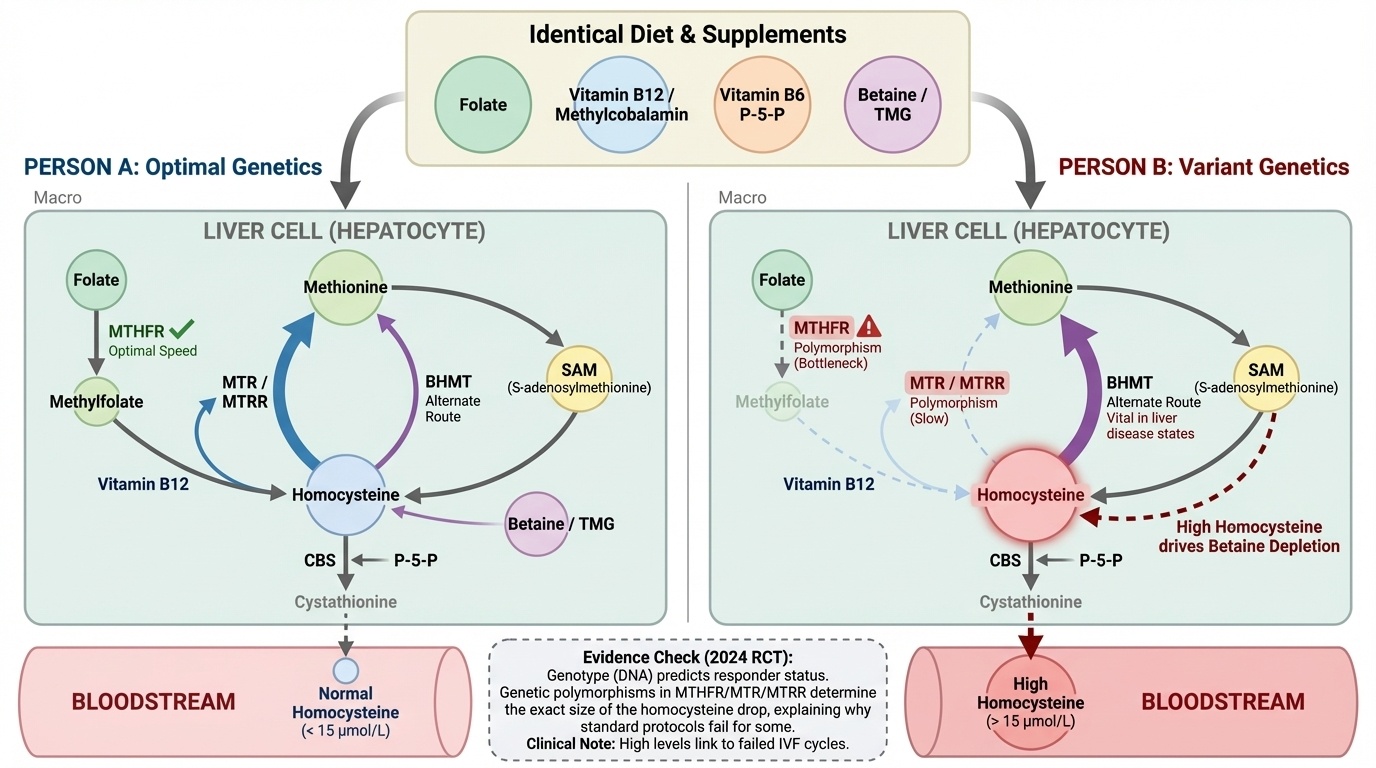
Your Homocysteine Level Is a Personal Report Card on Your Methylation Genetics — Here's How to Read It

Your Homocysteine Level Is a Personal Report Card on Your Methylation Genetics — Here's How to Read It

Why two people with identical diets and supplements can have wildly different homocysteine levels

Diagram glossary
adenosylmethionine:
A primary methyl donor molecule involved in cellular methylation reactions.
B12:
An essential vitamin required for remethylating homocysteine back into methionine.
B6:
An essential vitamin whose active form helps metabolize homocysteine.
BHMT:
An enzyme that uses betaine to convert homocysteine into methionine.
DNA:
The molecule that carries genetic instructions for development and functioning.
Homocysteine:
An amino acid whose elevated levels indicate impaired methylation cycle function.
IVF:
A medical procedure where an egg is fertilized by sperm outside the body.
MTHFR/MTR:
Key genes and enzymes that regulate folate metabolism and homocysteine remethylation.
MTR/MTRR:
Genes and enzymes driving the B12-dependent step that remethylates homocysteine to methionine.
P-5-P:
Pyridoxal-5'-phosphate, the biologically active form of vitamin B6.
SAM:
S-adenosylmethionine, the principal methyl donor in cellular metabolic pathways.
TMG:
Trimethylglycine, or betaine, a compound that provides methyl groups to reduce homocysteine.

Track this in your stack

See how homocysteine relates to your health goals, compare it against evidence tiers, and monitor changes in your biomarkers over time.

Open Aviado

Conclusions

Folate and vitamin B12 are the clear winners for lowering homocysteine, backed by the strongest evidence of any supplements for this biomarker. A simple daily combination of 400–800 mcg folic acid and 500–1,000 mcg B12 can lower homocysteine by about 30%. Vitamin B6 adds modest benefit as a third agent. Betaine is a useful alternative that works through a different pathway. Omega-3s have only weak, inconsistent effects. While lowering homocysteine is achievable and worthwhile, large trials have not clearly shown this reduces cardiovascular events. The greatest benefit comes from correcting actual B vitamin deficiencies — which affect many people, especially vegans, older adults, and those with certain genetic variants.

Limitations

Several important limitations should be acknowledged. First, most homocysteine-lowering trials used folic acid rather than methylfolate, so the evidence base for 5-MTHF is smaller despite its theoretical advantages. Second, the disconnect between homocysteine lowering and cardiovascular outcomes remains unexplained — it's possible that homocysteine is partly a marker of poor nutrition rather than a direct cause of disease. Third, individual responses vary widely based on genetics, baseline nutrient status, kidney function, and other factors. Fourth, most studies were conducted in Western populations with access to fortified foods, so results may differ in other settings. Fifth, long-term safety data for high-dose betaine supplementation is limited. Finally, the optimal target homocysteine level is still debated — while below 15 is considered normal, some experts advocate for levels below 10, and the evidence for this stricter target is not conclusive.

Sources (15)

1

Lowering blood homocysteine with folic acid based supplements: meta-analysis of randomised trials. Homocysteine Lowering Trialists' Collaboration.

Homocysteine Lowering Trialists' Collaboration. BMJ, 1998.

PMID: 9569395
2

Homocysteine-lowering interventions for preventing cardiovascular events.

Martí-Carvajal AJ et al.. Cochrane Database of Systematic Reviews, 2017.

PMID: 28816346
3

A comprehensive review and meta-regression analysis of randomized controlled trials examining the impact of vitamin B12 supplementation on homocysteine levels.

First Author et al.. Nutrition Reviews, 2023.

PMID: 37495210
4

A systematic review and meta-analysis of functional vitamin B12 status among adult vegans.

First Author et al.. American Journal of Clinical Nutrition, 2024.

PMID: 39373282
5

Effect of Nutritional Supplements for Reducing Homocysteine Levels in Healthy Adults: A Systematic Review and Network Meta-Analysis of Randomized Trials.

First Author et al.. Nutrition Reviews, 2025.

PMID: 39960689
6

Impact of Omega-3 supplementation on homocysteine levels in humans: A systematic review and meta-regression analysis of randomized controlled trials.

First Author et al.. Nutrition, Metabolism and Cardiovascular Diseases, 2022.

PMID: 35843792
7

Betaine and aging: A narrative review of findings, possible mechanisms, research perspectives, and practical recommendations.

First Author et al.. Ageing Research Reviews, 2024.

PMID: 39647584
8

Homocysteine-lowering interventions for preventing cardiovascular events.

Martí-Carvajal AJ et al.. Cochrane Database of Systematic Reviews, 2015.

PMID: 25590290
9

Homocysteine-lowering interventions for preventing cardiovascular events.

Martí-Carvajal AJ et al.. Cochrane Database of Systematic Reviews, 2013.

PMID: 23440809
10

The preventive efficacy of vitamin B supplements on the cognitive decline of elderly adults: a systematic review and meta-analysis.

First Author et al.. BMC Geriatrics, 2021.

PMID: 34134667
11

Impact of supplementation with vitamins B on cognitive outcomes.

First Author et al.. Nutrients, 2021.

PMID: 34058062
12

The effectiveness and safety of the active form of folate on biochemical parameters in women of childbearing age: A systematic review and meta-analysis.

First Author et al.. Journal of Nutrition, 2025.

PMID: 41398893
13

Dietary Intake of Homocysteine Metabolism-Related B-Vitamins and the Risk of Stroke: A Dose-Response Meta-Analysis of Prospective Studies.

First Author et al.. Advances in Nutrition, 2020.

PMID: 32503038
14

Effects of folic acid supplementation on cognitive impairment: A meta-analysis of randomized controlled trials.

First Author et al.. Clinical Nutrition, 2024.

PMID: 38465839
15

Effectiveness of vitamin-B supplements on cognition in older adults: A meta-analysis.

First Author et al.. Archives of Gerontology and Geriatrics, 2023.

PMID: 36940509