
Preliminary Evidence
CalciumHeart HealthHormone Balance

Calcium's Sex-Specific IGF-1 Effect: Why the Same Supplement Raises One Child's Growth Hormone and Lowers Another's

The Surprising Hormonal Divergence Behind a Common Mineral Supplement

4 min read6 peer-reviewed sourcesUpdated Mar 23, 2026

Listen to this article

Audio available

Executive Summary

Most people think calcium supplements work the same for everyone, but surprising new research shows the opposite. The same daily dose can boost growth hormone by 14% in boys while dropping it by 18% in girls. That's a complete reversal from one supplement. If you're giving calcium to your kids or taking it yourself, you might get the exact opposite effect you want.

This matters because IGF-1 isn't just any hormone. It controls how children grow and how your body handles food. The idea that calcium affects boys and girls differently breaks everything we know about standard dosing. Other studies show calcium's effects on inflammation vary wildly between people too. The supplement aisle advice to "take 1,000 mg daily" ignores how personal your response really is.

If you want calcium to help growth or health, you need to track your response. The study showing the boy-girl split used 1,500 mg of calcium carbonate daily. Start with 500 mg twice daily and test your IGF-1 and inflammation markers after 8-12 weeks. Calcium isn't one-size-fits-all. Track your response to find what works for your biology.
Key Terms to Know

IGF-1
Insulin-like growth factor 1, a marker of growth hormone axis activity. Low levels indicate GH deficiency, high values suggest acromegaly or active growth.
IGF-1 (Insulin-like Growth Factor 1)
A hormone that plays a key role in growth and development in children and adults. In this article, it's the main biomarker showing opposite responses to calcium in boys and girls.
Sex-specific effects
When the same treatment or supplement produces different results in males versus females, as seen with calcium's opposite effects on IGF-1.
Randomized controlled trial (RCT)
A high-quality study design used to test the effects of treatments or supplements. The key findings here come from RCTs.
Calcium
Total serum calcium, essential for bone health, muscle contraction, and nerve signaling. low levels cause muscle cramps and osteoporosis risk, while high values may indicate parathyroid disorders.
Short-chain fatty acids (SCFAs)
Beneficial compounds produced by gut bacteria when they break down fiber and some minerals, including calcium. SCFAs may mediate some of calcium's metabolic effects.
C-Reactive Protein (cardiac)
High-sensitivity C-reactive protein, a liver-produced acute-phase reactant. Independent predictor of heart attack and stroke.
acetate
A short-chain fatty acid that plays a key role in cellular energy metabolism.
carbonate
A chemical compound often combined with calcium to create dietary bone supplements.
CRP
C-reactive protein is a common blood marker used to measure systemic inflammation.

Calcium’s Hidden Hormonal Split: Why Sex Matters

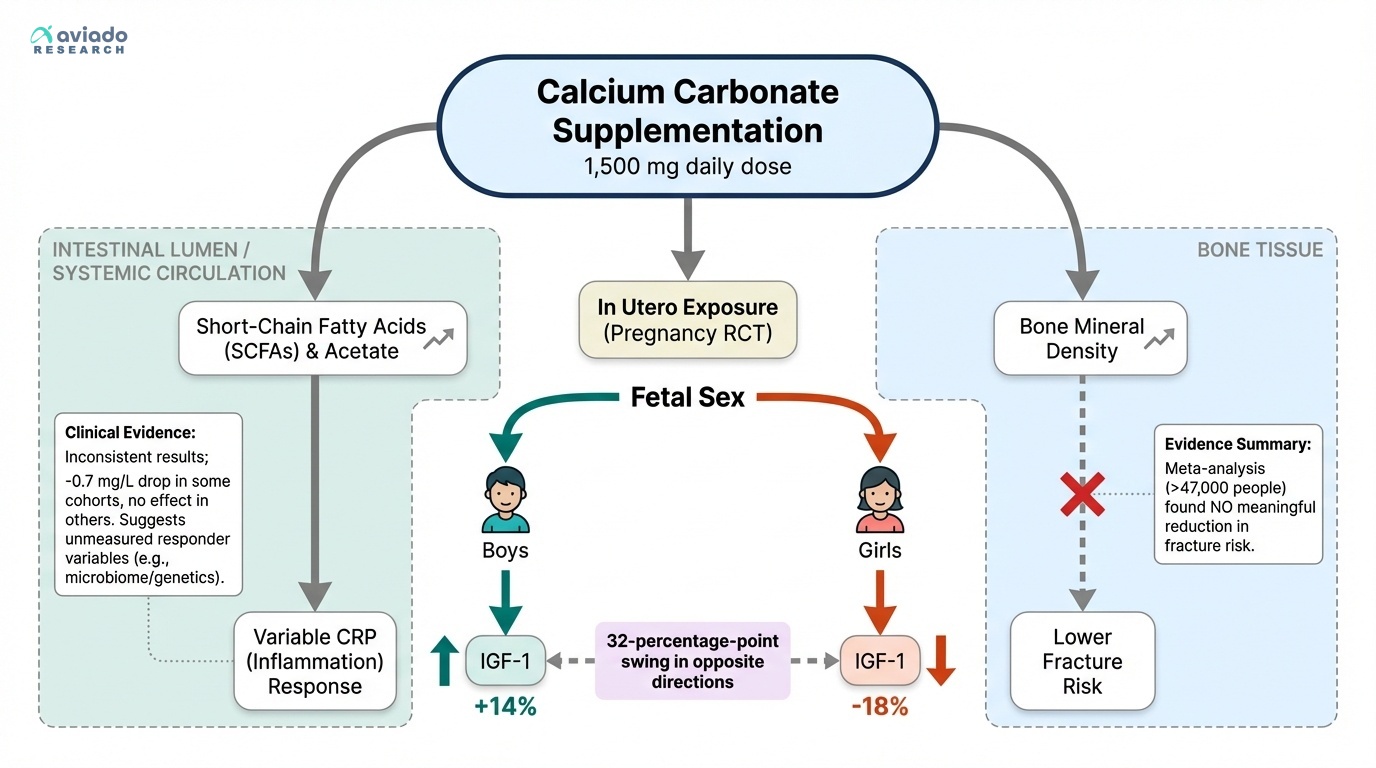
For decades, calcium has been marketed as a bone-builder, safe and effective for everyone. But a recent randomized controlled trial in pregnant women revealed something no one expected: the same 1,500 mg daily dose of calcium carbonate can move a child’s IGF-1—a crucial growth hormone—in opposite directions depending on their sex. Boys exposed to extra calcium in utero saw their IGF-1 go up by 14%, while girls saw an 18% drop. This isn’t a minor difference—it's a complete reversal in hormonal signaling from the same supplement [1].

IGF-1 is central to how children grow, how muscles and bones develop, and even influences metabolism later in life. A 32-point swing from the same dose challenges the entire idea of universal recommendations. It also raises questions for parents, clinicians, and anyone thinking about calcium for growth support: Are you helping, or could you be doing the opposite?

This sex-specific effect is unique to calcium—other minerals like magnesium or iron don’t show the same hormonal divergence. It’s a powerful reminder that not all nutrition advice is one-size-fits-all.

Beyond Bones: Calcium’s Metabolic and Inflammatory Effects

Calcium's effects don't stop at bones or growth. Several RCTs have investigated calcium's influence on markers of inflammation, like CRP (C-reactive protein), and found wildly inconsistent results. In one study of 30 overweight adults, calcium supplementation dropped CRP by 0.7 mg/L while the placebo group saw it rise by 0.2 mg/L. But in a larger trial of 193 healthy adults, calcium showed no effect on CRP at all. This suggests that personal factors—perhaps genetics or gut microbiome differences—determine whether calcium fights inflammation in your body.

More recently, researchers discovered that calcium can boost production of short-chain fatty acids (SCFAs) in the gut. In a double-blind study of 62 people, 8 weeks of calcium supplementation significantly increased total SCFA and acetate concentrations. These SCFAs are linked to better metabolic health and reduced inflammation, but again, not everyone responds the same way to the same dose.

What About Bone Fractures? The Meta-Analysis Surprise

You might expect that taking calcium supplements would lower your risk of breaking a bone, since it often increases bone mineral density. But a large meta-analysis covering over 47,000 people found no meaningful reduction in fracture risk from calcium supplementation, even when bone density improved [5].

This disconnect between what happens to your bones on a scan and real-world fracture outcomes is a cautionary tale: higher bone density doesn’t automatically mean stronger bones, or fewer breaks. It’s another reason why simply following generic dosing advice may not give you the results you’re hoping for.

Personalizing Calcium: How to Find Your Dose

Given these findings, the smartest approach is not to blindly follow the standard advice, but to personalize your calcium intake. Most clinical studies on calcium supplementation use 500 mg twice daily (morning and evening) or 1,000-1,500 mg total per day, often in the form of calcium carbonate.

If you’re considering calcium for growth, metabolism, or inflammation, track your response: check IGF-1 and CRP with simple blood tests before and after a few months of supplementation. Notice if you feel better, sleep better, or see improvements in strength or energy. If you have children, remember that boys and girls may need different approaches—and what helps one could hinder the other.

Finally, consider your gut health and diet: calcium from food sources is absorbed differently and may interact with your microbiome in unique ways [6]. Personal tracking is the only way to know if calcium is helping or hurting in your unique context.

Calcium's Sex-Specific IGF-1 Effect: Why the Same Supplement Raises One Child's Growth Hormone and Lowers Another's

Calcium's Sex-Specific IGF-1 Effect: Why the Same Supplement Raises One Child's Growth Hormone and Lowers Another's

The Surprising Hormonal Divergence Behind a Common Mineral Supplement

Diagram glossary
acetate:
A short-chain fatty acid that plays a key role in cellular energy metabolism.
carbonate:
A chemical compound often combined with calcium to create dietary bone supplements.
CRP:
C-reactive protein is a common blood marker used to measure systemic inflammation.
IGF-1:
A crucial growth hormone that regulates childhood development and influences lifelong metabolism.
SCFA:
Short-chain fatty acids are microbial metabolites that provide energy and support gut health.

Track this in your stack

See how calcium relates to your health goals, compare it against evidence tiers, and monitor changes in your biomarkers over time.

Open Aviado

Conclusions

Calcium is far more than a basic mineral for bones—it’s a powerful, individualized signal for growth, metabolism, and inflammation. The same dose can help one person and hinder another, especially between boys and girls. Generic supplementation advice misses these crucial differences. The best approach is to personalize your calcium intake, track key markers like IGF-1 and CRP, and adjust your dose based on your unique biology.

Limitations

Most studies on calcium's sex-specific effects are limited to pregnancy and early childhood, so it’s unclear how these findings apply to older children or adults. Many trials combine calcium with vitamin D, making it hard to isolate pure calcium effects. There is still little data on long-term impacts of sex-specific IGF-1 changes, and individual responses may depend on genetics, diet, and gut microbiome—factors not always measured in studies.

Sources (6)

1

Calcium supplementation during pregnancy and offspring growth hormone axis: a randomized controlled trial

Jiang X et al.. Journal of Clinical Endocrinology & Metabolism, 2018.

PMID: 30465917
2

Calcium supplementation and C-reactive protein in healthy adults: a randomized controlled trial

Prentice RL et al.. Nutrition, Metabolism and Cardiovascular Diseases, 2015.

PMID: 26304464
3

Calcium supplementation modulates C-reactive protein levels in overweight adults: a double-blind, randomized, placebo-controlled trial

Salehi-Abargouei A et al.. Nutrition, 2017.

PMID: 28668998
4

Short-chain fatty acid production is increased after calcium supplementation: a randomized controlled trial

Bendtsen LQ et al.. Gut Microbes, 2021.

PMID: 35014026
5

Calcium supplementation, bone density, and fractures: meta-analysis of randomized controlled trials

Bolland MJ et al.. BMJ, 2015.

PMID: 26420387
6

Calcium Absorption from Food Products: Food Matrix Effects

Guéguen L et al.. Nutrients, 2022.

PMID: 35011055