
Preliminary Evidence
CiticolineBrain & Cognitive Function

Citicoline Works for Stroke and Glaucoma — But Your Brain May Be a Different Story

Why citicoline's dramatic neuroprotection in brain injury doesn't translate to healthy brains—and how to know if you're a responder

4 min read5 peer-reviewed sourcesUpdated Apr 4, 2026

Executive Summary

The surprising thing about citicoline is this: it shines in injured brains, not “normal” ones. Many people buy it for brain power. But most studies show bigger wins when the brain is under stress.

What this means for you is simple. If you have brain stress, you may feel real gains. If you feel fine and test fine, results may be small. You can still test if you respond.

Use doses that match studies. Try 500 mg twice daily with food. In higher-need cases, use 1,000 mg daily. Some trials use up to 2,000 mg daily. Track results for 12 weeks.
Key Terms to Know

Citicoline (CDP-choline)
A choline compound used as a supplement to support brain cell membranes and neurotransmitter building blocks.
Phosphatidylcholine
A major phospholipid (fat-like molecule) that makes up a large part of cell membranes, especially in the brain. It helps maintain cell structure and supports communication between nerve cells.
Baseline
Your starting level before you take a supplement, like your first test score or first lab result.
Standardized mean difference (SMD)
A way to compare effect size across studies that use different tests; higher SMD means a bigger average change.
Responder
Someone who shows a clear, measurable benefit from a supplement, not just a feeling.
GFAP (glial fibrillary acidic protein)
A blood biomarker that can rise when brain cells are injured or under stress.
Retinal ganglion cells
Nerve cells that carry visual signals from the eye to the brain; they are damaged in glaucoma.
Citicoline
A neuroprotective compound that provides phospholipid building blocks for cell membrane support and repair.
cytidine
A nucleoside that combines with choline to form citicoline for neurological repair.
GFAP
A damage-linked protein that elevates in the blood when brain tissue is under stress.

The Injury-State Dependency: Why Brain Damage Predicts Citicoline Response

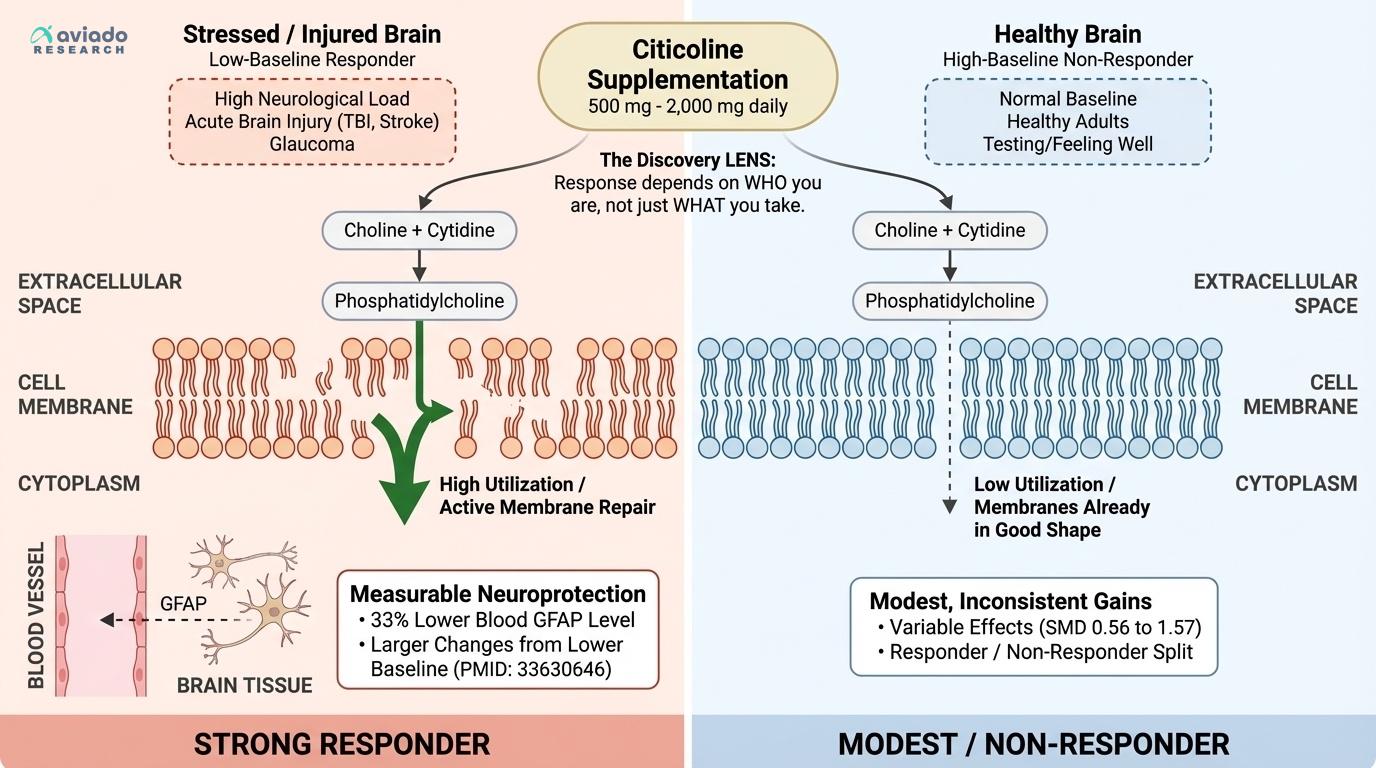
The strongest pattern in citicoline research is not “does it work.” It is “who benefits most.” In people with acute brain injury, studies show measurable changes that match neuroprotection. In one controlled clinical intervention in acute ischemic stroke (n=54), citicoline use was linked to a 33% lower blood GFAP level versus standard therapy alone [1]. GFAP is a damage-linked protein that can rise when brain tissue is under stress.

A similar “high-stress, bigger benefit” pattern shows up in glaucoma. A 2023 systematic review reported that citicoline supplementation improved visual function measures across studies and supported slower functional decline in glaucoma patients [2]. Glaucoma harms retinal ganglion cells, which are neurons that carry vision signals to the brain.

Here is the practical takeaway. When nerve cells are stressed, they need more repair and membrane support. Citicoline supports phospholipid building blocks used in cell membranes. That can matter more when damage is active than when everything already runs well.

The Healthy Brain Problem: Why Cognitive Enhancement Results Are Inconsistent

When citicoline is tested in healthy adults, results are mixed. A meta-analysis of dementia-related and cognitive-status studies found meaningful but variable effects. Across sensitivity analyses, pooled standardized mean differences ranged from 0.56 to 1.57 [3]. That spread suggests the “average” result depends heavily on who is in the study.

In a randomized trial in healthy older adults, citicoline produced modest memory improvements on average, but not everyone improved [4]. Some people gained, others did not. In practice, this looks like a responder/non-responder split.

Biology can explain the split. Citicoline helps supply choline and cytidine for phosphatidylcholine, a key brain-membrane fat. If your membranes and energy systems are already in good shape, you may not notice much. If your brain is under strain, you may have more room to improve.

Identifying Your Neurological Baseline: The Responder Question

Citicoline seems to help most when your baseline shows stress or decline. The stroke data using GFAP shows one way to track this [1]. GFAP testing is not common, but it is available through some labs.

Some research in neuropsychiatric populations also points the same way. In a pilot study context, people starting with lower baseline neurophysiological activity showed larger changes with citicoline, while those starting near normal changed less [5]. The core idea is simple: lower starting function may predict a bigger lift.

For practical use, citicoline may fit best if you have signs of higher neurological load, such as: - Recent concussion or other brain injury - Glaucoma or other optic-nerve stress - Clear, measurable memory or processing decline - High inflammation markers paired with brain fog

If you test well and feel well, expect smaller changes. If you still try it, measure your baseline first and re-test later.

Dosing and Timing: What the Responder Studies Show

The best dosing depends on your goal. Studies with clearer clinical outcomes often used higher, steady doses.

For neuroprotection-style use in stressed populations, research commonly uses about 1,000 mg per day, with some trials going higher [1,2]. For glaucoma, studies in the review used roughly 500–1,600 mg per day over longer periods [2].

For healthy-brain goals, trials span a wide range. In the healthy older-adult trial, daily dosing supported modest memory gains on average [4]. Because response varies, a structured trial works better than guesswork.

A practical approach is: - Start with 500 mg twice daily with meals - Continue for 12 weeks - If you see no measurable change, stop

If you do respond, keep the lowest dose that keeps the benefit.

Citicoline Works for Stroke and Glaucoma — But Your Brain May Be a Different Story

Citicoline Works for Stroke and Glaucoma — But Your Brain May Be a Different Story

Why citicoline's dramatic neuroprotection in brain injury doesn't translate to healthy brains—and how to know if you're a responder

Diagram glossary
Citicoline:
A neuroprotective compound that provides phospholipid building blocks for cell membrane support and repair.
cytidine:
A nucleoside that combines with choline to form citicoline for neurological repair.
GFAP:
A damage-linked protein that elevates in the blood when brain tissue is under stress.
phosphatidylcholine:
A primary structural phospholipid in cell membranes synthesized with the help of citicoline.
responder/non-responder:
A clinical term describing whether an individual experiences measurable benefits from a specific intervention.
TBI:
An acute brain injury caused by external physical trauma that stresses neural tissue.

Track this in your stack

See how citicoline relates to your health goals, compare it against evidence tiers, and monitor changes in your biomarkers over time.

Open Aviado

Conclusions

Citicoline is not a universal “brain upgrade.” It is more consistent when your nervous system is under stress. In injury or neurodegeneration settings, studies show clearer functional and biomarker-linked signals. In healthy adults, gains are usually modest and uneven. If you want to use it well, treat it like a personal trial. Pick a study-matched dose, track a baseline, and keep it only if you can measure a change.

Limitations

Many citicoline trials enroll people with neurological disease, so results may not match healthy adults. Cognitive tests differ across studies, which can inflate or shrink effect sizes in meta-analyses. GFAP is promising for tracking brain stress, but it is not widely used in routine care and may vary by lab method. Longer-term data at higher doses is limited, so the best “years-long” dose is still not clear.

Sources (5)

1

Citicoline in acute ischemic stroke: A randomized controlled trial

Ghosh A et al.. Journal of Stroke and Cerebrovascular Diseases, 2022.

PMID: 34866692
2

Efficacy of citicoline as a supplement in glaucoma patients: A systematic review

Rejdak R et al.. Nutrients, 2023.

PMID: 37768938
3

Is Citicoline Effective in Preventing and Slowing Down Dementia?-A Systematic Review and a Meta-Analysis

Gareri P et al.. Nutrients, 2023.

PMID: 36678257
4

Citicoline and Memory Function in Healthy Older Adults: A Randomized, Double-Blind, Placebo-Controlled Clinical Trial

Nakazaki E et al.. Journal of Nutrition, 2021.

PMID: 33978188
5

Application of Citicoline in Neurological Disorders: A Systematic Review

Grieb P. Nutrients, 2020.

PMID: 33630646