
Here's a surprising fact: the molecule that powers 95% of your body's energy production starts declining in your 20s — and by age 60, your levels may be half of what they were. That molecule is coenzyme Q10 (CoQ10). Your heart, brain, and muscles depend on it. Statin drugs cut your levels even further. This slow drain may explain why fatigue, heart problems, and muscle pain creep up with age. The good news: for several conditions, supplementing CoQ10 actually works. A landmark two-year trial found that heart failure patients taking 300 mg/day cut serious cardiac events nearly in half. Meta-analyses show it lowers blood pressure and reduces key inflammatory markers like CRP and TNF-alpha. For statin users with muscle aches, CoQ10 provides real relief. And nearly half of migraine patients taking it saw their attacks drop by 50% or more. Dosing matters — and so does the form you choose. For statin muscle pain, take 100–200 mg daily with a fatty meal. For heart health, take 200–400 mg split into two doses. For migraines, take 300 mg daily (100 mg three times a day) for at least three months. For fertility support, take 600 mg daily (200 mg three times a day). Always choose ubiquinol or a solubilized softgel — cheap powder capsules absorb poorly. Take with food that contains fat.
CoQ10: The Cellular Fuel Your Body Makes Less of Every Decade — and What the Evidence Says About Replacing It
Listen to this article
Audio available
Executive Summary
Key Terms to Know
- Meta-Analysis
- A statistical method that combines results from multiple studies to find overall patterns and stronger conclusions than any single study alone.
- Ubiquinol vs. Ubiquinone
- The two forms of CoQ10 supplements. Ubiquinol is the active, reduced form; ubiquinone is the oxidized form that the body must convert. Ubiquinol and solubilized ubiquinone are generally better absorbed.
- Mitochondrial Electron Transport Chain
- The biochemical assembly line inside mitochondria that converts food into ATP (cellular energy). CoQ10 is an essential component of this chain.
- Mevalonate Pathway
- The metabolic pathway that produces both cholesterol and CoQ10. Statins block this pathway, which is why they lower cholesterol but also reduce CoQ10 levels.
- NLRP3 Inflammasome
- A protein complex in immune cells that triggers inflammation. Overactivation contributes to heart damage and chronic disease. CoQ10 has been shown to suppress it.
- C-Reactive Protein (CRP)
- A protein produced by the liver that rises with inflammation. High-sensitivity CRP is an independent predictor of heart attack and stroke.
- TNF-alpha
- Tumor necrosis factor-alpha, a key inflammatory signaling molecule. Elevated in chronic inflammatory conditions and metabolic disease.
- NYHA Functional Class
- A clinical classification (I–IV) of how much physical activity a heart failure patient can tolerate. Lower class means better function.
- Bioavailability
- The proportion of a supplement that actually reaches your bloodstream after you swallow it. Higher bioavailability means more of the dose is usable by your body.
- Number-Needed-to-Treat (NNT)
- The number of patients who must receive a treatment for one to benefit. Lower is better — an NNT of 3 is exceptionally strong.
What CoQ10 Actually Does in Your Body
Coenzyme Q10 is not a vitamin, though it's sometimes called "vitamin Q." It's a benzoquinone compound that your body synthesizes on its own — every human cell manufactures it. Its primary job: serving as an essential electron carrier in the mitochondrial electron transport chain, the biochemical assembly line that produces roughly 95% of your body's ATP, the universal energy currency of cells [21]. But CoQ10 wears a second hat equally important: it is the only fat-soluble antioxidant your body makes on its own. Present in every cellular membrane and circulating in the blood, CoQ10 neutralizes free radicals and shields lipids, proteins, and DNA from oxidative damage [24]. It also regenerates other antioxidants, including vitamin E, creating a cascading defense system [30]. The organs with the highest energy demands — heart, brain, kidneys, liver — maintain the highest concentrations of CoQ10. This is why deficiency tends to surface first as cardiovascular problems, neurological symptoms, or unexplained fatigue. Plasma levels in healthy adults typically range from 0.4 to 1.9 µg/mL, but they decline with age and drop further with certain medications, most notably statins [16, 21].
The Absorption Problem: Why Formulation Matters More Than You Think
CoQ10 presents a pharmacological challenge. Its molecular weight of 863 daltons is large for a supplement, and it is extremely hydrophobic — it doesn't dissolve in water. Standard crystalline CoQ10 powder in a hard capsule absorbs slowly and poorly. Peak blood levels after oral dosing occur around 6 hours, and the elimination half-life is approximately 33 hours [21]. Because of these absorption limits, the formulation of a CoQ10 supplement can dramatically affect how much actually reaches your bloodstream. Solubilized formulations — where CoQ10 is dissolved in oil or encapsulated in lipid-based delivery systems — show significantly enhanced bioavailability compared to powder-filled capsules [21, 30]. This is why most clinical trials use softgel capsules containing CoQ10 dissolved in soybean oil or similar carriers. Taking CoQ10 with a fat-containing meal further boosts absorption. A comprehensive pharmacokinetics review found that food intake substantially increases total drug exposure, making mealtime dosing a simple but meaningful optimization [21]. The practical takeaway: a cheap powder capsule taken on an empty stomach delivers far less CoQ10 than a quality softgel taken with dinner.
Heart Failure: The Strongest Evidence in CoQ10's Portfolio
The most compelling clinical evidence for CoQ10 comes from cardiology — specifically chronic heart failure. The Q-SYMBIO trial, a randomized, double-blind, multicenter study, enrolled patients with moderate-to-severe heart failure and assigned them to either 100 mg of CoQ10 three times daily (300 mg/day total) or placebo for two years, layered on top of standard medical therapy [11]. The results were striking. Patients receiving CoQ10 experienced a significant reduction in major adverse cardiovascular events (MACE), including cardiovascular death, hospitalization for heart failure, and the need for mechanical circulatory support. The study also documented improvements in NYHA functional class — a clinical measure of how much physical activity a heart failure patient can tolerate — and a reduction in cardiovascular mortality specifically [11]. The biological rationale is straightforward: failing hearts are energy-starved. Myocardial CoQ10 levels correlate inversely with heart failure severity, and supplementation appears to partially restore this bioenergetic deficit. Animal research has further clarified the mechanism, showing that CoQ10 suppresses the NLRP3 inflammasome pathway in cardiac macrophages after myocardial infarction, reducing the inflammatory cascade that drives harmful cardiac remodeling [6]. In other words, CoQ10 doesn't just supply energy — it actively dampens the destructive immune response that worsens heart damage after an event.
Blood Pressure: Modest but Meaningful Reductions
A GRADE-assessed systematic review and dose-response meta-analysis of randomized controlled trials examined CoQ10's effects on blood pressure in patients with cardiometabolic disorders [14]. CoQ10 supplementation produced statistically significant reductions in both systolic and diastolic blood pressure. The dose-response analysis revealed that blood pressure benefits plateau at moderate doses — higher isn't necessarily better. The review also confirmed that supplementation reliably raises circulating CoQ10 concentrations, establishing a pharmacokinetic basis for the clinical effects [14]. While the magnitude of blood pressure reduction is modest compared to pharmaceutical antihypertensives, it is clinically relevant as an add-on strategy — particularly for patients already on medication who need additional support, or for those with borderline hypertension exploring non-drug options.
Cholesterol and Lipids: A Nuanced Picture
A 2022 meta-analysis of randomized controlled trials assessed CoQ10's effects on lipid profiles in adults [8]. The researchers explored whether CoQ10 could influence total cholesterol, LDL cholesterol, HDL cholesterol, and triglycerides, and attempted to identify optimal dosing through dose-response modeling. The findings were mixed. CoQ10 showed some favorable effects on certain lipid parameters, but the evidence was not uniformly strong across all markers. The dose-response relationship suggested that benefits, where present, were dose-dependent, with higher intakes generally linked to greater effects [8]. This positions CoQ10 not as a replacement for lipid-lowering therapy, but as a potential complementary strategy — especially relevant given that statin users are simultaneously depleting their CoQ10 levels.
Statin-Induced Muscle Pain: Restoring What Statins Deplete
Statins rank among the most prescribed drugs worldwide, and for good reason — they dramatically reduce cardiovascular risk. But 10–15% of statin users develop muscle symptoms ranging from mild aches to debilitating weakness, and this side effect is the leading cause of statin discontinuation. The mechanism involves statin inhibition of the mevalonate pathway, which produces both cholesterol and CoQ10. By blocking this pathway, statins inadvertently slash CoQ10 synthesis [5, 26]. Two meta-analyses have examined whether CoQ10 supplementation can alleviate these symptoms. An earlier analysis found evidence that CoQ10 reduces muscle pain scores in statin-treated patients, though the magnitude varied across studies [26]. A more comprehensive 2025 systematic review confirmed these findings, reporting that CoQ10 supplementation effectively reduced statin-associated muscle symptoms and supporting its use as an adjunctive treatment [5]. The clinical implication is significant: rather than discontinuing a life-saving medication, patients experiencing statin-induced muscle pain may benefit from adding 100–200 mg of CoQ10 daily, typically in divided doses [5, 26].
Migraine Prevention: A Surprising Application
CoQ10's role in migraine prevention emerged from the observation that migraineurs often have impaired mitochondrial energy metabolism in the brain. The rationale parallels that of riboflavin (vitamin B2), another mitochondrial cofactor with established efficacy in migraine prophylaxis. A pivotal randomized controlled trial tested 300 mg/day of CoQ10 (100 mg three times daily) against placebo in 42 migraine patients over three months [18]. By the third month, CoQ10 was superior to placebo for attack frequency, total headache days, and days with nausea. Nearly half of CoQ10-treated patients achieved at least a 50% reduction in attack frequency, compared to about 14% on placebo — a number-needed-to-treat (NNT) of just 3, which is remarkably strong for a nutritional supplement [18]. Subsequent meta-analyses pooling data from multiple trials confirmed that CoQ10 reduces migraine frequency and duration [27]. A more recent dose-response meta-analysis of dietary supplements for migraine prophylaxis further supported CoQ10's efficacy, placing it among the more evidence-backed supplement options [15]. The tolerability profile is excellent — CoQ10 causes essentially no more side effects than placebo, a notable advantage over conventional migraine drugs like topiramate or beta-blockers, which carry significant side effect burdens.
Exercise Performance and Muscle Recovery
A 2024 GRADE-assessed systematic review and dose-response meta-analysis examined CoQ10's effects on exercise-induced muscle damage, physical performance, and oxidative stress in adults [4]. The analysis of randomized controlled trials found that CoQ10 supplementation reduced markers of exercise-induced muscle damage and blunted oxidative stress following exercise. The dose-response component was particularly informative: protective effects scaled with dose. CoQ10 appears to work by reducing oxidative damage during intense physical activity and by supporting mitochondrial energy production during recovery [4]. While CoQ10 won't transform a casual jogger into an elite athlete, the evidence suggests it may help reduce post-exercise soreness and accelerate recovery — benefits that grow more meaningful with age as natural CoQ10 levels decline.
Inflammation: A Broad Anti-Inflammatory Effect
A comprehensive 2023 meta-analysis assessed CoQ10's efficacy and optimal dose for inflammation across 31 randomized controlled trials [20]. CoQ10 significantly reduced three key inflammatory markers: C-reactive protein (CRP), interleukin-6 (IL-6), and tumor necrosis factor-alpha (TNF-α). The optimal dose analysis revealed that anti-inflammatory effects were achievable at moderate supplementation levels, with diminishing returns at very high doses [20]. This broad anti-inflammatory action may underlie many of CoQ10's diverse benefits — from cardiovascular protection to migraine prevention to exercise recovery. The mechanistic basis was further clarified by research showing CoQ10 suppresses the NLRP3/IL-1β inflammatory pathway in macrophages [6], providing a molecular explanation for the clinical observations. A clinical trial in burn patients — who experience extreme systemic inflammation — demonstrated that CoQ10 supplementation reduced inflammatory markers and oxidative stress even in this acute, severe setting [7]. This suggests CoQ10's anti-inflammatory properties extend beyond chronic, low-grade inflammation to more intense inflammatory states.
Female Fertility: Energizing Aging Eggs
One of CoQ10's more intriguing applications is in reproductive medicine. Egg quality declines with age partly because the mitochondria within oocytes (egg cells) become less efficient — and each human egg contains roughly 100,000 mitochondria, more than almost any other cell type. The hypothesis is straightforward: if CoQ10 supports mitochondrial function, it might improve egg quality in women with diminished ovarian reserve. A randomized controlled trial tested this directly. Women with poor ovarian response who took 600 mg of CoQ10 daily (200 mg three times daily) before IVF treatment showed improved ovarian response to stimulation and better embryo quality compared to controls [19]. The treated group had more eggs retrieved and a higher fertilization rate. Broader systematic reviews of antioxidants for female subfertility have included CoQ10 among the interventions studied, with meta-analyses showing improvements in clinical pregnancy rates and other fertility outcomes for women with ovarian aging [13, 17]. A network meta-analysis of adjuvant treatments for poor responders undergoing IVF also evaluated CoQ10 alongside DHEA (dehydroepiandrosterone) and growth hormone [1]. While CoQ10 is not yet standard of care in fertility clinics, the evidence is building and the biological rationale is compelling.
Male Fertility: Protecting Sperm Quality
CoQ10's antioxidant properties extend to male reproductive health. Sperm cells are particularly vulnerable to oxidative damage, and CoQ10 is naturally present in seminal fluid where it helps protect sperm membrane integrity and motility. A randomized controlled trial compared L-carnitine (an amino acid derivative) against CoQ10 plus vitamin E in men with asthenozoospermia (poor sperm motility) and teratozoospermia (abnormal sperm shape) [10]. Both treatment approaches improved sperm parameters, providing evidence that CoQ10-containing regimens can benefit male fertility. A broader systematic review and meta-analysis of nutrients and dietary supplements for sperm quality confirmed that antioxidant supplementation, including CoQ10, can improve sperm concentration, motility, and morphology [25].
Neurological Conditions: Promise with Caveats
CoQ10's relevance to neurological health extends beyond migraine. A comprehensive review highlighted its potential in neurodegenerative conditions including Parkinson's disease, Huntington's disease, amyotrophic lateral sclerosis (ALS), and Alzheimer's disease [24]. The rationale centers on the brain's extraordinary energy demands — it consumes roughly 20% of the body's oxygen despite comprising only 2% of body weight — and the established role of mitochondrial dysfunction in neurodegeneration. Preclinical evidence is robust: CoQ10 protects against excitotoxicity, beta-amyloid toxicity, and various neurotoxin-induced lesions in laboratory models [2, 24]. However, translating these findings to human clinical benefit has proven more difficult. While some clinical trials show encouraging trends, the evidence for CoQ10 in established neurodegenerative diseases remains preliminary compared to the stronger data in cardiovascular disease and migraine [24]. In the related area of chronic fatigue, a randomized controlled trial tested CoQ10 combined with NADH (nicotinamide adenine dinucleotide, a cellular energy molecule) in patients with myalgic encephalomyelitis/chronic fatigue syndrome (ME/CFS) and found improvements in fatigue perception and health-related quality of life [22]. A trial in patients with chronic kidney disease — who frequently experience fatigue and exercise intolerance linked to mitochondrial dysfunction — tested CoQ10 and nicotinamide riboside (a form of vitamin B3), though the results were more nuanced [3].
Depression and Mental Health: An Emerging Frontier
Depression has been increasingly linked to oxidative stress and mitochondrial dysfunction, opening a theoretical door for CoQ10 as an adjuvant treatment. A 2024 review examined CoQ10's potential value as an add-on treatment for depression, noting that its antioxidant properties and role in cellular energy production provide a plausible mechanism for mood benefits [9]. A broader meta-analysis of antioxidant supplementation for depression and anxiety, which included CoQ10 among several antioxidant compounds, found that antioxidant supplementation had a protective role against depressive symptoms [28]. While CoQ10 was not isolated as a single intervention in this analysis, its inclusion among effective antioxidants is consistent with the oxidative stress hypothesis of depression. This is an area where the evidence is suggestive rather than definitive, and CoQ10 should be viewed as a potential complement to — not replacement for — established depression treatments.
Skin Health: Modest Evidence for an Anti-Aging Effect
CoQ10 is a ubiquitous ingredient in anti-aging skincare products, but the evidence for oral supplementation benefiting skin is thinner than the marketing suggests. A randomized, placebo-controlled, double-blind study in 33 healthy subjects investigated whether dietary CoQ10 intake could improve measurable skin parameters [29]. The study found positive effects on skin smoothness, suggesting that internal CoQ10 supplementation can influence skin condition beyond what topical application alone achieves [29]. However, this is a single small trial, and the dermatological evidence base for oral CoQ10 is far less developed than the cardiovascular or neurological evidence. Approach skin-specific claims with appropriate skepticism while acknowledging the biological plausibility — CoQ10 is a potent antioxidant, and skin faces substantial oxidative stress from UV exposure and environmental pollutants.
Safety: An Exceptionally Clean Track Record
One of CoQ10's most notable features is its safety profile. A comprehensive safety assessment reviewed toxicological and clinical data accumulated over more than two decades of widespread use [16]. The conclusion: CoQ10 has an excellent safety record. No serious adverse effects have been reported even at doses up to 1,200 mg/day in clinical trials. The most common side effects are mild gastrointestinal symptoms — nausea, diarrhea, or appetite suppression — which are infrequent and typically resolve with dose adjustment or taking the supplement with food [16]. CoQ10 does not appear to interact significantly with most medications, though patients on warfarin (a blood thinner) should be monitored, as CoQ10's structural similarity to vitamin K could theoretically affect anticoagulation [30]. The observed safe intake level has been established at 1,200 mg/day for adults, providing a wide margin above the typical supplemental doses of 100–400 mg/day used in most clinical trials [16]. This favorable risk-benefit ratio is an important consideration when weighing CoQ10 against pharmaceutical alternatives that may carry heavier side effect profiles.
Conclusions
Coenzyme Q10 occupies an unusual position in the supplement landscape: it is both a fundamental biological molecule with well-understood biochemistry and a supplement with a genuinely impressive body of clinical evidence behind several of its applications. The strongest evidence supports its use in chronic heart failure (300 mg/day), statin-induced muscle pain (100–200 mg/day), and migraine prevention (300 mg/day). Meaningful but less definitive evidence supports roles in blood pressure management, inflammation reduction, exercise recovery, and fertility support. The consistent thread across these diverse applications is mitochondrial energy production and antioxidant protection — two functions that become increasingly compromised with age, disease, and certain medications. CoQ10 supplementation appears to partially compensate for these declines, with benefits most pronounced in those who are most depleted. Practically, choose solubilized or ubiquinol formulations taken with fatty meals to maximize absorption. Doses of 100–400 mg daily cover most evidence-based applications, and the safety profile at these levels is excellent. While CoQ10 is not a cure-all, it represents one of the better-supported nutritional supplements available — particularly for aging adults, statin users, migraine sufferers, and those with heart failure.
What This Means For You
As your body's natural CoQ10 production declines with age — and may drop further if you take statins — targeted supplementation can help support energy, heart health, and more. Here's how to apply the latest evidence to your own routine.If you take statins and experience muscle aches, take 100–200 mg of CoQ10 daily in a softgel with a fat-containing meal.For heart health or blood pressure support, use 200–400 mg daily, split into two doses, and choose a solubilized or ubiquinol formula for better absorption.To reduce migraine frequency, take 300 mg of CoQ10 daily (100 mg three times per day) with meals. Allow at least three months to see full effects.If you are considering CoQ10 for fertility support, use 200 mg three times daily (600 mg total), as studied in ovarian reserve trials.Tracking Recommendation: Ask your healthcare provider to check your lipid panel, liver enzymes, and, if available, CoQ10 levels every 6–12 months if you are supplementing or managing heart or vascular conditions.Key Biomarkers to Monitor:Lipid panel (total cholesterol, LDL, HDL, triglycerides): Monitors heart health and statin effectiveness, both of which may be affected by CoQ10 status.Liver enzymes (AST, ALT): Assesses liver function, especially important for those on statins or with cardiovascular risk.Plasma CoQ10 (if available): Directly measures your CoQ10 status to personalize supplementation.C-Reactive Protein (high-sensitivity CRP): Tracks systemic inflammation, which CoQ10 has been shown to reduce across 31 trials.
Limitations
Several important limitations should be acknowledged. First, while the Q-SYMBIO heart failure trial was well-designed, it remains the single landmark trial in that space; larger confirmatory studies would strengthen the evidence considerably. Second, many CoQ10 trials are relatively small (under 100 participants) and of short duration, making it difficult to assess long-term outcomes. Third, the heterogeneity of CoQ10 formulations across studies complicates direct comparisons — a trial using crystalline powder may underperform one using solubilized CoQ10, muddying the dose-response picture. Fourth, publication bias is a concern, as positive supplement trials are more likely to be published than null results. Fifth, many of the neurological and mental health applications rely on preliminary evidence that has not been confirmed in large, well-powered trials. Finally, CoQ10 blood levels are not routinely measured in clinical practice, making it difficult to identify who is most deficient and most likely to benefit. The fertility evidence, while promising, comes from relatively few trials in specific populations and may not generalize broadly.
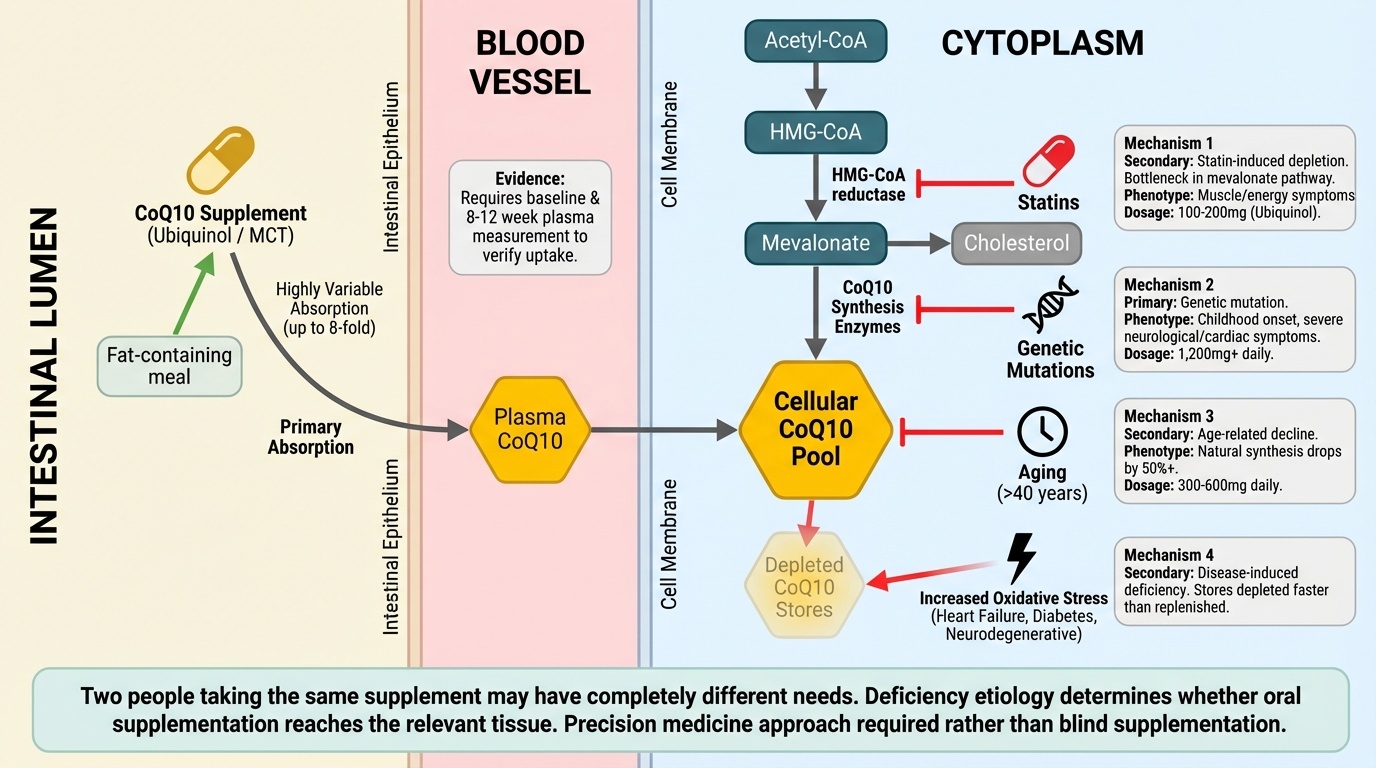
CoQ10 Deficiency Is Not One Thing: Why Your Genetics, Statins, and Age Each Create a Different Problem
Understanding your deficiency mechanism determines whether supplementation will actually work
Diagram glossary
- HMG:
- An enzyme target (HMG-CoA reductase) inhibited by statin drugs to lower cholesterol.
- MCT:
- Medium-chain triglycerides, a type of dietary fat often used to enhance supplement absorption.
- mevalonate:
- A metabolic pathway responsible for synthesizing both cholesterol and CoQ10 in the body.
- Statin:
- A class of lipid-lowering medications that inhibit the synthesis of cholesterol and CoQ10.
Track this in your stack
See how coq10 relates to your health goals, compare it against evidence tiers, and monitor changes in your biomarkers over time.
Conclusions
Limitations
Sources (30)
Adjuvant treatment strategies in ovarian stimulation for poor responders undergoing IVF: a systematic review and network meta-analysis
Nagels HE et al.. Human Reproduction Update, 2020.
PMID: 32045470Randomized crossover clinical trial of coenzyme Q10 and nicotinamide riboside in chronic kidney disease
Roshanravan B et al.. JCI Insight, 2023.
PMID: 37159264The effects of coenzyme Q10 supplementation on biomarkers of exercise-induced muscle damage, physical performance, and oxidative stress: A GRADE-assessed systematic review and dose-response meta-analysis of randomized controlled trials
Sarmiento A et al.. Journal of Exercise Science & Fitness, 2024.
PMID: 38479900Effects of coenzyme Q10 supplementation on myopathy in statin-treated patients: a systematic review and meta-analysis
Qu H et al.. Nutrition Reviews, 2025.
PMID: 41158831Coenzyme Q10 mitigates macrophage mediated inflammation in heart following myocardial infarction via the NLRP3/IL1β pathway
Chen K et al.. BMC Cardiovascular Disorders, 2024.
PMID: 38281937Coenzyme Q10 supplementation in burn patients: a double-blind placebo-controlled randomized clinical trial
Hasanloei MAV et al.. Journal of Burn Care & Research, 2024.
PMID: 38431600Effects of Coenzyme Q10 Supplementation on Lipid Profiles in Adults: A Meta-analysis of Randomized Controlled Trials
Zhao S et al.. Journal of Clinical Lipidology, 2022.
PMID: 36337001Discovering the Potential Value of Coenzyme Q10 as an Adjuvant Treatment in Patients With Depression
Mehrpooya M et al.. Journal of Clinical Psychopharmacology, 2024.
PMID: 38684047Comparison of L-Carnitine vs. CoQ10 and Vitamin E for idiopathic male infertility: a randomized controlled trial
Guo X et al.. European Review for Medical and Pharmacological Sciences, 2022.
PMID: 35856361The effect of coenzyme Q10 on morbidity and mortality in chronic heart failure: results from Q-SYMBIO: a randomized double-blind trial
Mortensen SA et al.. JACC: Heart Failure, 2014.
PMID: 25282031Antioxidants for female subfertility
Showell MG et al.. Cochrane Database of Systematic Reviews, 2020.
PMID: 32851663Antioxidants for female subfertility
Showell MG et al.. Cochrane Database of Systematic Reviews, 2017.
PMID: 28752910Dose-Response Effect of Coenzyme Q10 Supplementation on Blood Pressure among Patients with Cardiometabolic Disorders: A GRADE-Assessed Systematic Review and Meta-Analysis of Randomized Controlled Trials
Zhao D et al.. Nutrients, 2022.
PMID: 36130103Effects of selected dietary supplements on migraine prophylaxis: A systematic review and dose-response meta-analysis of randomized controlled trials
Salehi M et al.. Cephalalgia, 2024.
PMID: 39404918Safety assessment of coenzyme Q10 (CoQ10)
Hidaka T et al.. Regulatory Toxicology and Pharmacology, 2008.
PMID: 19096117Antioxidants and Fertility in Women with Ovarian Aging: A Systematic Review and Meta-Analysis
Wang Y et al.. Antioxidants, 2024.
PMID: 39019217Efficacy of coenzyme Q10 in migraine prophylaxis: a randomized controlled trial
Sándor PS et al.. Neurology, 2005.
PMID: 15728298Pretreatment with coenzyme Q10 improves ovarian response and embryo quality in low-prognosis young women with decreased ovarian reserve: a randomized controlled trial
Xu Y et al.. Reproductive Biology and Endocrinology, 2018.
PMID: 29587861Efficacy and Optimal Dose of Coenzyme Q10 Supplementation on Inflammation-Related Biomarkers: A GRADE-Assessed Systematic Review and Updated Meta-Analysis of Randomized Controlled Trials
Liang Y et al.. Molecular Nutrition & Food Research, 2023.
PMID: 37118903Coenzyme Q10: absorption, tissue uptake, metabolism and pharmacokinetics
Bhagavan HN et al.. Free Radical Research, 2006.
PMID: 16551570Effect of Dietary Coenzyme Q10 Plus NADH Supplementation on Fatigue Perception and Health-Related Quality of Life in Individuals with Myalgic Encephalomyelitis/Chronic Fatigue Syndrome: A Prospective, Randomized, Double-Blind, Placebo-Controlled Trial
Castro-Marrero J et al.. Nutrients, 2021.
PMID: 34444817Senescent macrophages induce ferroptosis in skeletal muscle and accelerate osteoarthritis-related muscle atrophy
Zhang H et al.. Nature Communications, 2025.
PMID: 40579479Coenzyme Q10 effects in neurological diseases
Manzar H et al.. Molecular Biology Reports, 2022.
PMID: 35199552The Effect of Nutrients and Dietary Supplements on Sperm Quality Parameters: A Systematic Review and Meta-Analysis of Randomized Clinical Trials
Salas-Huetos A et al.. Advances in Nutrition, 2018.
PMID: 30462179Effects of Coenzyme Q10 on Statin-Induced Myopathy: An Updated Meta-Analysis of Randomized Controlled Trials
Qu H et al.. Journal of the American Heart Association, 2018.
PMID: 30371340Efficacy of CoQ10 as supplementation for migraine: A meta-analysis
Zeng Z et al.. Acta Neurologica Scandinavica, 2019.
PMID: 30428123Protective role of antioxidant supplementation for depression and anxiety: A meta-analysis of randomized clinical trials
Saghafian F et al.. Journal of Affective Disorders, 2023.
PMID: 36442656The effect of dietary intake of coenzyme Q10 on skin parameters and condition: Results of a randomised, placebo-controlled, double-blind study
Żmitek K et al.. BioFactors, 2017.
PMID: 27548886Related Research
CoQ10 Deficiency Is Not One Thing: Why Your Genetics, Statins, and Age Each Create a Different Problem
Understanding your deficiency mechanism determines whether supplementation will actually work
What the Curcumin Evidence Actually Measures — and Which Populations It Applies To
Most curcumin research enrolled people with metabolic dysfunction, not healthy adults seeking optimization
The Lipid Biomarker Decision Tree: Why Your Standard Cholesterol Panel Misses Half the Story
Understanding the four distinct cardiovascular risk pathways that basic lipid panels can't distinguish