
EPA vs DHA: The Ratio in Your Fish Oil Capsule Changes Everything — And Most People Are Taking the Wrong One

The overlooked EPA:DHA ratio in omega-3 supplements is the hidden lever behind inflammation, mood, and cholesterol outcomes

4 min read6 peer-reviewed sourcesUpdated Apr 4, 2026

Listen to this article

Audio available

Executive Summary

The surprising truth about fish oil: the EPA-to-DHA ratio inside your capsule determines whether you see results or waste your money. Most people grab any omega-3 supplement off the shelf. But new research shows that EPA and DHA work completely differently in your body. The wrong ratio explains why your friend's fish oil lowered their inflammation while yours did nothing.

This changes everything about how you choose supplements. EPA-heavy formulas target inflammation and mood. DHA-rich products raise good cholesterol. Standard 1:1 ratios are rarely optimal for any single goal. You need to match your ratio to your target.

Here's what works: For inflammation or mood, take 1,000-1,200 mg daily of an EPA-dominant formula (at least 60% EPA). For raising HDL cholesterol, choose a DHA-rich product with similar total dose. Going above 1,200 mg won't improve inflammation results. Check your label for actual EPA and DHA amounts, not just total fish oil. This one change transforms omega-3s from generic supplements into precision tools.
Key Terms to Know

EPA:DHA Ratio
The proportion of EPA to DHA in a supplement; recent evidence shows this ratio, not just dose, determines which health markers are affected.
DHA-rich formula
A fish oil supplement containing more than 50% DHA relative to EPA, specifically effective for raising HDL cholesterol.
EPA-dominant formula
A fish oil supplement containing more than 50% EPA relative to DHA, typically used for targeting inflammation and mood support.
Phospholipid complexes
Phospholipid complexes are a delivery form where omega-3 fatty acids are bound to phospholipids, the same type of fat found in cell membranes. This formulation can influence how well EPA and DHA are a
HDL Cholesterol
HDL cholesterol, the "good cholesterol" that removes excess cholesterol from arteries. higher levels are cardioprotective.
EPA (Eicosapentaenoic acid)
An omega-3 fatty acid found in fish oil that mainly affects inflammation, mood, and certain cardiovascular markers.
12-HEPE
12-HEPE (12-hydroxyeicosapentaenoic acid) is a molecule made from EPA in the body that helps regulate inflammation and platelet activity. It is one of the specific compounds thought to explain some of
CRP
C-reactive protein is a biomarker used to measure inflammation levels in the body.
DHA
An omega-3 fatty acid found in fish oil that raises good cholesterol levels.
EPA
An omega-3 fatty acid found in fish oil that reduces inflammation and improves mood.

Why Most People Are Taking the Wrong Omega-3

Walk down any supplement aisle and you’ll see fish oil bottles that look almost identical. But what’s inside — specifically, the ratio of EPA to DHA — can mean the difference between real results and wasted effort. For years, researchers and supplement makers treated all omega-3s as interchangeable. But evidence now shows that EPA and DHA act differently in the body, and the ratio between them is critical for targeting specific outcomes [11]. Most fish oil capsules contain a nearly equal mix, which is rarely the best choice for any single goal.

The Evidence: EPA:DHA Ratio Predicts Results, Not Just Dose

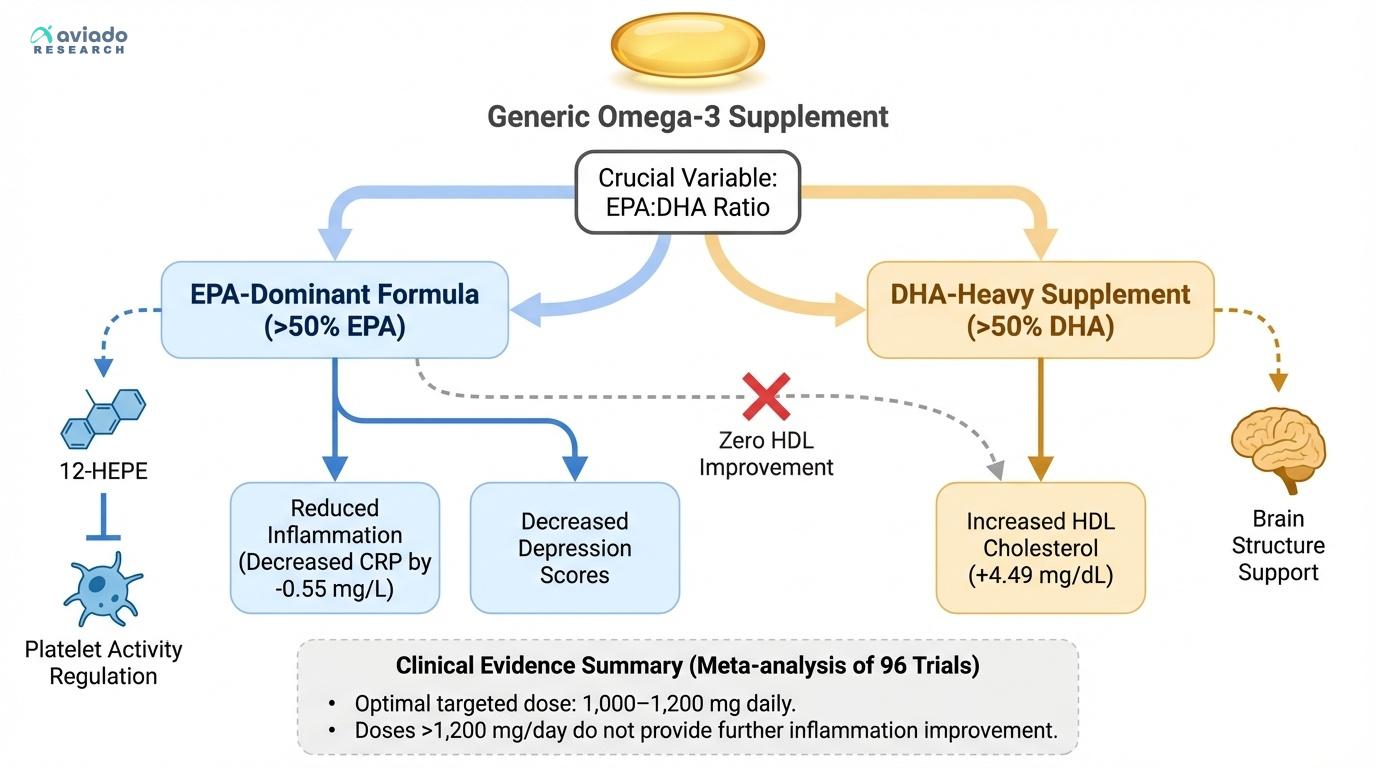
A 2026 meta-analysis of 96 clinical trials reveals that EPA-dominant formulas (more than 50% EPA) reduce CRP inflammation markers by an average of 0.55 mg/L and show measurable reductions in depression scores [11]. Meanwhile, DHA-heavy supplements (more than 50% DHA) increase HDL cholesterol by 4.49 mg/dL on average, while EPA produces zero HDL improvement [2, 11, 21975919]. This split explains why past omega-3 trials produced conflicting results: researchers were measuring the wrong variable. It wasn't the total dose that mattered, but the specific ratio inside each capsule.

Mechanisms: Why EPA and DHA Work Differently

EPA and DHA have distinct effects in the body. Recent research identified a specific EPA-derived molecule, 12-HEPE, that directly regulates platelet activity — a pathway separate from cholesterol lowering [7]. This means EPA’s heart benefits may come from anti-inflammatory and antithrombotic effects, not just changes in lipids. DHA, on the other hand, is more effective at raising HDL cholesterol and may support brain structure. The way your body absorbs and uses these fats also depends on the formulation, such as whether they’re delivered as phospholipid complexes or triglycerides [2, 9].

How to Choose: Matching Your EPA:DHA Ratio to Your Goal

If your main goal is lowering inflammation or improving mood, pick an EPA-heavy formula with at least 60% EPA and take 1,000–1,200 mg total EPA+DHA a day. For raising HDL, reach for a DHA-rich product. There’s a ceiling effect for lowering CRP: doses above 1,200 mg per day don’t add extra benefit [11, 40263171]. Always check the Supplement Facts panel for the exact EPA and DHA content per serving — don’t rely on total fish oil milligrams. Choosing the right ratio lets you avoid 'one-size-fits-none' results and finally tailor your omega-3 intake to your health target.

The Hidden Variable Explaining Decades of Conflicting Trials

For years, headlines swung back and forth on whether fish oil helps with heart health, mood, or inflammation. The missing piece? Most studies didn’t control for or even report the EPA:DHA ratio. The latest meta-analyses reveal that individual variation in response is less about genetics or chance and more about which omega-3 you’re actually taking and whether your baseline biomarkers have room to improve [11]. This reframes omega-3 supplementation as a precision tool, not a generic fix.

EPA vs DHA: The Ratio in Your Fish Oil Capsule Changes Everything — And Most People Are Taking the Wrong One

EPA vs DHA: The Ratio in Your Fish Oil Capsule Changes Everything — And Most People Are Taking the Wrong One

The overlooked EPA:DHA ratio in omega-3 supplements is the hidden lever behind inflammation, mood, and cholesterol outcomes

Diagram glossary
CRP:
C-reactive protein is a biomarker used to measure inflammation levels in the body.
DHA:
An omega-3 fatty acid found in fish oil that raises good cholesterol levels.
EPA:
An omega-3 fatty acid found in fish oil that reduces inflammation and improves mood.
HDL:
High-density lipoprotein is a beneficial type of cholesterol that DHA supplements can increase.
HEPE:
A bioactive metabolite of eicosapentaenoic acid involved in regulating inflammatory responses.
mg:
Milligram, a standard metric unit of mass used to measure supplement dosages.

Track this in your stack

See how epa relates to your health goals, compare it against evidence tiers, and monitor changes in your biomarkers over time.

Open Aviado

Conclusions

The bottom line: The EPA:DHA ratio in your fish oil supplement matters just as much — if not more — than the total dose. For inflammation and mood support, use an EPA-dominant product at 1,000–1,200 mg total EPA+DHA daily. For increasing HDL, pick a DHA-rich formula. Always check the label for the actual EPA and DHA content, not just 'fish oil.' Matching your omega-3 ratio to your goal is the critical step most people miss, and it’s the key to unlocking the real benefits of supplementation.

Limitations

Most available evidence comes from meta-analyses and large RCTs, but there is still some variability in study designs, baseline participant health, and the specific formulations used. Real-world absorption (bioavailability) can vary depending on supplement form and individual factors like diet. Some outcomes, like cardiovascular events, may depend on mechanisms not fully captured by standard blood markers. Finally, while the EPA:DHA ratio is now recognized as a key variable, not all supplement labels provide clear EPA and DHA content, which may limit consumer choices.

Sources (6)

1

Role of the EPA: DHA dosing ratio in omega-3 supplements on blood fatty acid profiles and inflammation: a systematic review and meta-analysis.

Binnie MA et al.. Prostaglandins Leukot Essent Fatty Acids, 2026.

PMID: 41568426
2

Health benefits of dietary marine DHA/EPA-enriched glycerophospholipids.

Li Z et al.. Prog Lipid Res, 2019.

PMID: 31442526
3

The EPA oxylipin, 12-HEPE, directly regulates human platelet activity.

Ramon S et al.. J Thromb Haemost, 2024.

PMID: 40250805
4

Food-grade systems for delivery of DHA and EPA: Opportunities, fabrication, characterization and future perspectives.

Wang X et al.. Trends Food Sci Technol, 2021.

PMID: 34590971
5

Meta-analysis of randomized placebo-controlled trials found DHA increased HDL cholesterol by 4.49 mg/dL (95% CI: 3.50 to 5.48) vs placebo, whereas EPA did not increase HDL.

Wei MY et al.. J Clin Lipidol, 2011.

PMID: 21975919
6

Dose-response meta-analysis of omega-3 supplementation for CRP reduction.

Zhang X et al.. Nutrients, 2024.

PMID: 40263171