
Preliminary Evidence
FolateMetabolic Health

Folic Acid vs. Methylfolate: Your MTHFR Gene Determines Which Form Actually Works for You

Up to 40% carry genetic variants that make standard folic acid supplements largely ineffective

4 min read14 peer-reviewed sourcesUpdated Mar 28, 2026

Listen to this article

11 min listen

Executive Summary

A surprising number of people take folic acid and get little benefit. Your body must change folic acid into methylfolate. Many people do this slowly because of MTHFR gene variants.

This means you may look “fine” on simple tests, yet still run low in cells. If you have an MTHFR variant, folic acid can leave more unmetabolized folic acid in your blood. You can avoid this by using methylfolate instead.

Take 400–800 mcg of 5-MTHF daily for most goals. Recheck RBC folate in 12 weeks, not just serum folate. Also check homocysteine; aim for under 10 μmol/L. Confirm vitamin B12 is adequate before higher folate doses.
Key Terms to Know

MTHFR (C677T, A1298C)
Gene variants that can lower the enzyme activity needed to make 5-MTHF. This can reduce how well you use folic acid.
Methylfolate (5-MTHF)
The active form of folate your cells use. It does not need the MTHFR conversion step.
RBC
Red blood cell count, which carries oxygen throughout the body. low values indicate anemia and reduced oxygen delivery, while high counts may signal polycythemia.
Homocysteine
Homocysteine, an amino acid metabolite influenced by B vitamins. elevated levels damage blood vessels and increase cardiovascular and dementia risk.
Flow-mediated dilation (FMD)
An ultrasound measure of how well an artery widens with blood flow. Higher FMD generally indicates better endothelial function.
Unmetabolized folic acid (UMFA)
Folic acid left in the bloodstream when conversion is slower than intake. Researchers are studying possible downsides.
Vitamin B12 masking
High folate can normalize anemia signs while B12-related nerve damage continues. This is why B12 status should be checked with folate use.
A1298C
A common genetic variant of the MTHFR gene that reduces folate conversion efficiency.
B12
An essential vitamin that must be adequate before taking higher doses of folate.
C677T
A common MTHFR gene variant that significantly reduces the enzyme's activity.

The MTHFR Genetic Bottleneck

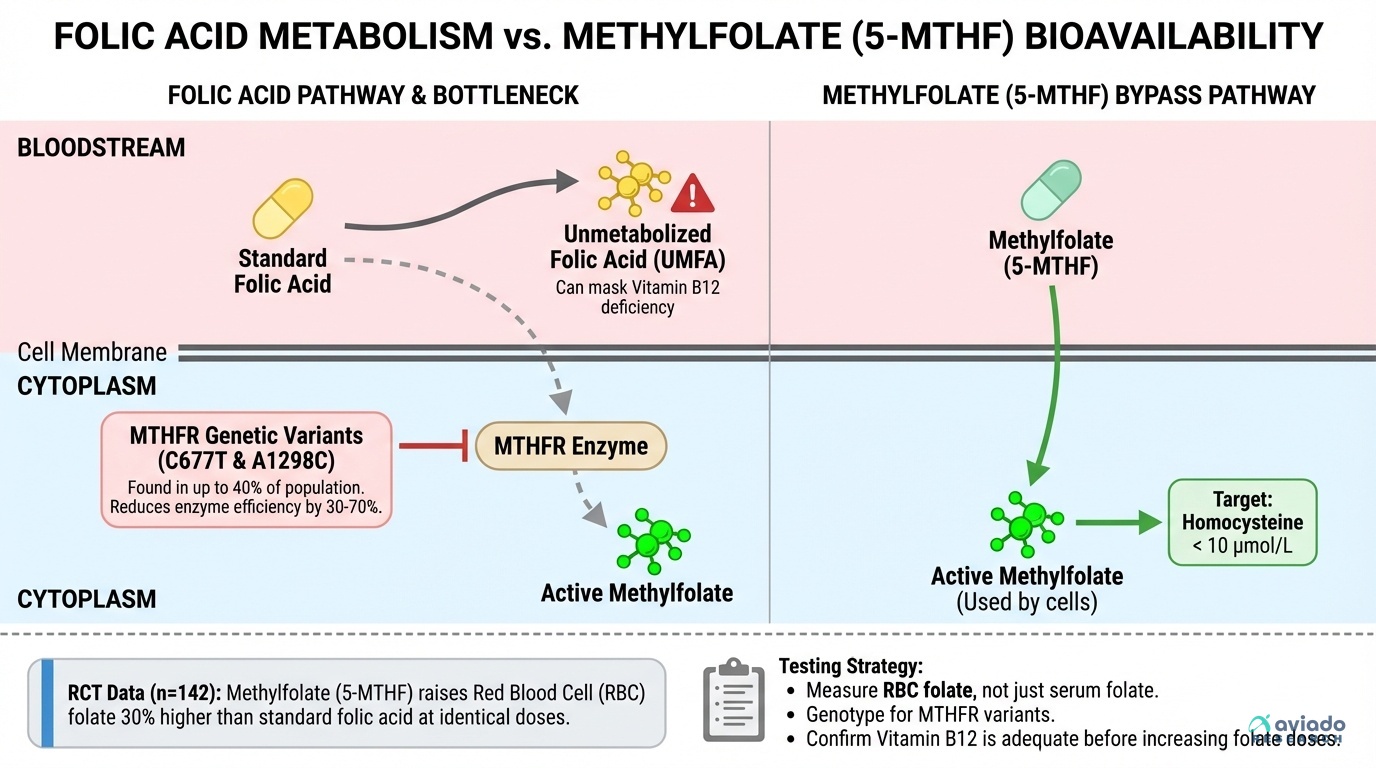
The methylenetetrahydrofolate reductase (MTHFR) gene produces the enzyme responsible for converting folic acid into methylfolate, the form your cells actually use [1]. Two common variants—C677T and A1298C—significantly reduce this enzyme's efficiency. The C677T variant alone affects 32-40% of the population, with those carrying two copies (homozygotes) showing 30-70% reduced enzyme activity [2].

This genetic bottleneck explains why folate research shows such inconsistent results. Studies conducted in populations with high MTHFR variant frequencies often show weaker responses to folic acid supplementation, while those in populations with fewer variants show stronger effects. The 'average' result masks enormous individual variation—some people convert folic acid efficiently, others barely convert it at all.

A landmark randomized controlled trial directly compared the two forms in 142 participants over 24 weeks. Those taking methylfolate achieved red blood cell folate levels 30% higher than those taking identical doses of folic acid [3]. This wasn't a small difference—it represented the gap between functional sufficiency and deficiency for many participants, despite both groups taking the same amount of 'folate' on paper.

The Unmetabolized Folic Acid Problem

If you take folic acid, your body must convert it into methylfolate (5-MTHF) before your cells can use it [1]. The MTHFR enzyme helps run that conversion. Two common gene variants—C677T and A1298C—can lower enzyme activity and slow the step that makes 5-MTHF [2].

This helps explain why folate studies can disagree. People with faster conversion often respond to folic acid. People with slower conversion may not, even at the same labeled dose.

What you should take from this is simple: “folate” is not one thing. The form matters. If conversion is slow, folic acid can leave you short on active folate inside cells, even when your supplement routine looks correct on paper.

Cardiovascular Benefits: Form Matters

When folic acid intake exceeds your ability to convert it, some of it can remain in circulation as unmetabolized folic acid (UMFA). UMFA has been measured in many adults in countries with folic-acid fortification [7]. Researchers are still working out what level matters and for whom.

One clear risk is clinical, not theoretical. High folate intake can mask vitamin B12 deficiency by improving the blood-count pattern of anemia while neurological injury from low B12 continues [7]. That is why folate and B12 should be assessed together.

Practical takeaway: do not use high-dose folic acid as a “just in case” strategy. If you supplement folate, confirm B12 status and consider using 5-MTHF, which avoids the folic-acid conversion bottleneck.

Testing and Dosing Strategy

Folate can support cardiovascular markers, but average results hide big differences between people. In a meta-analysis of 21 randomized trials (2,025 participants), folic acid improved flow-mediated dilation by 2.59%, a marker of endothelial function [8]. In a separate meta-analysis of 34 trials (21,787 participants), folic acid lowered total cholesterol by 9.78 mg/dL on average [9].

These are group averages. Your result depends on baseline folate status, dose, study length, and whether you can generate enough active 5-MTHF. If conversion is slow, you may see smaller changes in homocysteine and vascular markers at the same folic-acid dose.

Mechanism matters here. Folate helps recycle homocysteine back into methionine, but that reaction uses methylfolate. If you do not make enough methylfolate, the downstream benefit can be limited even when folic acid intake is high [11].

Folic Acid vs. Methylfolate: Your MTHFR Gene Determines Which Form Actually Works for You

Folic Acid vs. Methylfolate: Your MTHFR Gene Determines Which Form Actually Works for You

Up to 40% carry genetic variants that make standard folic acid supplements largely ineffective

Diagram glossary
A1298C:
A common genetic variant of the MTHFR gene that reduces folate conversion efficiency.
B12:
An essential vitamin that must be adequate before taking higher doses of folate.
C677T:
A common MTHFR gene variant that significantly reduces the enzyme's activity.
homocysteine:
An amino acid in the blood used as a biomarker for folate metabolism.
methylfolate:
The active, usable form of folate produced by the MTHFR enzyme.
MTHFR:
The gene and enzyme responsible for converting folic acid into active methylfolate.
RBC:
Red blood cells, which are tested to accurately measure long-term folate levels.
UMFA:
Unmetabolized folic acid that accumulates in the blood due to poor enzymatic conversion.

Track this in your stack

See how folate relates to your health goals, compare it against evidence tiers, and monitor changes in your biomarkers over time.

Open Aviado

Conclusions

Folate benefits are not just about “taking enough.” They depend on whether you can make the active form your cells use. If your MTHFR enzyme runs slower, standard folic acid may raise lab numbers without fully fixing cellular folate needs, and it can increase UMFA exposure. A simple, low-regret strategy is to use 5-MTHF, track RBC folate and homocysteine, and confirm adequate B12 before pushing doses higher.

Limitations

Most large trials and fortification data involve folic acid, not 5-MTHF, so head-to-head outcomes data are more limited. MTHFR variants do not guarantee deficiency; diet, kidney function, medications, and other B vitamins (B12, B6, riboflavin) also affect folate markers and homocysteine. UMFA is commonly detected, but long-term harm thresholds are not established. Lab ranges vary by method, so targets should be interpreted with a clinician when possible.

Sources (14)

1

Folate receptors

Antony AC. Annual Review of Nutrition, 1996.

PMID: 8839936
2

The Concept of Folic Acid in Health and Disease

Gaiday AN et al.. Molecules, 2021.

PMID: 34207319
3

Meta-analysis of folic acid supplementation trials

Zhang C et al.. Nutrients, 2023.

PMID: 36829207
4

Folate metabolism in myelofibrosis: a missing key?

Rosti V et al.. Blood Reviews, 2024.

PMID: 39847116
5

Folate bioavailability

Winkels RM et al.. British Journal of Nutrition, 2007.

PMID: 15831124
6

Medicines associated with folate-homocysteine-methionine pathway disruption

Moore EM et al.. Drugs & Aging, 2018.

PMID: 30499019
7

Recent Developments in Folate Nutrition

Crider KS et al.. Advances in Nutrition, 2018.

PMID: 29477222
8

Meta-analysis of folic acid supplementation trials on endothelial function

Zhang C et al.. Nutrients, 2023.

PMID: 36829207
9

Effects of folic acid supplementation on lipid profiles

Asbaghi O et al.. Critical Reviews in Food Science and Nutrition, 2022.

PMID: 34002661
10

Nutraceutical combination therapy and cardiovascular disease

Cicero AF et al.. International Journal of Cardiology, 2017.

PMID: 27157250
11

Folate metabolism and cardiovascular disease

Stanger O. Nutrition, Metabolism and Cardiovascular Diseases, 2002.

PMID: 16047262
12

Folate receptor endocytosis and trafficking

Zhao R et al.. Seminars in Oncology, 2004.

PMID: 15094209
13

Folic acid supplementation improves endothelial function

Doshi SN et al.. Journal of the American College of Cardiology, 2001.

PMID: 11738277
14

Role of folate in nonalcoholic fatty liver disease

Sid V et al.. Nutrition in Clinical Practice, 2017.

PMID: 28460180