
Preliminary Evidence
InulinGut HealthImmune System

Inulin's Gut-to-Blood Pipeline: Why Your Microbiome Decides Whether It Works

Why the Right Gut Bacteria Are the Real Key to Inulin’s Benefits

4 min read10 peer-reviewed sourcesUpdated Apr 4, 2026

Listen to this article

Audio available

Executive Summary

Most people think inulin fiber works the same for everyone. Here's the surprising truth: your gut bacteria decide whether inulin helps or just makes you gassy. If you lack the right microbes, you won't see benefits no matter how much you take.

This explains why some people see amazing results while others get nothing. Your gut needs specific bacteria like Bifidobacterium to turn inulin into butyrate. Butyrate lowers inflammation and improves blood sugar. No right bacteria? No butyrate. No benefits.

Start with 5 grams daily and build to 10-15 grams over 2-3 weeks. Split doses to avoid gas. Test your HbA1c and CRP after 8 weeks. If they don't improve, add a Bifidobacterium probiotic. Track ALT if you're iron-deficient.
Key Terms to Know

Short-Chain Fatty Acids (SCFAs)
Compounds like butyrate, acetate, and propionate produced by gut bacteria fermenting fibers; crucial for many health effects.
Hemoglobin A1c
Average blood sugar over the past 2-3 months by assessing glycated hemoglobin. each 1% increase raises cardiovascular risk by 18%.
ALT (SGPT)
Alanine aminotransferase enzyme, highly specific to liver cells. elevated in hepatocellular injury from viral hepatitis, fatty liver, or medications.
Inulin
A soluble fiber from plants like chicory root that feeds beneficial gut bacteria. Not to be confused with insulin, the blood sugar hormone.
Glucose
Blood sugar level, the primary energy source for cells. Fasting glucose is normal, prediabetes, ≥126 suggests diabetes.
Bifidobacterium
A group of beneficial bacteria commonly found in the human gut, crucial for fermenting inulin into helpful short-chain fatty acids.
LPS (Lipopolysaccharide)
A molecule from bacterial cell walls that can trigger inflammation if it leaks into your bloodstream; lower levels are better for health.
ALT
A liver enzyme often measured in blood tests to assess liver health.
Butyrate
A short-chain fatty acid produced by gut bacteria that reduces inflammation.
CRP
A blood marker used to measure inflammation levels in the body.

Inulin: A Substrate, Not a Solution

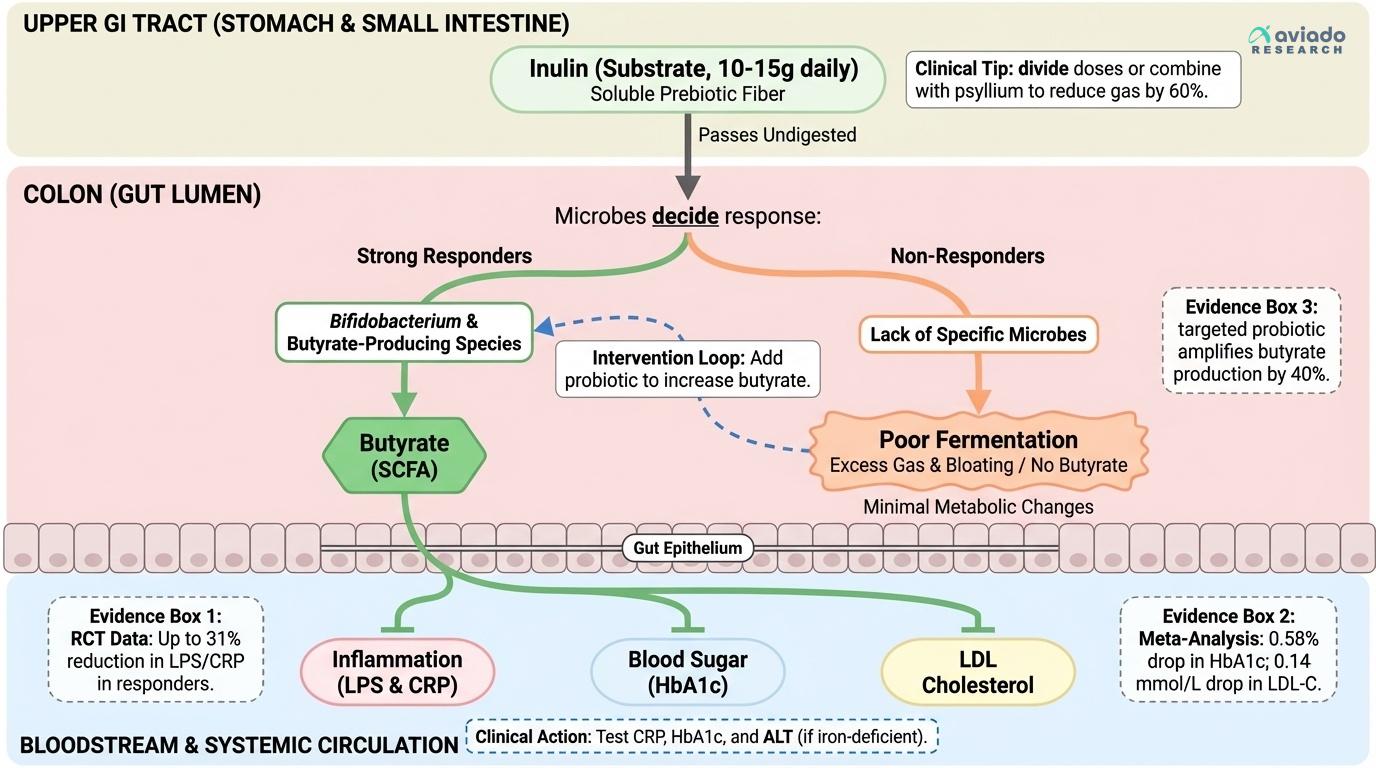
Inulin is a soluble fiber found in chicory root, Jerusalem artichoke, and many other plants. While it's marketed as a "prebiotic" that boosts gut health, what truly matters is what happens after you swallow it. Unlike other nutrients, inulin passes through your stomach and small intestine undigested, landing in your colon as raw material. There, it becomes a feast for select gut bacteria—and what those bacteria do with inulin determines your health outcomes.

The key insight: inulin is not a drug with direct effects. Instead, it's a substrate—food for microbes. If your gut contains the right bacteria, such as Bifidobacterium and butyrate-producing species, they convert inulin into short-chain fatty acids, especially butyrate. Butyrate acts as a signaling molecule, reducing inflammation by 31% and improving blood sugar control. If you lack these bacteria, inulin ferments poorly, leading to gas and minimal metabolic changes.

The Microbiome Bottleneck: Explaining Inulin’s Mixed Results

Clinical trials on inulin show wildly different results, with some demonstrating 18% drops in LDL cholesterol and others showing almost no effect. The reason? Individual gut microbiome differences. Recent crossover RCTs found that butyrate production after inulin supplementation can rise by 40% in some people, while others see barely any change [40274191, 38309832]. The hidden variable is the presence or absence of Bifidobacterium and other fermenters.

Meta-analyses confirm this split: on average, inulin lowers LDL cholesterol by 0.14 mmol/L and HbA1c by 0.58%, but these averages hide a divide between strong responders and non-responders [38309832, 31805963]. Inflammatory markers like LPS and CRP drop by 31% only in those with the right microbial balance [27771020, 31504857]. Your microbiome is the switch that turns inulin's potential into measurable results.

Targeting Response: Dosing, Timing, and Personalization

RCTs show that the most effective inulin doses for metabolic effects are 10-16 grams per day, with most studies splitting the dose in half to reduce gastrointestinal symptoms [40274191, 38309832]. Combining inulin with psyllium or taking it in smaller, divided doses can cut gas and bloating by 60% without losing the fermentation benefit [39732438].

To determine if you're a responder, measure your downstream outputs. After 4-8 weeks on 10-15 grams of inulin daily, look for increases in fecal butyrate, lower LPS or CRP via blood tests, or a drop in HbA1c if you're tracking blood sugar. If you see little or no change, add a Bifidobacterium-containing probiotic or switch to a synbiotic formula. Studies show this combination can amplify butyrate production by 40% and improve both inflammatory and metabolic markers [31504857, 40366770].

New Safety and Cognitive Findings

Most people tolerate inulin well, but new data highlight some caveats. A 2024 study flagged a mild increase in ALT (a liver enzyme) in iron-deficient women taking inulin, suggesting that those with underlying liver or iron issues should monitor their response [39707781]. On the positive side, a recent RCT found that pairing inulin with the probiotic GCL2505 improved neurocognitive scores, hinting at a gut-brain benefit that may extend beyond metabolic health [40366770].

These findings reinforce the importance of personalizing your approach—not just to maximize metabolic gains, but also to avoid rare side effects and explore emerging benefits.

Inulin's Gut-to-Blood Pipeline: Why Your Microbiome Decides Whether It Works

Inulin's Gut-to-Blood Pipeline: Why Your Microbiome Decides Whether It Works

Why the Right Gut Bacteria Are the Real Key to Inulin’s Benefits

Diagram glossary
ALT:
A liver enzyme often measured in blood tests to assess liver health.
Butyrate:
A short-chain fatty acid produced by gut bacteria that reduces inflammation.
CRP:
A blood marker used to measure inflammation levels in the body.
Inulin:
A soluble plant fiber that acts as a prebiotic food source for gut bacteria.
LDL:
A type of cholesterol often linked to cardiovascular disease risk.
LPS:
A bacterial structural molecule that can trigger strong inflammatory responses in the body.
SCFA:
Beneficial fatty acids produced when gut bacteria ferment dietary fiber.
Substrate:
A raw material or substance upon which microbes or enzymes act.
intestine:
The portion of the digestive tract responsible for nutrient absorption and waste processing.
mmol:
A scientific unit of measurement representing one thousandth of a mole.

Track this in your stack

See how inulin relates to your health goals, compare it against evidence tiers, and monitor changes in your biomarkers over time.

Open Aviado

Conclusions

Inulin is not a one-size-fits-all supplement. Its real power comes from feeding specific gut bacteria that turn it into health-promoting compounds. To get meaningful results, you need the right microbial "factory workers" in your gut. Start with 10-15 grams per day, split into two doses, and measure your downstream biomarkers after 4-8 weeks. If you don't see a benefit, upgrade your strategy with targeted probiotics or a synbiotic formula. The future of inulin is personalized and measurable.

Limitations

Much of the evidence for inulin’s benefits comes from short-term RCTs and meta-analyses that may not capture long-term effects or rare side effects. Most studies do not stratify participants by microbiome composition, so true responder rates remain unclear. Current measurement of butyrate and other SCFAs is not common in routine clinical practice. Safety signals such as ALT elevations in specific subgroups need further exploration. The gut-brain effects, while promising, are based on early-stage data and need confirmation in larger, longer trials.

Sources (10)

1

Meta-analysis of 38 RCTs: Inulin-type fructans reduced LDL-C by MD -0.14 mmol/L.

Fan Y. et al.. Frontiers in Nutrition, 2024.

PMID: 38309832
2

Inulin and its intestinal metabolites: Immunomodulatory effects

Zhang Y. et al.. International Journal of Biological Macromolecules, 2023.

PMID: 37638034
3

Prebiotic inulin as a treatment of obesity related nonalcoholic fatty liver disease through gut microbiota: a critical review.

Wang J. et al.. Nutrition & Metabolism, 2021.

PMID: 34292103
4

Effects of inulin on calcium metabolism and bone health.

Roberfroid M. et al.. Nutrition Research Reviews, 2021.

PMID: 33611985
5

Meta-analysis of 40 RCTs: Inulin-type fructans reduced triglycerides by 0.06 mmol/L.

Fan Y. et al.. Frontiers in Nutrition, 2024.

PMID: 38309832
6

Synbiotic effect on butyrate and cognitive function

Takada M. et al.. Nutrients, 2024.

PMID: 40366770
7

Psyllium reduces gas production from inulin

Zhu Y. et al.. American Journal of Clinical Nutrition, 2025.

PMID: 39732438
8

ALT elevation with inulin in iron-deficient women

Cheng X. et al.. Clinical Nutrition, 2024.

PMID: 39707781
9

Butyrate production after inulin supplementation

Lin X. et al.. Gut Microbes, 2024.

PMID: 40274191
10

Inulin: properties and health benefits.

Singh B. et al.. Food Science and Biotechnology, 2023.

PMID: 36876591