
Preliminary Evidence
L CitrullineAthletic PerformanceHeart Health

L-Citrulline Cuts Blood Pressure as Effectively as Exercise — But Only If Your Vascular System Responds

Meta-analyses show wildly different effect sizes across trials, suggesting your vascular biology determines whether you're a responder

4 min read6 peer-reviewed sourcesUpdated Mar 29, 2026

Listen to this article

10 min listen

Executive Summary

The surprising part about L-citrulline is this: it can work like exercise. Or do almost nothing. Most people get this wrong. They think more dose always means more effect.

What this means for you is simple. If your blood vessels are stressed, you may respond. If your blood vessels are healthy, you may not. Your blood pressure numbers will tell you.

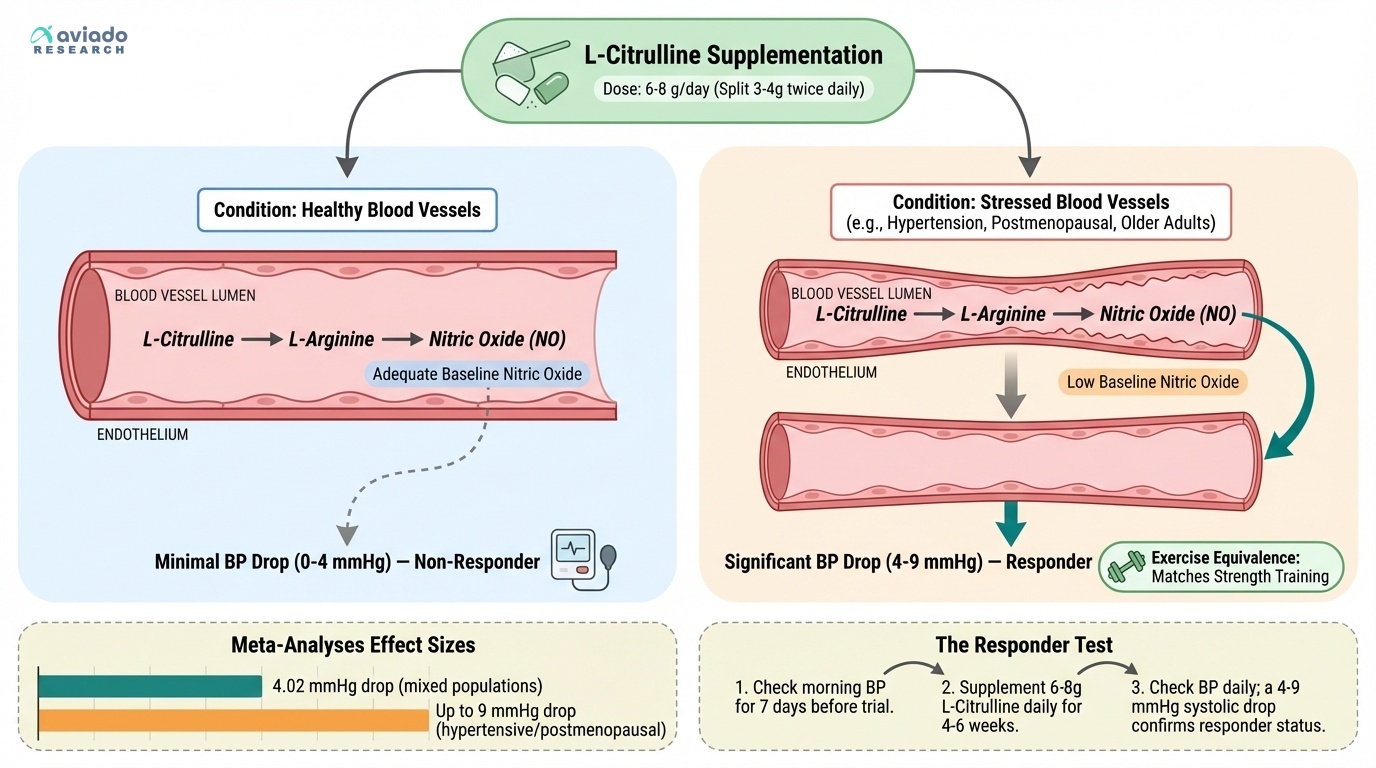
Try 6–8 grams per day for 4–6 weeks. Split it into 3–4 grams, twice daily. Check morning blood pressure for 7 days before. Then check daily during the trial. A 4–9 mmHg systolic drop means you respond.
Key Terms to Know

L-citrulline
An amino acid supplement that can raise arginine and support nitric oxide in blood vessels.
Nitric oxide (NO)
A signal made by blood vessels that helps arteries relax and widen.
Systolic Blood Pressure
Peak arterial pressure during heart contraction, strongest predictor of cardiovascular events. elevated systolic BP damages blood vessels, heart, kidneys, and brain over time.
Flow-mediated dilation (FMD)
A test of how well an artery widens when blood flow increases, used to gauge endothelial health.
Diastolic blood pressure (DBP)
The bottom number on a blood pressure reading. It reflects pressure between heartbeats.
Systolic blood pressure (SBP)
The top number on a blood pressure reading. It rises with artery stiffness and predicts heart risk.
Responder vs. non-responder
A responder shows a clear blood pressure drop with citrulline; a non-responder does not.
arginine
An amino acid that helps produce nitric oxide to support blood vessel function.
Citrulline
An amino acid that supports nitric oxide signaling and can lower blood pressure.
FMD
A medical test measuring blood vessel dilation to assess overall endothelial function.

The Exercise Equivalence Discovery

When researchers compared L-citrulline to strength training, they saw an unexpected match. A systematic review of 9 studies (303 people) found similar blood-pressure lowering from citrulline and resistance exercise [1].

That does not mean citrulline replaces training. Exercise improves many systems at once. But it suggests a shared lever: nitric oxide signaling in blood vessels. Citrulline can raise arginine. That can support nitric oxide when your endothelium struggles.

Time is the practical difference. Exercise plans often need 3–4 sessions each week for months. In trials, citrulline effects show up faster in responders. Many studies report changes within about 2–4 weeks.

The Responder Paradox: Why Effect Sizes Vary Wildly

Citrulline studies swing from big wins to small changes. One meta-analysis of 15 trials reported about a 7.54 mmHg drop in systolic pressure [2]. A newer meta-analysis, including citrulline and watermelon, reported about a 4.02 mmHg drop [3]. In hypertensive postmenopausal women, a systematic review reported drops up to about 9 mmHg [4].

This gap likely reflects who was studied. Citrulline mainly helps when nitric oxide is a limiting step. That is more common with endothelial dysfunction, inflammation, or stiffer arteries. If your vascular function is already strong, extra citrulline may not move blood pressure much.

Groups that tend to respond more include people with hypertension, older adults, and many postmenopausal women. These groups often start with lower nitric oxide activity. That gives citrulline more room to help.

Dosing Strategy: What the Research Shows

The most effective dosing protocol emerging from clinical trials is 6-8 grams of L-citrulline daily, typically split into two doses of 3-4 grams each. This range consistently produces cardiovascular benefits in responsive populations across multiple studies [2][3][4]. Lower doses (2-3 grams daily) show inconsistent results, while higher doses don't appear to provide additional benefits.

Timing matters less than consistency. Some studies used single daily doses, others split the amount morning and evening — both approaches worked equally well as long as the total daily intake reached the 6-8 gram threshold. The supplement can be taken with or without food, though some people report better gastrointestinal tolerance when taken with meals.

Benefits typically emerge within 2-4 weeks of consistent supplementation, with maximum effects reached by 6-8 weeks. Unlike some cardiovascular interventions that require months to show results, citrulline's blood pressure effects appear relatively quickly in responsive individuals, making it easy to determine whether you're getting meaningful benefits.

Beyond Blood Pressure: Emerging Cardiovascular Benefits

Blood pressure is citrulline’s strongest outcome. Other markers are less certain. One 7-day RCT (82 people) reported drops in LDL and total cholesterol after L-citrulline [5]. That is interesting, but short. It does not prove long-term lipid benefit.

Glucose results are mixed. One double-blind RCT in type 2 diabetes (54 people) reported lower fasting glucose with L-citrulline [6]. But a systematic review in postmenopausal women found no consistent glucose effect across trials [4].

Takeaway: treat cholesterol and glucose changes as possible extras. Do not rely on them as the main reason to supplement. Use blood pressure as the primary yardstick.

Testing Your Responder Status

You can test citrulline like a mini trial. First, measure your blood pressure for 7 days. Do it seated, after 5 minutes of rest, at the same time each morning.

Then take 6–8 grams of L-citrulline daily. Split it into 3–4 grams twice per day. Keep measuring daily for 4–6 weeks. Most responders show change by week 2–3.

Count it as a real response if systolic pressure drops at least 4–5 mmHg. A 7–9 mmHg drop suggests a strong response. If you see no clear change by week 6, you are likely a non-responder.

If you can access it, flow-mediated dilation (FMD) testing may help. It measures endothelial function directly. Lower baseline FMD may signal higher odds of benefit.

L-Citrulline Cuts Blood Pressure as Effectively as Exercise — But Only If Your Vascular System Responds

L-Citrulline Cuts Blood Pressure as Effectively as Exercise — But Only If Your Vascular System Responds

Meta-analyses show wildly different effect sizes across trials, suggesting your vascular biology determines whether you're a responder

Diagram glossary
arginine:
An amino acid that helps produce nitric oxide to support blood vessel function.
Citrulline:
An amino acid that supports nitric oxide signaling and can lower blood pressure.
FMD:
A medical test measuring blood vessel dilation to assess overall endothelial function.
mmHg:
A standard unit of pressure measurement commonly used to express blood pressure readings.
SBP:
Systolic blood pressure, which is the maximum pressure exerted in arteries during a heartbeat.

Track this in your stack

See how l_citrulline relates to your health goals, compare it against evidence tiers, and monitor changes in your biomarkers over time.

Open Aviado

Conclusions

L-citrulline is not a guaranteed blood pressure fix. It works best when your blood vessels need nitric oxide support. If you have hypertension, are older, or are postmenopausal, your odds of benefit are higher. The practical approach is a 4–6 week self-trial at 6–8 grams per day with daily morning readings. If your systolic pressure falls by 4–9 mmHg, it is worth continuing. If it does not, stop and focus on proven basics like exercise, sleep, diet, and medical care.

Limitations

Most trials run 4–12 weeks, so long-term outcomes are uncertain. Meta-analyses combine different populations, doses, and products (pure citrulline vs. watermelon), which can shrink or inflate average effects. The “responder” idea is supported by patterns across groups, but there is no simple test that predicts your response. Cholesterol and glucose findings come from small or short studies and may not hold in larger trials. If you take blood pressure drugs, have kidney disease, or have low baseline blood pressure, talk with a clinician before using citrulline.

Sources (6)

1

Systematic review of 9 studies found L-citrulline had similar effectiveness as strength training on lowering blood pressure

Multiple Authors. Systematic Review, 2019.

PMID: 31492032
2

Meta-analysis of 15 RCTs found L-citrulline supplementation reduced systolic blood pressure by 7.54 mmHg

Multiple Authors. Meta-Analysis, 2018.

PMID: 30206378
3

Meta-analysis of 15 RCTs found l-citrulline supplementation and watermelon intake reduced systolic blood pressure by 4.02 mmHg

Multiple Authors. Meta-Analysis, 2024.

PMID: 40789388
4

Systematic review found citrulline supplementation may reduce systolic blood pressure by up to 9 mmHg in hypertensive postmenopausal women

Multiple Authors. Systematic Review, 2024.

PMID: 41588439
5

7-day RCT found L-citrulline supplementation significantly reduced LDL cholesterol and total cholesterol

Multiple Authors. Randomized Controlled Trial, 2022.

PMID: 36620736
6

Double-blind RCT found L-citrulline supplementation significantly reduced fasting blood glucose concentrations in type 2 diabetes patients

Multiple Authors. Randomized Controlled Trial, 2021.

PMID: 33952324