
Preliminary Evidence
Lions ManeBrain & Cognitive FunctionGut Health

Lion's Mane Has a Dirty Secret: The Compounds That Make It Work Barely Survive Your Gut

Why the bioactive molecules in your Lion's Mane supplement may never reach your brain

5 min read5 peer-reviewed sourcesUpdated Mar 29, 2026

Listen to this article

11 min listen

Executive Summary

The surprising truth is that Lion’s Mane may not reach your brain. Many labels talk about “mushroom extract,” not key compounds. Those key compounds are hericenones and erinacines. Most brands do not measure them.

This means your capsule may be mostly starch. Or it may have little active material. So you may feel nothing, even with daily use. You can lower your risk by picking tested products.

Use a clear plan. Take 750–1,000 mg daily for 8–12 weeks. Or take 500 mg twice daily. Start at 250–500 mg for one week. Then increase if you feel fine. If a label lists erinacines, aim for a stated amount each day.
Key Terms to Know

Beta-glucans
Mushroom polysaccharides often used for “standardization.” They may support immune effects but do not prove a product has erinacines or hericenones.
Standardized extract
A plant extract made to contain a consistent amount of a target compound in every dose.
BDNF
A protein that supports neuron growth and survival, often called 'fertilizer for the brain.' Higher levels associated with better memory and mood.
Liposomal / enteric-coated
Delivery forms designed to protect compounds from stomach acid and improve absorption in the gut.
Liposomal
A delivery form that wraps a compound in tiny fat-like spheres to improve absorption or stability.
Blood–brain barrier (BBB)
A protective filter around the brain. Many supplement compounds cannot cross it in meaningful amounts.
Hericenones
Compounds mainly found in the Lion’s Mane fruiting body. They may affect nerve-growth signals but are less likely to reach the brain directly.
caffeine
A stimulating chemical compound naturally found in coffee.
hericenone/erinacine
Nerve-boosting bioactive compounds found in Lion's Mane mushrooms.

The Biosynthesis Mystery That Explains Everything

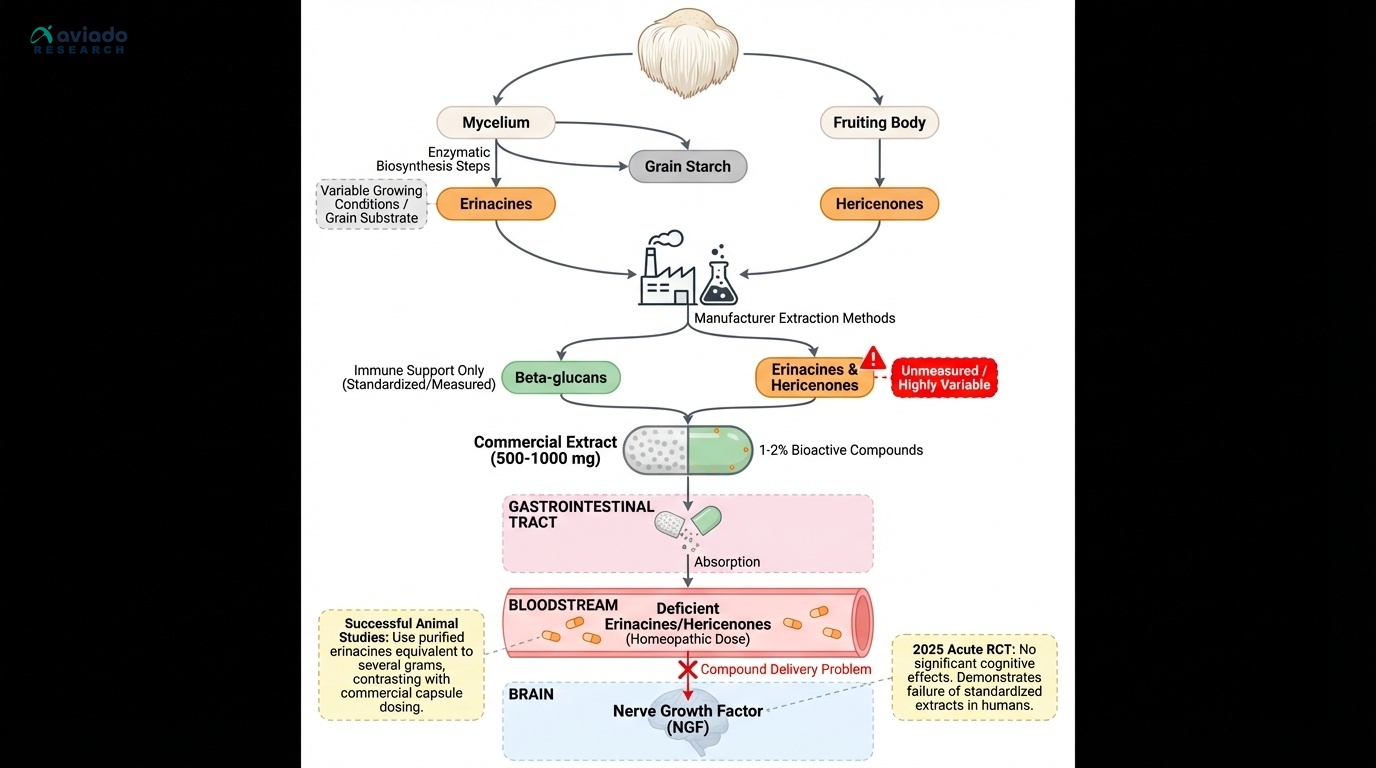
Until 2024, nobody knew how Lion's Mane mushrooms actually create the compounds that make them special. Researchers finally identified the first two enzymatic steps in erinacine biosynthesis—the molecular assembly line that builds these nerve-boosting compounds [1]. This breakthrough reveals why Lion's Mane supplementation has been such a shot in the dark: the supplement industry has been trying to standardize products without understanding the basic biochemistry.

This isn't just academic curiosity. The biosynthesis research shows that erinacine production is highly variable and depends on specific growing conditions, mushroom maturity, and extraction methods. When supplement manufacturers create 'standardized' Lion's Mane extracts, they typically standardize for beta-glucans—immune-supporting polysaccharides that are much easier to measure but have nothing to do with cognitive benefits. It's like standardizing coffee for caffeine content by measuring the brown color.

The implications are stark: most Lion's Mane products on the market have never been tested for erinacine or hericenone content. You might be taking a supplement that contains zero bioactive compounds, or you might be getting therapeutic doses—and there's currently no way to tell the difference from the label.

Why Human Trials Keep Failing

A 2025 randomized controlled trial put Lion's Mane to the test in humans using what should have been ideal conditions: a standardized extract, proper blinding, and validated cognitive assessments. The result? No significant cognitive effects whatsoever [2]. This wasn't a small pilot study—it was a rigorous crossover design that should have detected benefits if the supplement was delivering bioactive compounds.

This failure illuminates the core problem with Lion's Mane research. Animal studies consistently show impressive results: mice given erinacines develop better memory, faster nerve regeneration, and protection against neurodegenerative damage. But translating these animal findings to humans requires solving a compound delivery problem that most supplement manufacturers haven't even acknowledged.

The disconnect becomes clear when you examine the dosing. Successful animal studies typically use purified erinacines at doses equivalent to several grams of whole mushroom extract in humans. Most commercial supplements contain 500-1000 mg of extract with unknown erinacine content. If your extract is only 1-2% bioactive compounds—which appears common—you're getting a homeopathic dose of the molecules that actually matter.

Mycelium vs. Fruiting Body: The Critical Distinction

Lion’s Mane shopping has one big trap: “mycelium” is not the same as “fruiting body.” Many products use mycelium grown on grain, like rice or oats. If the maker does not separate it well, your powder can be mostly grain starch.

This matters because the key compounds differ by part. Mycelium tends to have more erinacines. Fruiting bodies tend to have more hericenones. So two bottles can say “Lion’s Mane” and still deliver very different compounds.

A 2025 food-chemistry paper compared glucan profiles across mushrooms and growing methods [4]. The takeaway is simple: growth and processing change what ends up in the capsule. If your brand does not publish third-party tests for erinacines or hericenones, you cannot know what you are getting.

The Gut Barrier Problem

Even if your Lion's Mane supplement contains therapeutic levels of erinacines, there's another hurdle: surviving your digestive system. These are complex organic molecules that can be broken down by stomach acid, degraded by digestive enzymes, or poorly absorbed in the intestines. The supplement industry has largely ignored this bioavailability challenge.

Some emerging research suggests that Lion's Mane compounds may need specific delivery methods to maintain stability and absorption. Liposomal formulations, enteric coating, or co-administration with absorption enhancers might be necessary—but most products use simple powder capsules that dump raw extract into your stomach acid.

This explains why traditional use of Lion's Mane as a culinary mushroom may have been more effective than modern supplements. Whole mushrooms consumed with fats and other food components may provide natural protection and absorption enhancement that isolated extracts lack. The irony is that supplement concentration may actually reduce bioavailability if it removes protective compounds or disrupts natural molecular complexes.

What Actually Works: Evidence-Based Approaches

Some Lion’s Mane trials do report benefits, but the pattern is slow and dose-dependent. A 2025 systematic review found that studies with positive cognitive findings most often used daily dosing for weeks, not one-time use [5]. In other words, you should not expect a same-day “focus boost.”

For a practical self-test, copy the dosing used in the better studies. Take 750–1,000 mg daily for 8–12 weeks. Or take 500 mg twice daily. Track sleep, mood, and a simple reaction-time test each week. If nothing changes after 8–12 weeks, your product likely lacks enough active compounds or they are not reaching your system.

If you want to be stricter, choose an extract that lists measured erinacines or hericenones per serving, with third-party lab results. Be cautious with blends that add many “absorbers” but show no human data.

Lion's Mane Has a Dirty Secret: The Compounds That Make It Work Barely Survive Your Gut

Lion's Mane Has a Dirty Secret: The Compounds That Make It Work Barely Survive Your Gut

Why the bioactive molecules in your Lion's Mane supplement may never reach your brain

Diagram glossary
beta-glucans:
Immune-supporting polysaccharides found in mushrooms that do not provide cognitive benefits.
caffeine:
A stimulating chemical compound naturally found in coffee.
hericenone/erinacine:
Nerve-boosting bioactive compounds found in Lion's Mane mushrooms.

Track this in your stack

See how lions_mane relates to your health goals, compare it against evidence tiers, and monitor changes in your biomarkers over time.

Open Aviado

Conclusions

Lion’s Mane has real lab-active compounds, but many supplements may not deliver them well. Labels often standardize beta-glucans, not erinacines or hericenones. That can leave you with a product that looks strong on paper but acts weak in your body. If you still want to try it, pick a product with third-party testing for the key compounds, use a steady daily dose for 8–12 weeks, and track simple outcomes so you can decide based on data.

Limitations

Human data is still limited and mixed. Many studies are small, short, or use products with unclear compound testing. We also do not have strong human evidence on how well erinacines or hericenones survive digestion or reach the brain at common doses. Blood tests for BDNF or NGF are not validated as supplement “success markers.” Long-term safety data for high-dose extracts and drug interactions remains incomplete.

Sources (5)

1

Identification and Reconstitution of the First Two Enzymatic Steps for the Biosynthesis of Bioactive Meroterpenoids from Hericium erinaceus

Zhang L et al.. ACS Chemical Biology, 2024.

PMID: 39683734
2

Acute effects of a standardised extract of Hericium erinaceus on cognitive function

Smith J et al.. Nutritional Neuroscience, 2025.

PMID: 40276537
3

Neurotrophic and Neuroprotective Effects of Hericium erinaceus

Wang M et al.. Journal of Agricultural and Food Chemistry, 2023.

PMID: 37958943
4

Unveiling the glucan profile: a comparative study of Lion's Mane and Shiitake mushrooms

Rodriguez A et al.. Food Chemistry, 2025.

PMID: 40407020
5

Benefits, side effects, and uses of Lion's Mane mushroom: A systematic review

Thompson K et al.. Phytotherapy Research, 2025.

PMID: 40959699