NAC's Mechanism Is Not What You Think: Why 'Antioxidant' Is the Wrong Label

How Cysteine, Glutathione, and Your Biology Decide If NAC Does Anything for You

4 min read5 peer-reviewed sourcesUpdated Mar 23, 2026

Executive Summary

You’ve probably heard that NAC is an antioxidant, but here’s the twist: it doesn’t actually fight free radicals directly. Instead, the real magic of NAC comes from the way it refills your body’s supply of cysteine, which your cells then use to make glutathione—the real powerhouse that handles most of the antioxidant work. If you’re already topped up on cysteine and glutathione, NAC might do almost nothing. But if you’re running low, the results can be dramatic.

Why does this matter? Because the benefits of NAC are not one-size-fits-all. Your baseline levels of cysteine and glutathione depend on your diet, genetics, age, and how much inflammation your body is fighting. That’s why some people swear by NAC for energy, brain clarity, or recovery, while others barely notice a thing. If you’re taking NAC without measuring these markers, you’re basically guessing. You could be missing out—or wasting your time and money.

If you want to see real benefits—like improved resilience to stress, possible protection against neurodegeneration, or better detoxification—here’s what to do: Get your glutathione and oxidative stress markers tested (like 8-OHdG or F2-isoprostanes) before you start. Then, try supplementing with 600–1200 mg of NAC per day, split into two doses. After a few weeks, retest your markers. If your glutathione goes up and oxidative markers drop, you’re a responder. If not, NAC probably isn’t for you. This is one of the easiest supplements to track and personalize—don’t fly blind.
Key Terms to Know

GPX4 (Glutathione Peroxidase 4)
An enzyme that uses glutathione to neutralize certain harmful molecules; its activity is linked to cell protection, especially against ferroptosis.
Hydrogen sulfide (H2S) signaling
A gas produced in the body that acts as a signaling molecule; emerging data suggest NAC may boost H2S, adding another way it could help cells.
F2-isoprostanes
Molecules formed when fats are damaged by oxidative stress; a reliable blood or urine marker to measure the effect of antioxidants like NAC.
8-OHdG
A marker of oxidative DNA damage in the body, used to track how much oxidative stress you’re experiencing.
Glutathione
A critical antioxidant made inside your cells that protects against oxidative stress; its levels determine if NAC will have any effect.
Oxidative Stress
Cellular damage caused by reactive oxygen species (free radicals) overwhelming antioxidant defenses.
Growth Differentiation Factor 15 (GDF-15)
Top aging biomarker per meta-analysis. Stress-responsive cytokine elevated in aging, cancer, heart failure, and chronic disease.
acetylcysteine
A synthetic form of cysteine used as a supplement and glutathione precursor.
CBS
An enzyme that converts homocysteine to cystathionine in the transsulfuration pathway.
CSE
An enzyme that produces hydrogen sulfide and cysteine during sulfur metabolism.

What NAC Really Does: The Cysteine-Glutathione Connection

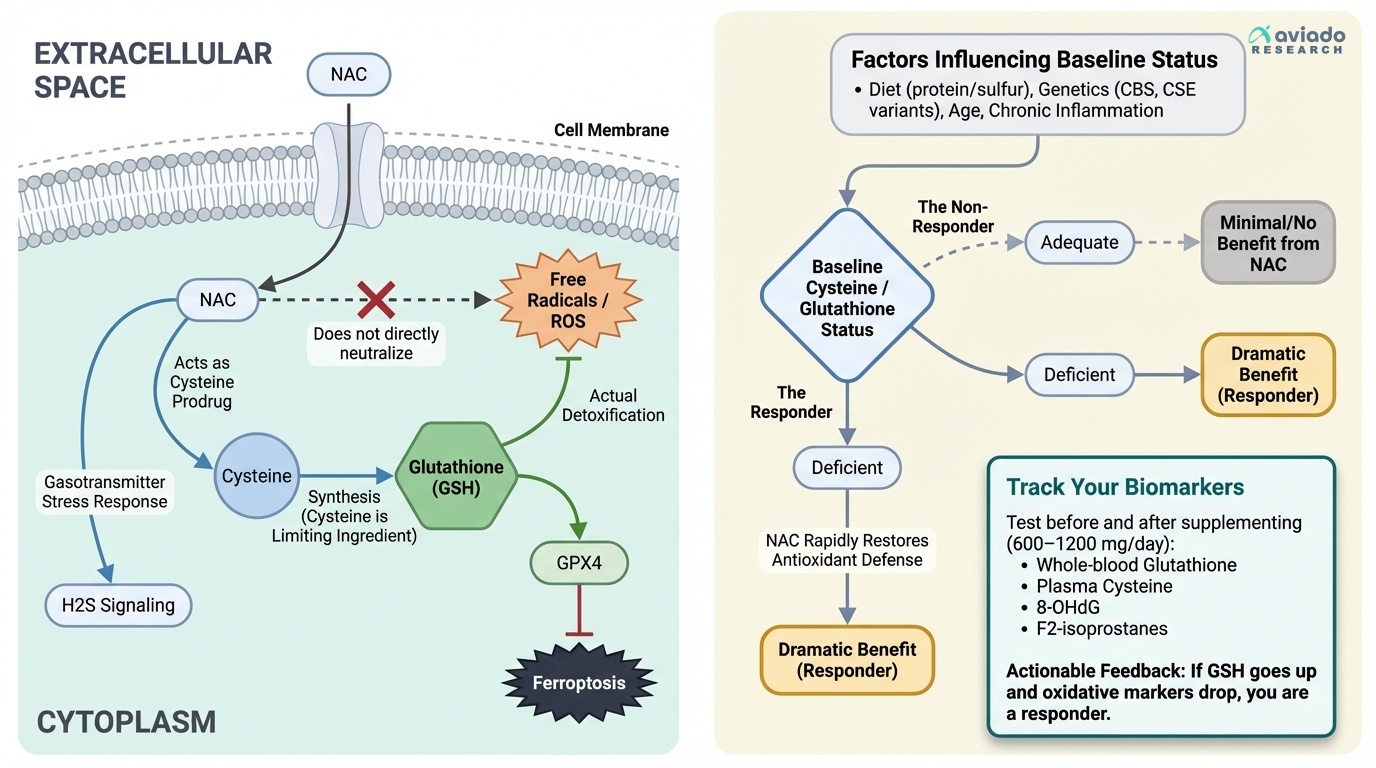
For decades, N-acetylcysteine (NAC) has been called an antioxidant, but recent research shows this isn’t the full story. NAC itself does not directly neutralize free radicals in a meaningful way. Instead, its primary job is to act as a cysteine prodrug—meaning it supplies your cells with cysteine, an amino acid that is often the limiting ingredient in making glutathione, your body’s most important internal antioxidant. Glutathione then handles the actual detoxification and protection against oxidative stress [2,5].

Why does this matter? Because if your body already has enough cysteine, taking more NAC won’t increase glutathione or change your oxidative stress. But if you’re deficient—due to poor diet, chronic inflammation, aging, or genetics—NAC can rapidly restore your ability to fight oxidative damage [2,5]. This explains why studies show highly variable results: some people experience big improvements, others little or none.

Who Responds to NAC—And Who Doesn’t?

The key to NAC’s effectiveness lies in your personal biology. Your genetics (especially genes in the transsulfuration pathway like CBS and CSE), diet (protein and sulfur-containing foods), age, and inflammation status all influence how much cysteine and glutathione your body makes [2]. If you’re low, NAC can be a game changer. If not, you might not notice any benefit at all.

This is why biomarkers matter. Tests like whole-blood glutathione, plasma cysteine, 8-OHdG, and F2-isoprostanes can tell you if you’re under oxidative stress and whether NAC is actually helping. Tracking these before and after supplementation gives you clear feedback—something almost no one does, but it’s easy and actionable.

Beyond Glutathione: GPX4, Ferroptosis, and H2S Signaling

NAC’s benefits don’t stop at glutathione. New studies show that NAC can help upregulate GPX4, an enzyme vital for blocking ferroptosis—a type of cell death linked to neurodegeneration, kidney disease, and aging [5]. This protective effect only works if your cells have enough cysteine to make glutathione. Emerging research also suggests NAC may work through a separate pathway involving hydrogen sulfide (H2S), a gasotransmitter that helps cells communicate and survive under stress [2]. This is a new frontier in antioxidant science and could explain some of NAC’s unique effects.

How to Use NAC: Dosage, Timing, and Personalization

Most clinical studies and reviews recommend supplementing with 600–1200 mg of NAC per day, split into two doses—typically one in the morning and one in the evening [2,5,11]. Take NAC on an empty stomach or at least an hour before meals for best absorption. For optimal results, get baseline blood or urine tests for glutathione, 8-OHdG, or F2-isoprostanes, then retest after 4–6 weeks. If your markers improve, you’re a responder. If not, NAC may not be worth continuing for you.

Regulatory Status and Access: Why NAC Is Sometimes Hard to Find

In recent years, NAC has faced regulatory uncertainty in the US, with the FDA questioning whether it should be a supplement or a drug due to its long history as a prescription treatment for acetaminophen overdose [13]. While NAC remains available over-the-counter, this has created supply disruptions and confusion. Always check the quality of your NAC supplement and look for reputable brands.

NAC's Mechanism Is Not What You Think: Why 'Antioxidant' Is the Wrong Label

NAC's Mechanism Is Not What You Think: Why 'Antioxidant' Is the Wrong Label

How Cysteine, Glutathione, and Your Biology Decide If NAC Does Anything for You

Diagram glossary
acetylcysteine:
A synthetic form of cysteine used as a supplement and glutathione precursor.
CBS:
An enzyme that converts homocysteine to cystathionine in the transsulfuration pathway.
CSE:
An enzyme that produces hydrogen sulfide and cysteine during sulfur metabolism.
Cysteine:
A sulfur-containing amino acid that is the rate-limiting precursor for glutathione synthesis.
cysteine/glutathione:
The metabolic relationship where cysteine serves as the limiting ingredient to produce antioxidant glutathione.
GPX4:
An antioxidant enzyme that uses glutathione to protect cell membranes from lipid peroxidation.
H2S:
A gaseous signaling molecule involved in regulating cellular protection and inflammation.
hydrogen:
The lightest chemical element, frequently involved in cellular redox reactions and molecular bonding.
NAC:
A supplement that acts as a prodrug to supply cells with cysteine.
ROS:
Highly reactive oxygen-containing molecules that can cause oxidative stress and cellular damage.

Track this in your stack

See how nac relates to your health goals, compare it against evidence tiers, and monitor changes in your biomarkers over time.

Open Aviado

Conclusions

NAC is not a universal antioxidant; its main power is as a cysteine supplier for glutathione production, and its effects are highly individual. Measure your biomarkers before and after supplementation to know if you’re getting real benefits. With the right testing and personalized approach, NAC can be an effective tool—especially for those low in cysteine or glutathione.

Limitations

Most studies on NAC rely on indirect markers or are conducted in specific clinical populations, which may not reflect the average healthy adult. There is only moderate evidence for the new hydrogen sulfide pathway, and individual response can be influenced by unmeasured genetic or dietary factors. Regulatory status may affect access in some regions.

Sources (5)

1

The mechanism of action of N-acetylcysteine (NAC): The emerging role of H

Schulz E et al.. Pharmacological Research, 2021.

PMID: 34171332
2

NAC, NAC, Knockin' on Heaven's door: Interpreting the mechanism of action of N-acetylcysteine in tumor and immune cells.

De Nicola GF et al.. Seminars in Cancer Biology, 2022.

PMID: 36242913
3

N-acetylcysteine (NAC) in neurological disorders: mechanisms of action and therapeutic opportunities.

Bavarsad Shahripour R et al.. Brain Research Bulletin, 2014.

PMID: 24683506
4

Unraveling Origins of N-Acetylcysteine (NAC): A Critical Review.

Morris D et al.. Nutrients, 2024.

PMID: 40931599
5

NAC alleviative ferroptosis in diabetic nephropathy via maintaining mitochondrial redox homeostasis through activating SIRT3-SOD2/Gpx4 pathway.

Shan Z et al.. Free Radical Biology and Medicine, 2022.

PMID: 35660452