Preliminary Evidence
Nicotinamide RibosideMetabolic Health

NR Reliably Raises Your NAD+ — But Whether That Translates to Any Clinical Benefit Depends Entirely on Who You Are

Nicotinamide riboside's universal NAD+ boost is just the starting line — not everyone gets a clinical win

5 min read8 peer-reviewed sourcesUpdated Apr 4, 2026

Listen to this article

Audio available

Executive Summary

Here's something surprising: nicotinamide riboside (NR) will raise your NAD+ levels in almost everyone who takes it. Studies show a 2.6- to 3.1-fold increase regardless of age or health status. But here's what most people miss: higher NAD+ doesn't automatically mean better health. The real question is whether your body can actually use that extra NAD+ to fix anything.

If you're healthy, you'll get the NAD+ boost but probably won't feel different or see better blood work. If you have conditions like fatty liver disease or Parkinson's, that same NAD+ increase might lower your liver enzymes or support energy metabolism. It's not that NR doesn't work. It's that your body might not need the help.

For proven benefits like reducing liver enzymes in fatty liver disease, studies support 1000 mg twice daily for 12-24 weeks. Track specific biomarkers like GGT or ALT to see if the NAD+ boost translates to real improvements. If you don't see changes in your target markers after 24 weeks, it's likely because your body isn't translating higher NAD+ into clinical benefits.
Key Terms to Know

NAD+ utilization bottleneck
The concept that having more NAD+ doesn't guarantee benefits unless your cells can actually use it effectively through enzymes like sirtuins and PARPs.
NRPT
A supplement formulation combining nicotinamide riboside and pterostilbene, often used in clinical trials for enhanced effects.
NAD+ depletion
A state where cellular NAD+ levels are abnormally low, often seen in metabolic diseases, neurodegeneration, or aging, making supplementation more likely to provide clinical benefits.
Gamma-glutamyl transferase
Gamma-glutamyl transferase, a liver enzyme sensitive to alcohol and metabolic dysfunction. elevated in hepatobiliary disease, alcohol use, and NAFLD.
ALT (SGPT)
Alanine aminotransferase enzyme, highly specific to liver cells. elevated in hepatocellular injury from viral hepatitis, fatty liver, or medications.
Glucose
Blood sugar level, the primary energy source for cells. Fasting glucose is normal, prediabetes, ≥126 suggests diabetes.
ALT (Alanine aminotransferase)
A liver enzyme highly specific to liver cell damage. Elevated ALT indicates hepatocellular injury from conditions like fatty liver or hepatitis.
ALT
An enzyme found primarily in the liver, used as a biomarker for liver health.
GGT
A liver enzyme used as a biomarker to assess liver function and disease.
NAD
A crucial coenzyme found in all living cells that is essential for energy metabolism.

Why NAD+ Elevation Is Guaranteed — and Why That’s Not Enough

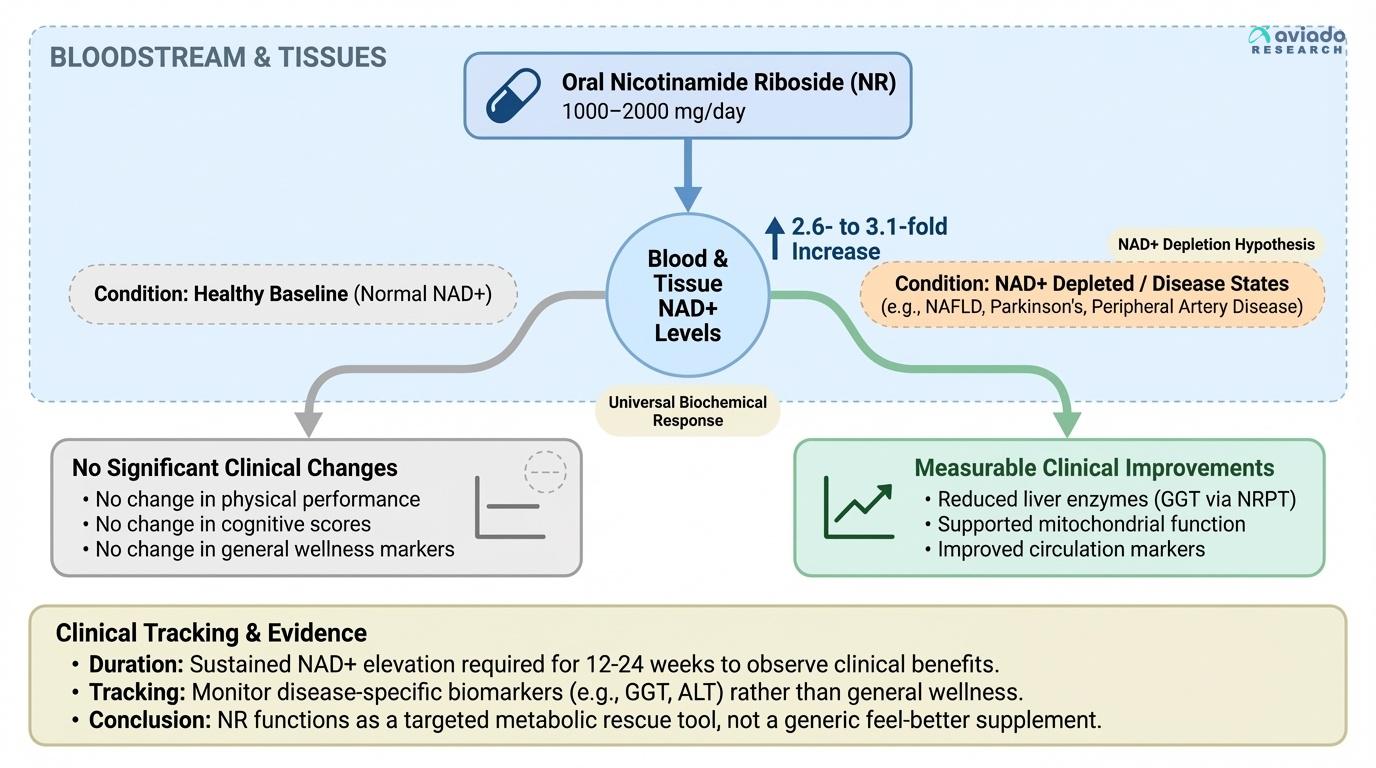
Nicotinamide riboside is one of the rare supplements with a totally reliable effect on a core cellular process: oral NR at 1000–2000 mg daily almost always raises blood and tissue NAD+ levels, sustaining the increase for at least 24 weeks [1]. This effect is rock-solid, confirmed across dozens of trials in people of all ages and health backgrounds [1][2]. For anyone interested in optimizing cellular energy, this might sound like a slam dunk.

But here’s the catch: boosting NAD+ is just the start. What actually matters is how your body uses that extra NAD+. In practice, most healthy adults see no change in physical performance, cognitive scores, or general wellness markers when they supplement NR, despite their NAD+ skyrocketing [1][2]. The reason? Unless your body is NAD+-starved — such as in specific diseases or severe metabolic stress — you may not get any downstream benefit, because your cells aren’t limited by NAD+ in the first place.

Who Actually Benefits? The NAD+ Depletion Hypothesis

Recent research has shifted the NR story from a universal 'anti-aging' solution to a targeted tool for those with real NAD+ depletion. Clinical trials show that only specific populations with documented NAD+ deficits get measurable clinical improvements when NAD+ levels rise [1][4][12].

In fatty liver disease (NAFLD), a 6-month randomized trial found that NRPT reduced liver enzymes GGT and ALT by statistically significant amounts compared to placebo [6]. In Parkinson's disease, NR supplementation showed early signs of supporting mitochondrial function, but only in patients with documented energy metabolism problems [4]. For peripheral artery disease, NR helped with circulation markers specifically in those with baseline NAD+ deficits [12].

In contrast, healthy older adults consistently show robust NAD+ increases but no significant changes in cognitive scores, physical performance, or metabolic markers [1][14]. The pattern is clear: clinical benefits require starting with low NAD+ and having a biological bottleneck that extra NAD+ can actually fix.

How to Use NR: Dosing, Duration, and Tracking What Matters

If you’re considering NR, research supports doses of 500 mg to 1000 mg twice daily (total 1000–2000 mg/day), with studies demonstrating sustained NAD+ elevation and safety at these levels for up to 24 weeks [1][10][14]. The key is persistence: NAD+ rises within weeks and stays high as long as you continue, but clinical benefits (if you’re going to get them) usually show up by 12-24 weeks. If you’re aiming for proven effects — like lowering GGT or ALT in fatty liver, or supporting energy in NAD+-depleted diseases — track those specific biomarkers.

If you’re healthy and want to take NR for prevention, know that you’ll almost certainly raise your NAD+, but unless you’re tracking a disease-specific risk marker, you may not notice any changes. The take-home: NR is best used as a 'metabolic rescue tool' in cases of known NAD+ depletion, not as a generic feel-better supplement for everyone.

Why Clinical Outcomes Vary: The NAD+ Utilization Bottleneck

The reason NR’s clinical results are so variable comes down to genetics and biology. Even with a big NAD+ boost, not everyone’s cells use it the same way. Enzymes like sirtuins and PARPs, which drive the anti-aging and repair benefits of NAD+, are regulated by factors beyond just NAD+ availability — including age, disease burden, and genetic differences [1][2]. For some, supplementing NR is like filling a gas tank that still has a clogged engine: the fuel is there, but the system can’t use it efficiently.

This explains why the same NR regimen can yield clear benefits for one person (lower liver enzymes, improved energy) and do nothing for another. It also means future NR research will likely focus on identifying 'responders' — those with the right biology to benefit most.

NR Reliably Raises Your NAD+ — But Whether That Translates to Any Clinical Benefit Depends Entirely on Who You Are

NR Reliably Raises Your NAD+ — But Whether That Translates to Any Clinical Benefit Depends Entirely on Who You Are

Nicotinamide riboside's universal NAD+ boost is just the starting line — not everyone gets a clinical win

Diagram glossary
ALT:
An enzyme found primarily in the liver, used as a biomarker for liver health.
GGT:
A liver enzyme used as a biomarker to assess liver function and disease.
NAD:
A crucial coenzyme found in all living cells that is essential for energy metabolism.
NAFLD:
A condition characterized by excessive fat buildup in the liver without heavy alcohol use.
Nicotinamide:
A form of vitamin B3 that serves as a precursor to the coenzyme NAD+.

Track this in your stack

See how nicotinamide_riboside relates to your health goals, compare it against evidence tiers, and monitor changes in your biomarkers over time.

Open Aviado

Conclusions

Nicotinamide riboside is a reliable way to raise your NAD+ levels, but whether that translates to real health benefits depends entirely on your baseline NAD+ status and individual biology. If you have a documented NAD+ deficit (such as in fatty liver disease or certain neurological conditions), NR may deliver measurable improvements in disease-specific markers at 1000–2000 mg per day over several months. For healthy adults, NAD+ will rise — but that alone is not a guarantee of clinical benefit. The smart move is to use NR with a targeted goal and track the biomarker that matters for you.

Limitations

While NR reliably increases NAD+ in nearly everyone, proven clinical benefits remain limited to specific populations with NAD+ depletion. Most healthy adults will not see meaningful improvements in cognitive function, metabolism, or general wellness in current RCTs. Research is ongoing to identify better predictors of who will clinically respond to NR supplementation. Long-term safety beyond six months and optimal dosing in different disease states also require further study.

Sources (8)

1

What is really known about the effects of nicotinamide riboside supplementation in humans.

Elhassan YS et al.. Pharmacological Research, 2023.

PMID: 37478182
2

NAD+ Precursors Nicotinamide Mononucleotide (NMN) and Nicotinamide Riboside (NR): Potential Dietary Contribution to Health.

de la Rubia JE et al.. Current Opinion in Clinical Nutrition and Metabolic Care, 2023.

PMID: 37273100
4

The NADPARK study: A randomized phase I trial of nicotinamide riboside supplementation in Parkinson's disease.

Schöndorf DC et al.. Movement Disorders, 2022.

PMID: 35235774
6

Nicotinamide riboside and pterostilbene supplementation decreases liver enzymes in adults with nonalcoholic fatty liver disease: A randomized controlled trial.

Dellinger RW et al.. Hepatology Communications, 2022.

PMID: 36082508
10

Chronic nicotinamide riboside supplementation is well-tolerated and elevates NAD+ in healthy middle-aged and older adults.

Martens CR et al.. Nature Communications, 2018.

PMID: 29599478
12

Nicotinamide riboside for peripheral artery disease: the NICE randomized clinical trial.

Levine GN et al.. Circulation Research, 2024.

PMID: 38871717
14

A randomized placebo-controlled trial of nicotinamide riboside in older adults with mild cognitive impairment.

Herskovits AZ et al.. Alzheimer's & Dementia, 2023.

PMID: 37994989
1

What is really known about the effects of nicotinamide riboside supplementation in humans.

Elhassan YS et al.. Pharmacological Research, 2023.

PMID: 37478182