Preliminary Evidence
ResveratrolImmune SystemMetabolic Health

Resveratrol Reliably Cuts Inflammation but Fails on Lipids — Your Disease State May Explain Why

Meta-analysis of 107 trials reveals resveratrol works consistently on CRP and blood sugar, but only in people with existing metabolic dysfunction

4 min read5 peer-reviewed sourcesUpdated Mar 23, 2026

Executive Summary

Most people think resveratrol helps everyone. That is surprising. The data show a clear split. It helps when your markers are high.

What this means for you is simple. If your hs-CRP or HbA1c is high, you may benefit. If both are already low, you may see no change. So test first, then decide.

Use 250–500 mg per day with food. Try it for 12 weeks, then retest. If you split doses, take 250 mg twice daily. If your hs-CRP is over 3 mg/L or HbA1c is 5.7% or higher, you are the best match.

Key Terms to Know

SIRT1
An enzyme involved in energy use and stress response. Resveratrol may influence it.
Liposomal
A delivery form that wraps a compound in tiny fat-like spheres to improve absorption or stability.
C-Reactive Protein (cardiac)
High-sensitivity C-reactive protein, a liver-produced acute-phase reactant. Independent predictor of heart attack and stroke.
Resveratrol
A plant polyphenol found in grapes and berries. Studied for inflammation and blood sugar effects.
Hemoglobin A1c
Average blood sugar over the past 2-3 months by assessing glycated hemoglobin. each 1% increase raises cardiovascular risk by 18%.
Triglycerides
Triglycerides, the primary fat storage molecule in blood. elevated levels indicate metabolic dysfunction and increase cardiovascular risk.
Umbrella meta-analysis
An umbrella meta-analysis is a study that combines and evaluates results from multiple meta-analyses to provide an overall summary of evidence on a topic. It sits at the top of the evidence hierarchy
CRP
A blood protein marker that indicates the level of inflammation in the body.
glucose
A simple sugar in the blood that serves as the body's primary energy source.
HDL
A high-density lipoprotein that removes excess cholesterol from the bloodstream.

The Inflammation Connection: Why Resveratrol Works Consistently on CRP

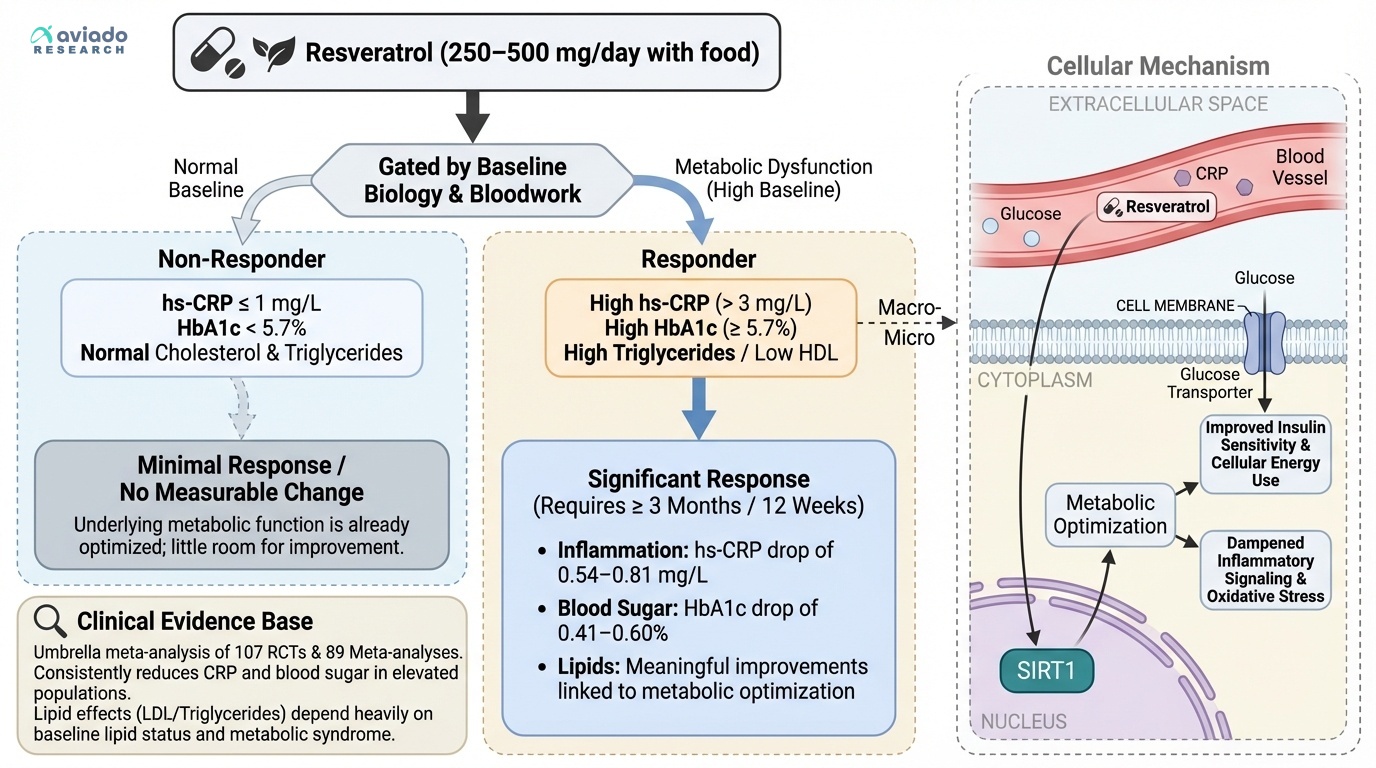
The strongest resveratrol signal is inflammation, not “longevity.” An umbrella meta-analysis pooling 81 unique RCTs (n=4,088) found a moderate drop in CRP (effect size −0.39) [1]. Other meta-analyses report an absolute CRP decrease of about 0.54 mg/L in 15 RCTs (n=658) [2] and 0.81 mg/L in 29 RCTs (n=1,069) [3].

This matters most if your inflammation starts high. CRP above 3 mg/L is commonly used as a higher-risk range for cardiovascular events. A 0.5–0.8 mg/L drop can be meaningful if you start elevated. If your hs-CRP is already near 1 mg/L or lower, you may not see a measurable change.

Mechanistically, resveratrol appears to dampen inflammatory signaling and oxidative stress. But the practical takeaway is simpler: the best “responders” tend to be people with more inflammation to lower.

Blood Sugar Benefits: The Three-Month Rule

Resveratrol’s blood sugar story has a built-in timing rule. HbA1c reflects the past 8–12 weeks. So trials shorter than about three months often miss changes. A meta-analysis found HbA1c improvements in studies lasting at least 3 months [3]. Another meta-analysis (17 RCTs, n=871) reported HbA1c improved by 0.41% at three months (P=0.001) [4].

Responder effects show up here too. An age-stratified meta-analysis found a 0.60% HbA1c reduction in adults ages 45–59 using 250–500 mg/day (p<0.00001) [5]. That size of change can move some people from prediabetes back to normal range, but mainly if they start above normal.

Resveratrol may help by improving insulin sensitivity through pathways linked to SIRT1 and cellular energy use. If your glucose control is already strong, there may be little room for improvement.

The Lipid Paradox: Why Cholesterol Effects Remain Inconsistent

Here's where resveratrol's story gets complicated. While inflammation and blood sugar effects show remarkable consistency, the evidence for lipid benefits—cholesterol and triglyceride improvements—remains frustratingly mixed. Some meta-analyses report significant improvements in LDL cholesterol and triglycerides, while others find no effect at all using similar data sets.

This inconsistency isn't a flaw in the research—it's revealing something important about how resveratrol works. The lipid effects appear to depend heavily on baseline lipid status and the presence of metabolic syndrome. People with already-normal cholesterol levels show minimal response, while those with elevated triglycerides and low HDL may see meaningful improvements.

The biological explanation centers on resveratrol's mechanism of action. Unlike statins, which directly block cholesterol synthesis, resveratrol works through metabolic optimization—improving insulin sensitivity, reducing inflammation, and enhancing cellular energy production. These upstream changes can improve lipid profiles, but only when there's underlying metabolic dysfunction driving the lipid abnormalities in the first place.

Dosing Strategy: The Non-Linear Response Curve

Dose-response work suggests resveratrol has a “sweet spot,” not a straight line. Many benefits in meta-analyses appear around 250–500 mg per day [5]. Higher doses are not guaranteed to work better, and some trials report more side effects at very high intakes.

Absorption is a real constraint. Resveratrol is rapidly metabolized, so blood levels can rise and fall quickly. Taking it with food, especially with some fat, may improve absorption. Splitting the dose (for example, 250 mg twice daily) can also smooth exposure.

Enhanced forms (like liposomal or phospholipid complexes) may increase absorption in theory. But most outcome data in meta-analyses come from standard oral supplements. So you do not need a specialty form to test whether you respond.

Resveratrol Reliably Cuts Inflammation but Fails on Lipids — Your Disease State May Explain Why

Resveratrol Reliably Cuts Inflammation but Fails on Lipids — Your Disease State May Explain Why

Meta-analysis of 107 trials reveals resveratrol works consistently on CRP and blood sugar, but only in people with existing metabolic dysfunction

Diagram glossary
CRP:
A blood protein marker that indicates the level of inflammation in the body.
glucose:
A simple sugar in the blood that serves as the body's primary energy source.
HDL:
A high-density lipoprotein that removes excess cholesterol from the bloodstream.
insulin:
A hormone produced by the pancreas that helps regulate blood sugar levels.
LDL:
A low-density lipoprotein that can build up as plaque in blood vessels.
SIRT1:
A protein linked to longevity and metabolism that is often activated by resveratrol.
triglyceride:
A type of lipid found in the blood that stores unused calories for energy.

Track this in your stack

See how resveratrol relates to your health goals, compare it against evidence tiers, and monitor changes in your biomarkers over time.

Open Aviado

Conclusions

Resveratrol is not a “for everyone” supplement. It shows the most reliable benefits for inflammation and long-term blood sugar, especially when your starting hs-CRP or HbA1c is high. Lipid changes are still inconsistent.

If you want to try it, treat it like a personal experiment. Test hs-CRP and HbA1c first. If hs-CRP is above 3 mg/L or HbA1c is 5.7% or higher, a 12-week trial of 250–500 mg/day with food is reasonable. Retest. If your markers do not improve after 12–24 weeks, stop.

Limitations

Most RCTs are short (often 3–6 months). That limits what we can say about long-term benefits and safety. Doses, populations, and lab methods vary across trials, which can inflate or hide effects. Baseline status likely drives “responder” results, but we still lack validated cutoffs that predict response for an individual. Lipid outcomes remain mixed across meta-analyses, so you should not rely on resveratrol as a cholesterol or triglyceride strategy.

Sources (5)

1

Resveratrol and Its Effects on the Vascular System

Carrizzo A et al.. Molecules, 2019.

PMID: 38374352
2

Effects of resveratrol supplementation on inflammatory biomarkers

Koushki M et al.. Critical Reviews in Food Science and Nutrition, 2024.

PMID: 30013206
3

Resveratrol supplementation and plasma lipids

Sahebkar A et al.. Nutrition Reviews, 2018.

PMID: 28933578
4

Effects of resveratrol on glucose control and insulin sensitivity

Liu K et al.. American Journal of Clinical Nutrition, 2021.

PMID: 34666902
5

Resveratrol supplementation and cardiometabolic biomarkers

Asbaghi O et al.. Nutrition, Metabolism and Cardiovascular Diseases, 2022.

PMID: 36014469