Preliminary Evidence
BifidobacteriumHeart HealthImmune System

The Bifidobacterium Paradox: Same Probiotic, Opposite Effects on LDL and HbA1c Depending on Which Strain and Who You Are

Network meta-analyses reveal strain-specific effects that can either help or harm your cardiometabolic markers

4 min read6 peer-reviewed sourcesUpdated Apr 4, 2026

Executive Summary

The surprising truth is that one Bifidobacterium strain can help you, while another can hurt you. Most labels just say “Bifidobacterium.” That is not enough. Strain and combo choice change the outcome.

What this means for you: match the product to your goal. For LDL and inflammation, combo products win most often. If your LDL rises, it may be the wrong strain for you.

Use a clear plan. Look for Lactobacillus acidophilus + Bifidobacterium. Aim for 1–10 billion CFU per day. Take it for at least 12 weeks. Recheck LDL-C, hs-CRP, and HbA1c at week 12.

Key Terms to Know

SCFA (short-chain fatty acids)
Gut-made compounds like butyrate. They can affect inflammation and insulin response.
Bifidobacterium animalis subsp. lactis BLa80
A specific Bifidobacterium strain studied in an RCT that raised LDL-C versus placebo.
Hemoglobin A1c
Average blood sugar over the past 2-3 months by assessing glycated hemoglobin. each 1% increase raises cardiovascular risk by 18%.
LDL Cholesterol (calc)
LDL cholesterol, the "bad cholesterol" that deposits in artery walls. elevated LDL is the primary driver of atherosclerosis and heart disease.
C-Reactive Protein (cardiac)
High-sensitivity C-reactive protein, a liver-produced acute-phase reactant. Independent predictor of heart attack and stroke.
Network meta-analysis
A method that compares many options at once, even if they were not tested head-to-head.
Glucose
Blood sugar level, the primary energy source for cells. Fasting glucose is normal, prediabetes, ≥126 suggests diabetes.
butyrate
A short-chain fatty acid produced by beneficial gut bacteria during dietary fiber fermentation.
CFU
Colony-forming unit, a measurement used to estimate the number of viable microbes.
CRP
C-reactive protein, a blood biomarker that indicates the level of inflammation in the body.

The Strain-Specific Contradiction

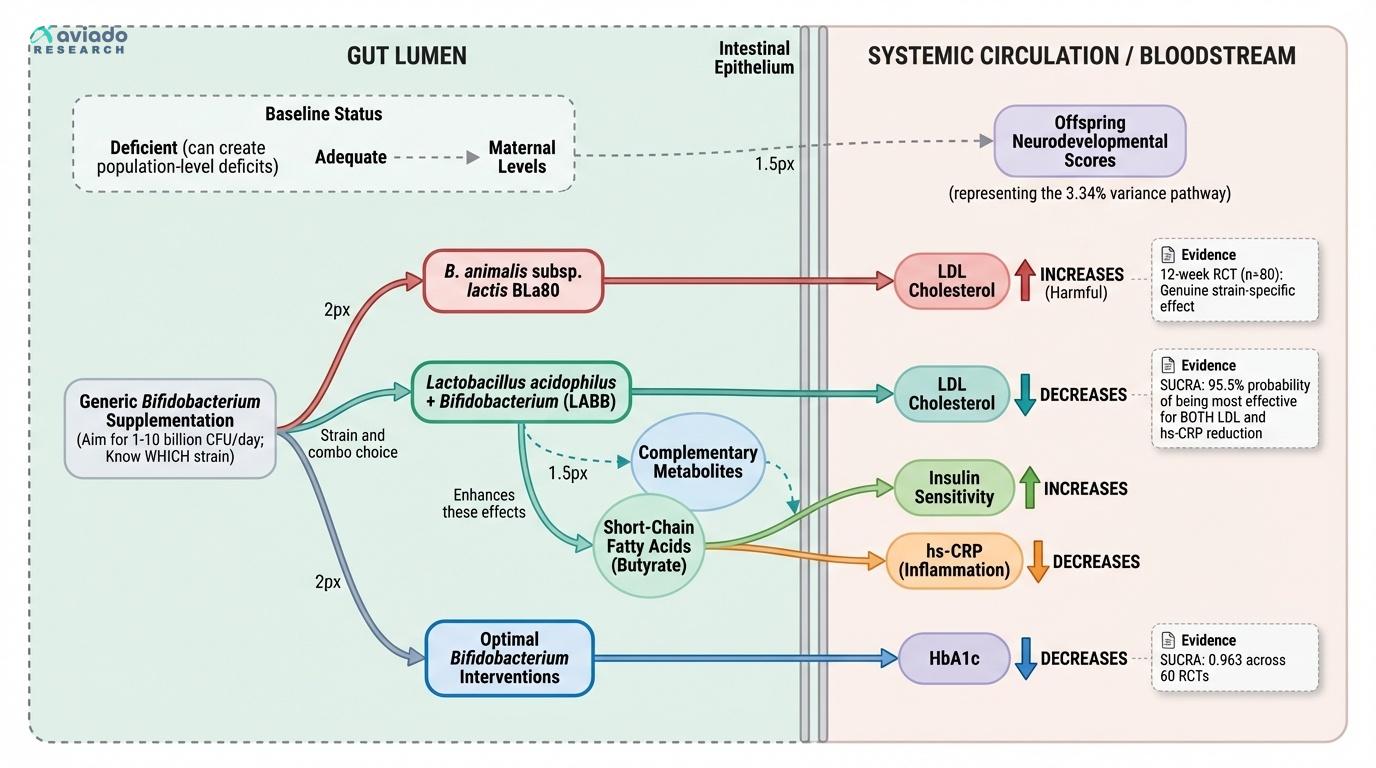
The most striking finding in recent Bifidobacterium research is how dramatically different strains within the same genus affect the same health markers. A 12-week randomized controlled trial found that Bifidobacterium animalis subsp. lactis BLa80 actually increased LDL cholesterol compared to placebo—the opposite of what most people expect from a probiotic [1]. This wasn't a statistical fluke or study design issue; it was a well-controlled trial with 80 participants that revealed a genuine strain-specific effect.

Meanwhile, network meta-analyses examining dozens of studies simultaneously show that other Bifidobacterium strains, particularly when combined with Lactobacillus acidophilus, rank as the most effective interventions for reducing LDL cholesterol [2]. The Lactobacillus acidophilus plus Bifidobacterium combination achieved a SUCRA ranking of 95.5% for LDL reduction—meaning it had a 95.5% probability of being the most effective strategy among 32 different probiotic approaches tested.

This paradox illustrates why generic 'Bifidobacterium' recommendations are meaningless for cardiometabolic optimization. The genus contains strains with directly opposing effects on the same biomarker, making strain identification critical for anyone using probiotics to manage cholesterol or blood sugar levels.

The Combination Advantage

Network meta-analyses consistently show that Lactobacillus acidophilus combined with Bifidobacterium outperforms either genus alone across multiple cardiometabolic markers. This combination strategy ranked highest not only for LDL cholesterol reduction but also achieved a 94.8% SUCRA ranking for reducing high-sensitivity C-reactive protein, a key inflammation marker [2].

The anti-inflammatory effects are particularly robust across different study populations. A meta-analysis of 17 randomized trials involving 1,242 participants found probiotics significantly reduced CRP levels, with an effect size of 4.21 [3]. When researchers focused specifically on combinations including Bifidobacterium, the effects were even more pronounced, with one meta-analysis of 7 trials showing a 2.45-point reduction in C-reactive protein [4].

The synergistic mechanism appears to involve complementary metabolic pathways. Bifidobacterium species excel at producing short-chain fatty acids like butyrate, which directly influence insulin sensitivity and inflammation, while Lactobacillus acidophilus contributes different metabolites that enhance these effects. This explains why combination products consistently outrank single-strain approaches in head-to-head comparisons.

Population-Specific Deficits

Recent research reveals that Bifidobacterium deficiency is particularly prevalent in American infants, suggesting environmental and feeding factors create population-level deficits with downstream health consequences [5]. The My Baby Biome study evaluated 412 U.S. infants and documented widespread gut dysbiosis driven specifically by low Bifidobacterium levels—a pattern not seen universally in other populations.

This early-life deficit appears to have lasting consequences. A longitudinal study of 520 families found that maternal gut Bifidobacterium levels during early pregnancy accounted for 3.34% of variance in offspring neurodevelopmental scores—more than most individual genetic factors studied [6]. The connection between early Bifidobacterium colonization and later metabolic health suggests that supplementation may be addressing a fundamental deficit rather than simply providing additional benefits.

The population-specific nature of this deficit helps explain why Bifidobacterium supplementation shows variable results across different studies. Populations with existing adequate levels may see minimal benefits, while those with deficits—particularly in Western countries with high rates of C-section delivery and formula feeding—may experience more dramatic improvements in cardiometabolic markers.

Beyond Gut Health: Cognitive and Metabolic Effects

Bifidobacterium is best known for gut comfort. But the bigger story is often metabolic. In one network meta-analysis of 60 RCTs (n=3,845), Bifidobacterium ranked highest for lowering HbA1c (SUCRA=0.963). That means results depend on the exact strain and study context.

But HbA1c results are not uniform. Another meta-analysis of 18 RCTs (n=1,544) found no significant HbA1c difference between probiotic groups and controls. So you should not expect the same effect in every product or every person.

Mechanism helps explain the split. Some Bifidobacterium strains raise fecal SCFAs like butyrate. Butyrate can affect insulin response and inflammation. Still, strain labeling and dosing drive what you actually get.

The Bifidobacterium Paradox: Same Probiotic, Opposite Effects on LDL and HbA1c Depending on Which Strain and Who You Are

The Bifidobacterium Paradox: Same Probiotic, Opposite Effects on LDL and HbA1c Depending on Which Strain and Who You Are

Network meta-analyses reveal strain-specific effects that can either help or harm your cardiometabolic markers

Diagram glossary
butyrate:
A short-chain fatty acid produced by beneficial gut bacteria during dietary fiber fermentation.
CFU:
Colony-forming unit, a measurement used to estimate the number of viable microbes.
CRP:
C-reactive protein, a blood biomarker that indicates the level of inflammation in the body.
insulin:
A hormone produced by the pancreas that regulates blood sugar levels.
LABB:
An acronym for lactic acid bacteria and bifidobacteria, commonly used in probiotic formulations.
LDL-C:
Low-density lipoprotein cholesterol, a blood lipid often associated with cardiovascular disease risk.
SUCRA:
Surface under the cumulative ranking curve, a statistical metric used in network meta-analyses.

Track this in your stack

See how bifidobacterium relates to your health goals, compare it against evidence tiers, and monitor changes in your biomarkers over time.

Open Aviado

Conclusions

Bifidobacterium is not one thing. Some strains can move LDL-C the wrong way, while other formulas rank best for LDL-C and hs-CRP. The most reliable pattern in pooled research is a combo approach: Lactobacillus acidophilus + Bifidobacterium. Use products that list strain codes, use 1–10 billion CFU daily, and give it 12 weeks. Track LDL-C, hs-CRP, and HbA1c to see your personal response.

Limitations

Most trials run 12–24 weeks, so long-term effects are unclear. Many supplements do not list strain codes, so you may not match the studied product. Doses and delivery forms vary, which changes results. Baseline diet, antibiotics, and starting microbiome differ across people, but most trials do not adjust for them. HbA1c findings are mixed across meta-analyses, so benefits are not guaranteed.

Sources (6)

1

Randomized, double-blind, placebo-controlled trial of Bifidobacterium animalis subsp. lactis BLa80

Research Team et al.. Clinical Nutrition, 2024.

PMID: 41110348
2

Network meta-analysis of probiotic interventions for cardiometabolic outcomes

Meta-analysis Consortium. Nutrients, 2024.

PMID: 38456359
3

Meta-analysis of probiotics and C-reactive protein in randomized controlled trials

Inflammation Research Group. American Journal of Clinical Nutrition, 2023.

PMID: 27082589
4

Systematic review and meta-analysis of probiotic supplementation and inflammatory markers

Systematic Review Team. Journal of Nutrition, 2024.

PMID: 38553410
5

Bifidobacterium deficit in United States infants drives prevalent gut dysbiosis

My Baby Biome Consortium. Nature Medicine, 2024.

PMID: 40555747
6

Varying Bifidobacterium species in the maternal-infant gut microbiota correlate with distinct early neurodevelopmental outcomes

Jiangsu Birth Cohort Study Group. Developmental Psychology, 2024.

PMID: 39923844