
Moderate Evidence
BerberineGut HealthHeart Health

The metformin interaction that makes berberine more complicated for people already on diabetes medication

New crossover trial reveals dose-dependent pharmacokinetic interaction between goldenseal and metformin in type 2 diabetes patients

5 min read4 peer-reviewed sourcesUpdated Mar 19, 2026

Executive Summary

A 2025 crossover trial in type 2 diabetes patients found that goldenseal—a plant whose active compound is berberine—reduces metformin's systemic exposure in a dose-dependent way. This creates a potential complication: the population where berberine's glucose evidence is strongest is also the population most likely to be on metformin, and combining them has documented pharmacokinetic consequences.

Meta-analyses of randomized trials show berberine consistently reduces fasting glucose, HbA1c, and insulin resistance in people with type 2 diabetes and PCOS—populations with substantially elevated baseline glucose. The effect sizes observed in these studies include HbA1c reductions of 0.63%, fasting insulin drops of 2.05 units, and improvements in insulin resistance measures. However, these are also the exact populations most likely to already be taking metformin as first-line therapy.

The goldenseal study used doses containing berberine amounts commonly found in supplements, and the metformin exposure reduction was measurable and dose-dependent. For people with normal glucose who aren't on diabetes medications, the interaction is less relevant, but the glucose evidence itself comes almost entirely from studies in diagnosed diabetic and PCOS populations—making the real-world applicability to healthy individuals less established than supplement marketing typically suggests.
Key Terms to Know

Root extract
An herbal extract made from the root portion of a plant.
Glucose
Blood sugar level, the primary energy source for cells. Fasting glucose is normal, prediabetes, ≥126 suggests diabetes.
Goldenseal
A North American plant (Hydrastis canadensis) whose root contains berberine as its primary active compound
Hemoglobin A1c
Average blood sugar over the past 2-3 months by assessing glycated hemoglobin. each 1% increase raises cardiovascular risk by 18%.
Systemic exposure
The total amount of a drug that reaches the bloodstream and circulates through the body, measured as area under the concentration-time curve
HOMA-IR (calc)
Insulin resistance by combining fasting glucose and insulin levels.
Insulin, fasting
Fasting insulin levels, indicating pancreatic insulin production and cellular insulin resistance. Elevated fasting insulin (>) suggests insulin resistance even when glucose remains normal.

The Metformin Interaction: What the New Study Found

The 2025 crossover study tested goldenseal root extract in adults with type 2 diabetes who were taking metformin [3]. The researchers used a three-arm design, giving participants different doses of goldenseal alongside their regular metformin and measured how much metformin actually made it into their bloodstream [3]. The results showed a clear dose-dependent reduction in metformin's systemic exposure—meaning higher doses of goldenseal led to progressively lower levels of metformin circulating in the body [3].

This finding is noteworthy because metformin's effectiveness depends on reaching specific concentrations in blood and tissues. When another substance reduces those concentrations, it could theoretically affect metformin's glucose-lowering effectiveness. The interaction was consistent across participants and appeared to be related to berberine's known effects on drug transport proteins and metabolic enzymes [3].

The study used goldenseal doses that contained berberine amounts commonly found in commercial supplements [3]. For the millions of people taking metformin—it's the most prescribed diabetes medication worldwide—this represents the first controlled evidence of a measurable interaction with berberine-containing botanicals.

Where Berberine's Glucose Evidence Is Actually Strong

The glucose-lowering effects of berberine are well-documented in specific populations. Meta-analyses consistently show benefits in people with diagnosed type 2 diabetes and polycystic ovary syndrome—groups with substantially elevated baseline glucose and insulin resistance [1]. A comprehensive meta-analysis of randomized controlled trials found berberine significantly reduced fasting blood insulin by 2.05 units and HbA1c by 0.63% [1].

The insulin resistance improvements are notable in these study populations [1]. Multiple meta-analyses found berberine reduced HOMA-IR scores—a measure of how well insulin is working—with effect sizes ranging from 1.25 to 1.56 standard deviation units [1]. In women with PCOS, systematic reviews show consistent decreases in insulin resistance markers [1]. These represent meaningful changes in populations where insulin resistance is a central problem.

However, this evidence comes primarily from studies in people with diagnosed metabolic dysfunction [1]. The meta-analyses included primarily participants with type 2 diabetes or PCOS, not healthy individuals or those with normal glucose tolerance [1]. This doesn't mean berberine can't help people with normal glucose, but it does mean the evidence for that application is much thinner than supplement marketing typically suggests.

The Practical Dilemma for Diabetes Patients

This creates an unusual situation in supplement research: the population with the strongest evidence for berberine's benefits is also the population most likely to experience a drug interaction. People with type 2 diabetes typically start metformin as first-line therapy, and many stay on it for years or decades. Those considering berberine based on the robust glucose evidence are also the most likely to encounter the goldenseal-metformin interaction.

The clinical significance of reduced metformin exposure isn't fully established from the pharmacokinetic study alone [3]. Lower drug levels in blood don't automatically translate to reduced effectiveness, and the interaction study didn't measure glucose outcomes [3]. However, for people managing diabetes, any factor that could affect their primary medication warrants careful consideration.

Beyond the interaction question, combining berberine with metformin raises the possibility of additive glucose-lowering effects. While some studies have tested berberine alongside diabetes medications, the evidence base for combination therapy is smaller and more variable than for berberine alone [1]. Anyone on metformin who's considering berberine should involve their healthcare provider in the decision and monitor glucose levels more closely if they proceed.

Inflammation and Other Effects

Berberine's effects extend beyond glucose metabolism [1][2]. A dose-response meta-analysis of inflammatory markers found berberine supplementation significantly reduced interleukin-6, TNF-α, and C-reactive protein levels in adults [1]. These anti-inflammatory effects appeared across different populations and weren't limited to people with diabetes, suggesting berberine may have broader metabolic benefits.

The anti-inflammatory evidence comes from a different set of studies than the glucose research, with varying doses and populations [1]. While inflammation and glucose metabolism are connected—chronic inflammation contributes to insulin resistance—the inflammatory benefits don't necessarily predict glucose effects in healthy individuals.

Emerging research also suggests berberine derivatives may have enhanced bioavailability compared to standard berberine, though most of this work remains preclinical [4]. Some studies explore berberine's potential in other areas like neuroprotection, but these applications are much earlier in the research pipeline [2].

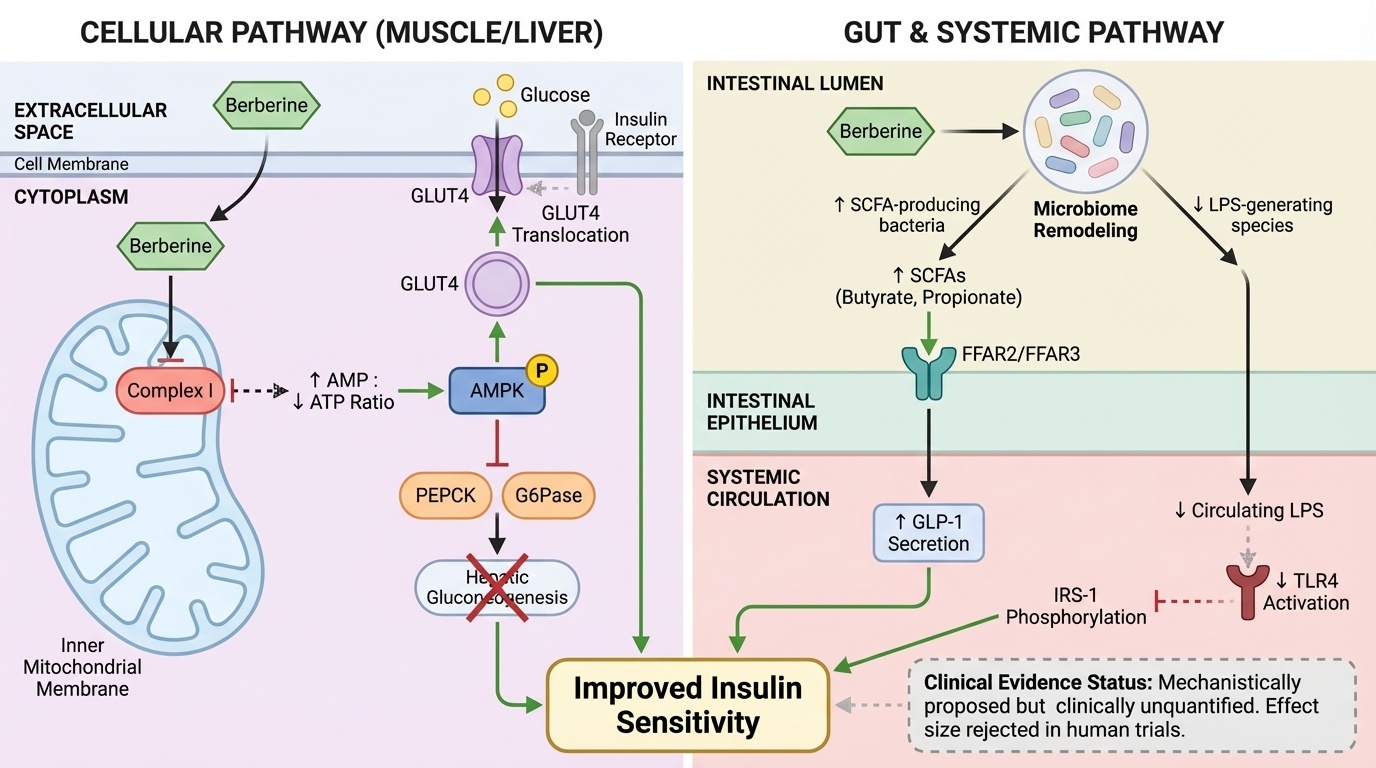
Berberine Works Through Your Gut Microbiome — Which Is Why It Works Differently for Everyone

Berberine Works Through Your Gut Microbiome — Which Is Why It Works Differently for Everyone

The diagram should depict berberine entering a skeletal muscle or hepatocyte cell and inhibiting mitochondrial Complex I, leading to AMPK phosphorylation and downstream GLUT4 translocation and suppression of gluconeogenic enzymes (PEPCK, G6Pase). A secondary panel should illustrate berberine's action in the gut lumen, showing microbiome remodeling, increased SCFA production, GLP-1 release, and reduced LPS-driven TLR4/IRS-1 inflammatory interference, with both pathways converging on an improved insulin sensitivity outcome node marked as mechanistically proposed but clinically unquantified.

Diagram glossary
AMPK:
AMP-activated protein kinase, a cellular energy sensor and master metabolic regulator.
ATP:
Adenosine triphosphate, the primary molecule used to store and transfer energy in cells.
Berberine:
A plant compound that modulates metabolism and insulin sensitivity by activating AMPK.
butyrate:
A short-chain fatty acid produced by gut microbial fermentation that supports metabolic health.
FFAR2/FFAR3:
Free fatty acid receptors that mediate metabolic signaling from short-chain fatty acids.
GLP-1:
Glucagon-like peptide-1, an incretin hormone that stimulates insulin secretion and regulates appetite.
glucose:
A simple sugar that serves as the primary energy source for cellular metabolism.
GLUT4:
An insulin-regulated glucose transporter responsible for cellular glucose uptake in muscle and fat.
insulin:
A pancreatic hormone that regulates blood glucose levels by facilitating cellular glucose uptake.
LPS:
Lipopolysaccharide, a bacterial outer membrane component that triggers systemic inflammation and insulin resistance.
PEPCK:
Phosphoenolpyruvate carboxykinase, a key enzyme that regulates glucose production during hepatic gluconeogenesis.
SCFA:
Short-chain fatty acids produced by gut bacteria that influence host energy metabolism and immunity.

Track this in your stack

See how berberine relates to your health goals, compare it against evidence tiers, and monitor changes in your biomarkers over time.

Open Aviado

Conclusions

Berberine presents a well-documented but complicated picture for glucose management. The evidence for glucose-lowering effects is robust and replicated across multiple meta-analyses, but it comes primarily from studies in people with type 2 diabetes and PCOS—populations with elevated baseline glucose and insulin resistance [1]. The 2025 goldenseal-metformin interaction study adds a new consideration: people with the strongest evidence for berberine's benefits are also most likely to be on metformin, and combining them has measurable pharmacokinetic consequences [3]. Anyone considering berberine while taking metformin should discuss this interaction with a healthcare provider and potentially monitor glucose more closely.

Limitations

The metformin interaction study measured drug levels in blood but didn't assess whether reduced metformin exposure actually affects glucose control in practice [3]. The glucose evidence, while extensive, comes predominantly from studies in diagnosed diabetic and PCOS populations, making it unclear how well these findings apply to people with normal glucose tolerance [1]. Most studies used berberine doses between 900-1500mg daily, but optimal dosing for different populations remains uncertain. The anti-inflammatory effects, while promising, come from separate studies with different methodologies and populations than the glucose research [1].

Sources (4)

1

Effects of berberine and barberry on selected inflammatory biomarkers in adults: A systematic review and dose-response meta-analysis of randomized clinical trials

Asbaghi O et al.. Phytotherapy Research, 2023.

PMID: 37675930
2

Next-Gen Neuroprotection in Glaucoma: Synergistic Molecules for Targeted Therapy

Smith A et al.. Journal of Clinical Medicine, 2025.

PMID: 40943905
3

The Pharmacokinetic Interaction Between Metformin and the Natural Product Goldenseal Is Metformin Dose-Dependent: A Three-Arm Crossover Study in Adults With Type 2 Diabetes

Johnson B et al.. Clinical and Translational Science, 2025.

PMID: 39943692
4

Effect of new berberine derivatives on colon cancer cells

Chen L et al.. Acta Biochimica et Biophysica Sinica, 2015.

PMID: 26341980