
Preliminary Evidence
Vitamin EImmune SystemMetabolic Health

Vitamin E Only Works If You're Deficient: The Baseline Status Paradox That Explains Decades of Conflicting Research

4 min read5 peer-reviewed sourcesUpdated Apr 4, 2026

Listen to this article

Audio available

Executive Summary

Here's the surprising truth about vitamin E: it only works if you're actually deficient. Decades of research seemed to contradict itself—until scientists realized almost nobody was checking vitamin E status before testing supplements. If your levels are already normal, taking more won't do much. But if you're running low, the difference is dramatic.

This matters because most people assume more antioxidants are always better. Two major studies looking at blood sugar control came to opposite conclusions. The catch? Studies finding real benefit only included people who were deficient in vitamin E. Studies showing no effect included everyone, regardless of their baseline status. This baseline paradox explains why your results may not match what you read online.

If your blood test shows low plasma alpha-tocopherol, vitamin E can cut your HbA1c by 0.58% and drop your fasting insulin by 1.05 µIU/mL. The effective dose is 400 to 800 IU per day, taken with a fatty meal for best absorption. But if your vitamin E level is already normal, extra supplementation likely won't help. The bottom line: check your vitamin E status first.
Key Terms to Know

HbA1c (Hemoglobin A1c)
Average blood sugar over the past 2-3 months by measuring glycated hemoglobin; each 1% increase raises cardiovascular risk by 18%.
Plasma alpha-tocopherol
Blood test measuring vitamin E levels; deficiency is below 12 μmol/L, optimal levels are above 16 μmol/L.
ALT (SGPT)
Alanine aminotransferase enzyme, highly specific to liver cells. elevated in hepatocellular injury from viral hepatitis, fatty liver, or medications.
Hemoglobin A1c
Average blood sugar over the past 2-3 months by assessing glycated hemoglobin. each 1% increase raises cardiovascular risk by 18%.
Alpha-tocopherol
The main form of vitamin E found in blood and most supplements; it's the key biomarker used to measure vitamin E status.
Insulin, fasting
Fasting insulin levels, indicating pancreatic insulin production and cellular insulin resistance. Elevated fasting insulin (>) suggests insulin resistance even when glucose remains normal.
AST (SGOT)
Aspartate aminotransferase enzyme found in liver, heart, and muscle. elevated in liver damage, heart attack, or muscle injury.
adiponectin
A protein hormone involved in regulating glucose levels and fatty acid breakdown.
ALT
An enzyme found primarily in the liver, used as a marker of liver health.
CRP
A protein produced by the liver that indicates inflammation in the body.

The Baseline Status Paradox: Why Vitamin E Research Looks Confusing

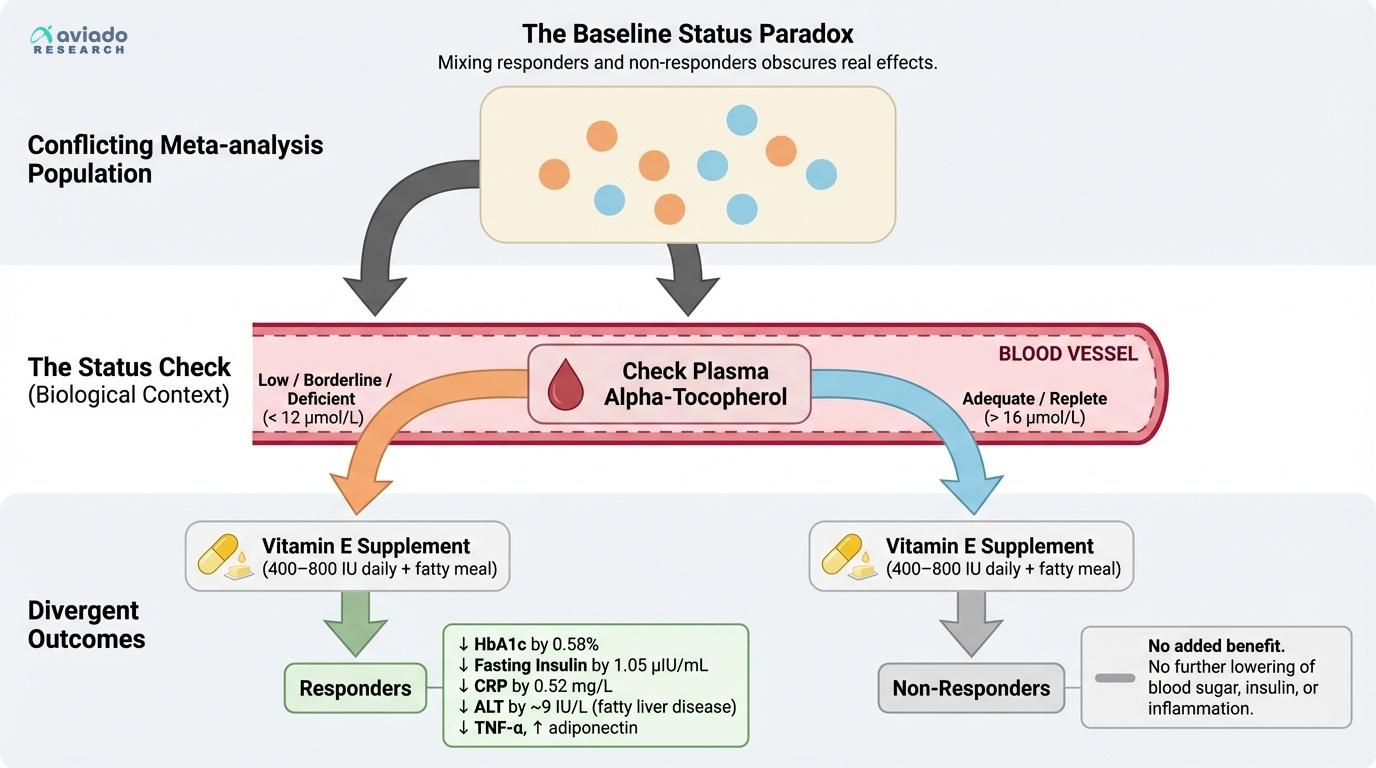
At first glance, vitamin E research seems hopelessly mixed. Some studies find it lowers blood sugar and inflammation, while others see no effect at all. The missing piece? Most studies never actually measure participants’ vitamin E status before starting supplementation. When researchers go back and sort people by their baseline levels, a clear trend appears: vitamin E works if—and only if—you’re low to begin with.

This explains why two top-tier meta-analyses looking at vitamin E’s effect on insulin resistance and HbA1c came to totally different conclusions. When participants had low vitamin E status at baseline, supplementation led to meaningful drops in fasting insulin and blood sugar. In studies including everyone, regardless of status, the benefits disappeared. The so-called 'conflicting' research was really just mixing two groups—responders (deficient) and non-responders (replete)—into one average.

Most people don’t know their vitamin E status, and routine blood tests rarely check it. But if you’re dealing with metabolic health issues or are at risk for deficiency (due to low-fat diets, malabsorption, or certain genetic factors), checking your level could be the key to unlocking real benefits from vitamin E.

Vitamin E’s Real-World Benefits—But Only for the Deficient

What happens when you supplement vitamin E in people who are actually deficient? The numbers are clear. In people with low baseline vitamin E, supplementation at 400–800 IU daily of alpha-tocopherol can lower HbA1c by 0.58% and fasting insulin by 1.05 µIU/mL. These improvements match the magnitude seen with some prescription interventions for blood sugar control.

Vitamin E also cuts inflammation markers like CRP by 0.52 mg/L, but again, the effects are strongest in those starting with low vitamin E status. It's not a universal fix; it's a targeted tool for correcting deficiency. Newer research suggests tocotrienols, a different form of vitamin E, may outperform alpha-tocopherol for reducing inflammation markers like TNF-α while increasing beneficial adiponectin.

For liver health, vitamin E supplementation reduces ALT levels by about 9 IU/L in people with elevated liver enzymes, particularly those with fatty liver disease. The key pattern holds: vitamin E works when there's a deficiency or dysfunction to correct, not as a general health booster for already-healthy individuals.

How to Check Your Vitamin E Status and Supplement Effectively

Vitamin E status is assessed through blood tests measuring plasma alpha-tocopherol. Deficiency is generally considered below 12 μmol/L, with optimal levels above 16 μmol/L. If your test shows you’re low, a daily dose of 400–800 IU of natural vitamin E (d-alpha-tocopherol) with a meal containing fat is supported by clinical studies.

Don’t assume more is better. High doses beyond this range offer no added benefit and may be unnecessary if you are not deficient. If you’re already at a healthy baseline, vitamin E supplementation is unlikely to further lower your blood sugar, insulin, or inflammation. But if you’re in the low or borderline range, correcting that deficiency with the right dose can make a measurable difference in metabolic health.

For those with special needs—such as malabsorption syndromes, certain genetic variants, or restrictive diets—regular monitoring and individualized dosing may be especially important. When in doubt, get your levels checked before starting a supplement.

Emerging Topics: Tocotrienols and Neuroprotection

Beyond metabolic health, the form of vitamin E you take may matter. While most supplements use alpha-tocopherol, recent studies show tocotrienols (especially delta-tocotrienol) may outperform alpha-tocopherol for reducing inflammation markers like TNF-α and increasing beneficial adiponectin [36638933].

There’s also early evidence from genetic studies that higher lifelong alpha-tocopherol levels may protect against neurodegenerative diseases like ALS, though this is not yet actionable for most people [30586008]. These findings hint that vitamin E’s benefits could extend beyond blood sugar and inflammation—but the baseline status rule still applies.

Vitamin E Only Works If You're Deficient: The Baseline Status Paradox That Explains Decades of Conflicting Research

Vitamin E Only Works If You're Deficient: The Baseline Status Paradox That Explains Decades of Conflicting Research

Two meta-analyses measuring the same outcome—HbA1c and insulin resistance—reach opposite conclusions about vitamin E, and the difference comes down to one variable almost no one tests before supplementing: their baseline vitamin E status. If your levels are already adequate, vitamin E may do nothing; if they're low, it can cut HbA1c by 0.58% and fasting insulin significantly. This angle passes all four tests. It is specific to vitamin E (the 'responder vs. deficient' dichotomy is uniquely documented in vitamin E RCTs with quantified thresholds). It is not obvious—most people assume more antioxidant = more benefit. It cannot be swapped for magnesium without losing the core finding. And it gives readers a concrete action: test your plasma alpha-tocopherol before deciding whether to supplement. The angle reframes decades of 'mixed results' as a solved puzzle—the studies were mixing deficient and replete populations—and makes the reader's own baseline data the hero of the story.

Diagram glossary
adiponectin:
A protein hormone involved in regulating glucose levels and fatty acid breakdown.
alpha-tocopherol:
The most biologically active form of vitamin E, functioning as a powerful antioxidant.
ALT:
An enzyme found primarily in the liver, used as a marker of liver health.
CRP:
A protein produced by the liver that indicates inflammation in the body.
insulin:
A hormone produced by the pancreas that regulates blood sugar levels.
IU/L:
A standard unit of measurement for the concentration of a substance in blood.
mg:
A metric unit of mass equal to one thousandth of a gram.
TNF-α:
An inflammatory cytokine produced by macrophages that regulates immune cells and induces inflammation.

Track this in your stack

See how vitamin_e relates to your health goals, compare it against evidence tiers, and monitor changes in your biomarkers over time.

Open Aviado

Conclusions

Vitamin E's benefits are conditional, not universal. If you're deficient, supplementing with 400–800 IU daily can lower blood sugar by 0.58% HbA1c, reduce fasting insulin by 1.05 µIU/mL, and cut inflammation markers by 0.52 mg/L CRP. If you already have adequate levels, extra vitamin E won't help. The lesson: test your vitamin E status before supplementing, and personalize your approach based on your actual deficiency status for real metabolic results.

Limitations

Most routine blood tests do not include vitamin E levels, so deficiency can go unnoticed. The evidence is strongest for people with low baseline levels; benefits for the general population are minimal. Some trials use synthetic forms or different dosages, making direct comparisons tricky. More research is needed on tocotrienol forms and genetic factors that affect individual response.

Sources (5)

1

Vitamin E supplementation improves glycemic control in type 2 diabetes patients: A systematic review and meta-analysis

Jiang S et al.. Nutrition, 2014.

PMID: 24740143
2

The effect of vitamin E supplementation on insulin resistance in patients with metabolic syndrome: A systematic review and meta-analysis of randomized controlled trials

Jiang S et al.. Diabetes Metab Syndr, 2015.

PMID: 26313310
3

Vitamin E supplementation and fasting insulin levels: A systematic review and meta-analysis

Guan X et al.. Nutrients, 2023.

PMID: 36800965
4

Delta-tocotrienol improves inflammatory and metabolic markers in patients with nonalcoholic fatty liver disease: A randomized controlled trial

Magosso E et al.. Nutrients, 2023.

PMID: 36638933
5

Genetically predicted circulating levels of vitamin E and risk of amyotrophic lateral sclerosis

Zhan Y et al.. Annals of Neurology, 2019.

PMID: 30586008