
What the Curcumin Evidence Actually Measures — and Which Populations It Applies To

Most curcumin research enrolled people with metabolic dysfunction, not healthy adults seeking optimization

4 min read6 peer-reviewed sourcesUpdated Mar 18, 2026

Executive Summary

Multiple curcumin meta-analyses show measurable effects on liver enzymes, blood pressure, and oxidative stress markers. The studies predominantly enrolled people with metabolic disease, NAFLD, or diabetes rather than healthy adults. When researchers analyzed curcumin trials across different health conditions, benefits appeared in people who already had elevated liver enzymes, insulin resistance, or other markers of metabolic dysfunction.

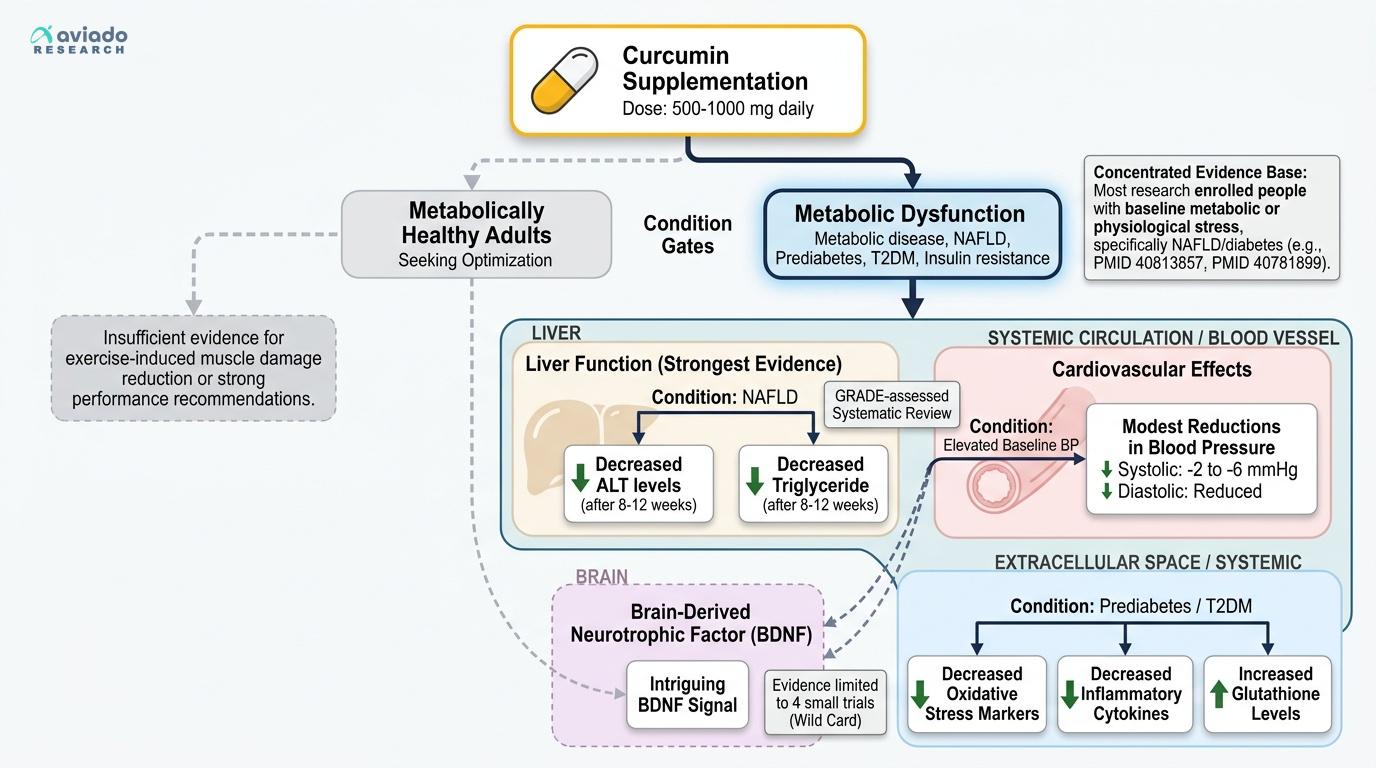
The research suggests curcumin's most robust effects occur in people with nonalcoholic fatty liver disease, where doses of 500-1000 mg daily showed improvements in liver enzymes. For blood pressure, the benefits were modest but measurable in people with elevated baseline readings. There's also an intriguing signal for brain-derived neurotrophic factor that appears across different populations, though this comes from just four small trials. The evidence is concentrated in specific populations with baseline dysfunction rather than metabolically healthy adults seeking optimization.
Key Terms to Know

NAFLD
Nonalcoholic fatty liver disease - a condition where fat builds up in the liver without alcohol being the cause, often linked to metabolic dysfunction
GRADE assessment
A systematic method for rating the quality of evidence in medical research, from very low to high confidence
BDNF
A protein that supports neuron growth and survival, often called 'fertilizer for the brain.' Higher levels associated with better memory and mood.
Curcuminoids
The active compounds in turmeric root, with curcumin being the most studied and abundant form
SMD
Standardized mean difference - a statistical measure used in meta-analyses to compare results across studies with different measurement scales
Dose-response
The relationship between different amounts of a substance and the size of the effect it produces
ALT (SGPT)
Alanine aminotransferase enzyme, highly specific to liver cells. elevated in hepatocellular injury from viral hepatitis, fatty liver, or medications.
ALT
A liver enzyme whose elevated levels indicate liver damage or metabolic dysfunction.
insulin
A hormone regulating blood sugar, whose resistance is a marker of metabolic dysfunction.
mmHg
Millimeters of mercury, a standard unit of measurement for blood pressure.

The Population Pattern Hidden in Plain Sight

The curcumin research predominantly enrolled people with metabolic dysfunction, liver disease, or diabetes rather than healthy adults seeking optimization. A systematic review of curcumin's effects on inflammation and oxidative stress specifically analyzed trials in people with prediabetes and type 2 diabetes [5]. These populations showed significant improvements in inflammatory markers and antioxidant status. Similarly, the liver enzyme research focused on patients with nonalcoholic fatty liver disease [2].

Even in athletic populations, where you might expect to see performance or recovery benefits in healthy individuals, a systematic review concluded that the evidence for curcumin reducing exercise-induced muscle damage remains insufficient to make strong recommendations [1]. The current evidence suggests that curcumin's measurable benefits appear in populations with existing metabolic or physiological stress rather than in metabolically healthy adults.

Liver Function: The Strongest Evidence Base

The most robust curcumin evidence comes from studies in people with nonalcoholic fatty liver disease. A GRADE-assessed systematic review of randomized controlled trials found that curcumin supplementation significantly reduced ALT levels in NAFLD patients [2]. The effective doses in these studies ranged from 500-1000 mg daily, with benefits becoming apparent after 8-12 weeks of supplementation [2].

A broader meta-analysis examining curcumin's effects on liver function across different adult populations confirmed these liver enzyme improvements, with effects appearing in people with elevated baseline levels [4]. The liver enzyme reductions occurred in people who started with elevated levels due to fatty liver disease [2][4].

The liver research also demonstrates curcumin's effects on related metabolic markers. In people with NAFLD, curcumin supplementation showed improvements in triglyceride levels and other lipid parameters [2][4].

Blood Pressure and Metabolic Effects: Modest but Measurable

A systematic review and dose-response meta-analysis found that curcumin supplementation produced modest but measurable reductions in both systolic and diastolic blood pressure [3]. The blood pressure benefits were most apparent in people with elevated baseline readings rather than those with optimal blood pressure [3]. The meta-analysis showed dose-dependent effects, with higher doses producing greater reductions, but the absolute changes were relatively small - typically 2-6 mmHg reductions in systolic pressure [3].

For metabolic markers, the evidence is strongest in people with prediabetes and type 2 diabetes. A comprehensive meta-analysis of 28 randomized controlled trials found significant improvements in oxidative stress markers and inflammatory indicators in these populations [5]. The research showed increased glutathione levels and reduced inflammatory cytokines in people with baseline metabolic dysfunction [5].

The metabolic research also revealed improvements in triglyceride levels, with multiple meta-analyses showing reductions of 12-21 mg/dL in various populations with elevated baseline levels [4][5]. These triglyceride improvements were most consistent in people with NAFLD, diabetes, or metabolic syndrome [4][5].

The BDNF Signal: A Neurological Wild Card

A meta-analysis of four randomized controlled trials found that short-term curcumin supplementation significantly increased serum BDNF levels in both men and women [6]. This BDNF increase represents nearly a 1,800 pg/mL rise in serum levels [6].

Unlike the liver and metabolic findings, this effect appeared across different populations rather than being limited to people with specific baseline dysfunction [6]. However, the BDNF evidence base comes from just four trials [6]. While the signal is intriguing and suggests potential neurological benefits, the limited number of studies means this remains more of a promising signal than established evidence [6].

The BDNF finding represents the clearest example of curcumin potentially benefiting people without baseline dysfunction, making it relevant for healthy adults considering supplementation. But given the small number of studies, this evidence base is much smaller than the metabolic research [6].

What the Curcumin Evidence Actually Measures — and Which Populations It Applies To

What the Curcumin Evidence Actually Measures — and Which Populations It Applies To

Most curcumin research enrolled people with metabolic dysfunction, not healthy adults seeking optimization

Diagram glossary
ALT:
A liver enzyme whose elevated levels indicate liver damage or metabolic dysfunction.
BDNF:
Brain-derived neurotrophic factor, a protein promoting the survival and growth of neurons.
insulin:
A hormone regulating blood sugar, whose resistance is a marker of metabolic dysfunction.
mmHg:
Millimeters of mercury, a standard unit of measurement for blood pressure.
NAFLD/diabetes:
Co-occurring nonalcoholic fatty liver disease and metabolic blood sugar dysregulation.
prediabetes:
A condition with elevated blood sugar levels preceding a formal type 2 diabetes diagnosis.
T2DM:
Type 2 diabetes mellitus, a chronic condition characterized by insulin resistance and high blood sugar.
triglyceride:
A type of lipid found in the blood, often elevated in metabolic dysfunction.

Track this in your stack

See how curcumin relates to your health goals, compare it against evidence tiers, and monitor changes in your biomarkers over time.

Open Aviado

Conclusions

The curcumin research shows benefits in people with metabolic dysfunction, liver disease, or diabetes. The liver enzyme improvements in NAFLD patients represent the most robust evidence base [2][4], followed by modest blood pressure reductions in people with elevated baseline readings [3]. The BDNF signal offers potential benefit for healthy populations, but comes from a much smaller evidence base [6]. The current trials predominantly studied populations with baseline dysfunction rather than metabolically healthy adults.

Limitations

Most curcumin trials studied populations with metabolic dysfunction rather than healthy adults [1][2][3][4][5]. Most trials lasted 8-16 weeks, so long-term effects remain unclear [2][3][4][5][6]. The BDNF findings, while promising, come from only four small studies [6]. The research doesn't provide systematic guidance on optimal dosing across different populations or health goals.

Sources (6)

1

Evaluation of curcumin intake in reducing exercise-induced muscle damage in athletes: a systematic review

Fernandez-Lazaro D et al.. Nutrients, 2024.

PMID: 39623590
2

Curcumin supplementation effect on liver enzymes in patients with nonalcoholic fatty liver disease: a GRADE-assessed systematic review and dose-response meta-analysis of randomized controlled trials

Jalili C et al.. Nutrition Reviews, 2024.

PMID: 38213188
3

Effects of curcumin on blood pressure: A systematic review and dose-response meta-analysis

Asbaghi O et al.. Nutrition, Metabolism and Cardiovascular Diseases, 2023.

PMID: 37567790
4

Effects of curcumin/turmeric supplementation on liver function in adults: A GRADE-assessed systematic review and dose-response meta-analysis of randomized controlled trials

Jalili C et al.. Complementary Therapies in Medicine, 2023.

PMID: 37178581
5

Efficacy of curcumin/turmeric on inflammation and oxidative stress in prediabetes and type 2 diabetes: a systematic review and dose-response meta-analysis

Ghorbani Z et al.. Inflammopharmacology, 2024.

PMID: 41240262
6

Short-term curcumin supplementation enhances serum brain-derived neurotrophic factor in adult men and women: a systematic review and dose-response meta-analysis of randomized controlled trials

Zeinali M et al.. Nutrition Research, 2019.

PMID: 31279955