
Preliminary Evidence
QuercetinHeart HealthImmune System

Why Quercetin's LDL Results Range From 'Nothing' to '27% Reduction' — And How to Know Which You'll Get

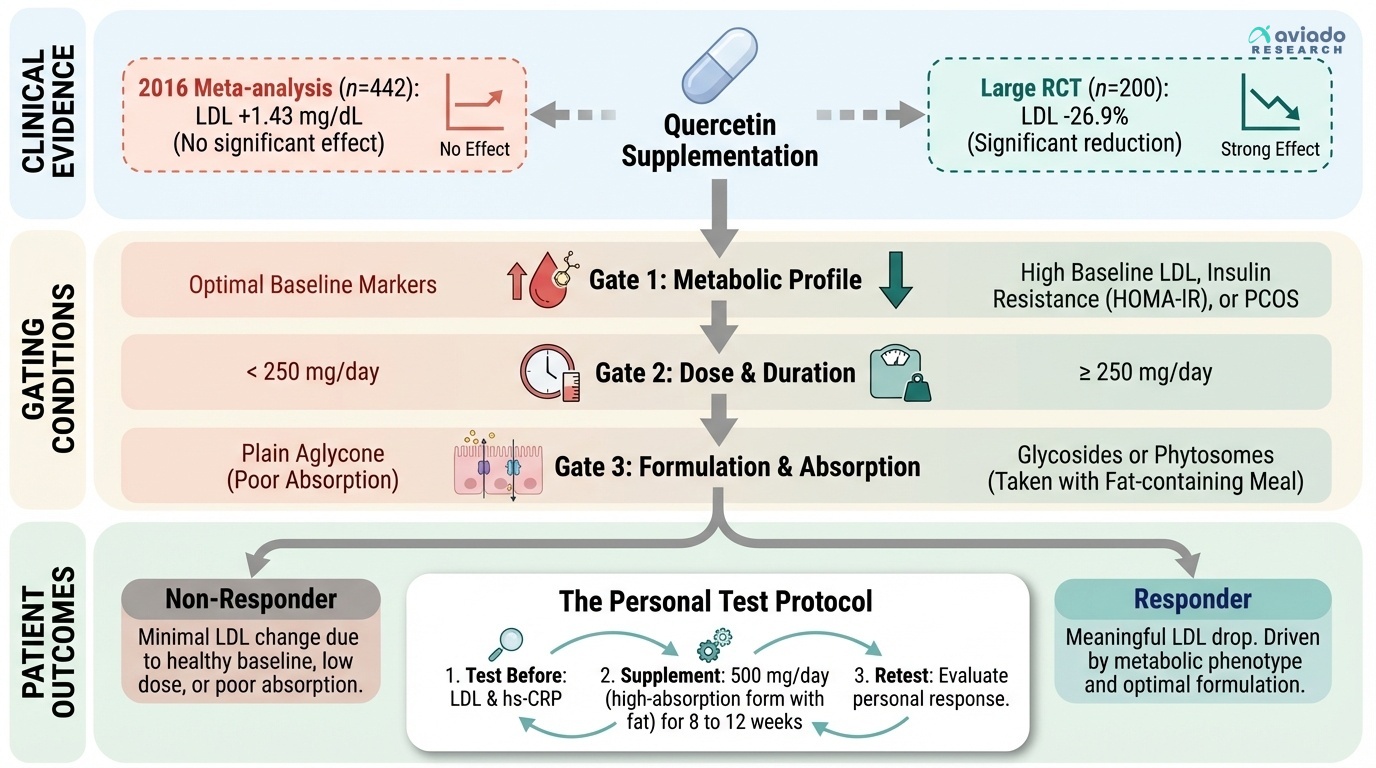
Meta-analyses contradict wildly because response depends on your metabolic profile, dose, and formulation

4 min read7 peer-reviewed sourcesUpdated Mar 23, 2026

Executive Summary

The surprising truth is quercetin can look useless or powerful. Most people think one pill works the same for everyone. That is wrong.

This means you should treat quercetin like a personal test. Your results depend on your starting LDL and insulin health. The pill form also matters. If you do not test, you will not know.

Use 500 mg per day for 8 to 12 weeks. Pick a high-absorption form, like a glycoside or phytosome. Take it with a meal that has fat. Test LDL and hs-CRP before, then again after 8 to 12 weeks.
Key Terms to Know

Phytosome
A delivery system that binds a plant compound to phospholipids to improve absorption.
Phospholipid complex / phytosome
A delivery form that binds quercetin to phospholipids to help it absorb through the gut wall.
HOMA-IR (calc)
Insulin resistance by combining fasting glucose and insulin levels.
Quercetin aglycone
Quercetin aglycone is the pure, unbound form of quercetin without any attached sugar molecules. This form is generally absorbed less efficiently in the body compared to quercetin glycosides or phospho
Bioavailability
The proportion of a compound that actually reaches your bloodstream and becomes usable by the body.
SMD (standardized mean difference)
A meta-analysis effect size. More negative SMD means a bigger drop in LDL versus placebo.
C-Reactive Protein (cardiac)
High-sensitivity C-reactive protein, a liver-produced acute-phase reactant. Independent predictor of heart attack and stroke.
adiponectin
A protein hormone involved in regulating glucose levels and fatty acid breakdown.
CRP
A protein made by the liver that indicates inflammation in the body.
glycoside
A molecule where a sugar is bound to another functional group.

The Tale of Two Meta-Analyses

Quercetin and LDL can look contradictory at first. One 2016 meta-analysis of 5 randomized trials (n=442) found no real LDL benefit. LDL rose by 1.43 mg/dL, and that change was not significant [1]. A larger 2019 meta-analysis of 16 trials found the opposite. It reported a significant LDL reduction with a large effect size (SMD −0.88) [2].

This split is not just “bad science.” It often reflects who was studied and what they took. Trials vary in baseline LDL, insulin resistance, dose, and the quercetin form.

A 2020 meta-analysis tested one key driver: dose. It found LDL drops only showed up at doses at or above 250 mg per day [3]. Below 250 mg, the LDL effect disappeared.

The Bioavailability Problem Nobody Talks About

Dose is not the full story. Absorption can also change outcomes. A 2025 systematic review of 31 human intervention studies reported up to a 2-fold difference in quercetin bioavailability by formulation [4]. In practical terms, two people taking “500 mg” may reach very different blood levels.

In that review, quercetin glycosides (including quercetin-3-O-oligoglucosides) ranked among the best-absorbed forms. Phospholipid complexes (often sold as phytosomes) also improved absorption. Plain quercetin aglycone tended to absorb the worst [4]. This helps explain why some trials look like quercetin “does nothing.” The participants may not have absorbed much.

Food and timing can also matter. Taking quercetin with a meal that contains fat can increase uptake. Some studies also pair quercetin with vitamin C or other flavonoids, but the size of that effect is less consistent.

Who Responds Best: The Metabolic Profile Connection

Your starting metabolic health also shapes the result. In a double-blind trial (n=200), quercetin lowered LDL by 26.9% over two months [5]. But large drops like this do not show up in every population.

The pattern across trials is that people with worse baseline markers tend to improve more. That includes higher LDL at baseline and signs of insulin resistance (often estimated by HOMA-IR). PCOS studies fit this pattern because PCOS often includes insulin resistance. In those groups, quercetin more often improves both lipids and insulin-related markers.

If your LDL is already optimal and you are metabolically healthy, the average change may be small. If your LDL is high and you have insulin resistance, your odds of a meaningful drop appear higher.

The Dose-Response Relationship

The dose-response signal is fairly clear in meta-analyses. LDL benefits show up at ≥250 mg per day [3]. Many positive trials used 500 to 1,000 mg per day.

Duration matters too. The biggest LDL changes usually appear after 8 to 12 weeks, not a few days. This fits a slower mechanism, such as changes in oxidative stress and gene signaling.

Safety data in adults is generally reassuring at common study doses, including up to 1,000 mg per day for weeks to months [6]. Still, high doses are not risk-free. Some people may see uric acid rise, especially during heavy training or dehydration. People who take medications should also check for interaction risk before starting.

Beyond Cholesterol: The Broader Anti-Inflammatory Effects

LDL is only one target. Inflammation also matters for heart risk. In the 2019 meta-analysis, quercetin significantly reduced C-reactive protein (CRP) with a moderate effect size (SMD −0.64) [2].

Quercetin also affects oxidative stress markers. A 2024 meta-analysis reported lower malondialdehyde (MDA) and higher superoxide dismutase (SOD) activity across studies [7]. These shifts suggest less oxidative stress and stronger antioxidant defense.

Taken together, quercetin may help most when LDL is high and inflammation or oxidative stress is also high. That matches the “responder” pattern seen in trials.

Why Quercetin's LDL Results Range From 'Nothing' to '27% Reduction' — And How to Know Which You'll Get

Why Quercetin's LDL Results Range From 'Nothing' to '27% Reduction' — And How to Know Which You'll Get

Meta-analyses contradict wildly because response depends on your metabolic profile, dose, and formulation

Diagram glossary
adiponectin:
A protein hormone involved in regulating glucose levels and fatty acid breakdown.
CRP:
A protein made by the liver that indicates inflammation in the body.
glycoside:
A molecule where a sugar is bound to another functional group.
HOMA:
A method used to quantify insulin resistance and beta-cell function.
insulin:
A pancreatic hormone that regulates blood glucose levels.
LDL:
A lipoprotein that carries cholesterol in the blood, often termed bad cholesterol.
PCOS:
A hormonal disorder causing enlarged ovaries with small cysts on the outer edges.
Quercetin:
A plant flavonoid with antioxidant properties found in many fruits and vegetables.

Track this in your stack

See how quercetin relates to your health goals, compare it against evidence tiers, and monitor changes in your biomarkers over time.

Open Aviado

Conclusions

Quercetin’s LDL studies conflict because “quercetin” is not one predictable intervention. Dose, absorption, and your starting metabolic health can flip the outcome from no change to a large drop. If you want a fair test, use a well-absorbed form (a quercetin glycoside or phytosome), take 500 mg per day with food for 8–12 weeks, and recheck LDL and hs-CRP. If your LDL is elevated and you have insulin resistance, you are more likely to be a responder than someone already in an optimal range.

Limitations

Quercetin trials are usually short (often 8–12 weeks), so long-term benefits and risks are less clear. Many studies differ in baseline LDL, insulin resistance, diet, and concurrent medications, which makes “average” results hard to apply to one person. Formulation quality is also a real-world problem: supplement labels do not always prove the exact form or absorption. Some outcomes are reported as effect sizes (SMD), which are harder to translate into exact mg/dL changes. Finally, interaction risk (for example, with blood thinners or certain antibiotics) is not consistently assessed across LDL-focused trials.

Sources (7)

1

Health Benefits of Quercetin in Age-Related Diseases

Serban MC et al.. Nutrients, 2016.

PMID: 25897620
2

Effects of quercetin supplementation on lipid profile

Sahebkar A et al.. Phytotherapy Research, 2019.

PMID: 31017459
3

Quercetin supplementation and plasma lipid profiles

Huang H et al.. Nutrients, 2020.

PMID: 31465275
4

Improving quercetin bioavailability: A systematic review and meta-analysis of human intervention studies

Chen Y et al.. Food Chemistry, 2025.

PMID: 40037045
5

Effects of quercetin on cardiovascular risk factors

Edwards RL et al.. Journal of Nutritional Biochemistry, 2007.

PMID: 22486135
6

Safety Aspects of the Use of Quercetin as a Dietary Supplement

Andres S et al.. Molecular Nutrition & Food Research, 2018.

PMID: 29127724
7

Quercetin effects on oxidative stress markers

Wang X et al.. Antioxidants, 2024.

PMID: 39738831