
Why Your Iron Supplement Dose May Not Matter—But Your Hepcidin Level Does

How your body's iron gatekeeper determines whether any dose works at all

4 min read5 peer-reviewed sourcesUpdated Mar 23, 2026

Executive Summary

A surprising finding shows iron dose is not the main issue. Many people take 100–200 mg daily. They think more iron works better. But trials in pregnancy found ≤60 mg works the same.

This means you should not chase bigger doses. Your body may block iron first. A hormone called hepcidin can shut the iron “gate.” If your hepcidin is high, you absorb little iron. Then even high doses may not help you.

Start with 60 mg elemental iron once daily. Recheck labs in 8–12 weeks. Track serum iron and transferrin saturation. Not ferritin alone. If numbers do not rise, ask about inflammation tests. Check CRP or IL-6. You may need to treat inflammation or use IV iron.
Key Terms to Know

IL-6 (Interleukin-6)
An inflammation signal that can raise hepcidin. It is a cytokine, not an iron product name.
Hepcidin
A liver hormone that can block iron from entering your blood by shutting down iron transport.
Elemental iron
The usable iron amount on the label (not the pill’s total weight). Example: 325 mg ferrous sulfate has about 65 mg elemental iron.
Serum iron
A blood test for iron moving in your blood right now. It can change fast.
Ferritin
Ferritin, the primary iron storage protein reflecting total body iron stores.
TIBC (Total Iron Binding Capacity)
A blood test that helps interpret TSAT and serum iron. It often rises when iron is low.
CRP (C-reactive protein)
A common inflammation blood test. Higher CRP often means higher hepcidin and lower iron absorption.
CRP
A blood test marker used to detect and measure inflammation in the body.
ferroportin
The primary iron exporter protein located in the gut and storage cells.
IL-6
A marker of inflammation that can be tested if iron levels do not rise.

The Dose Equivalence Discovery

For decades, iron advice was simple: take more. Many plans use 100–200 mg of elemental iron daily. But an unexpected result showed this is not always better.

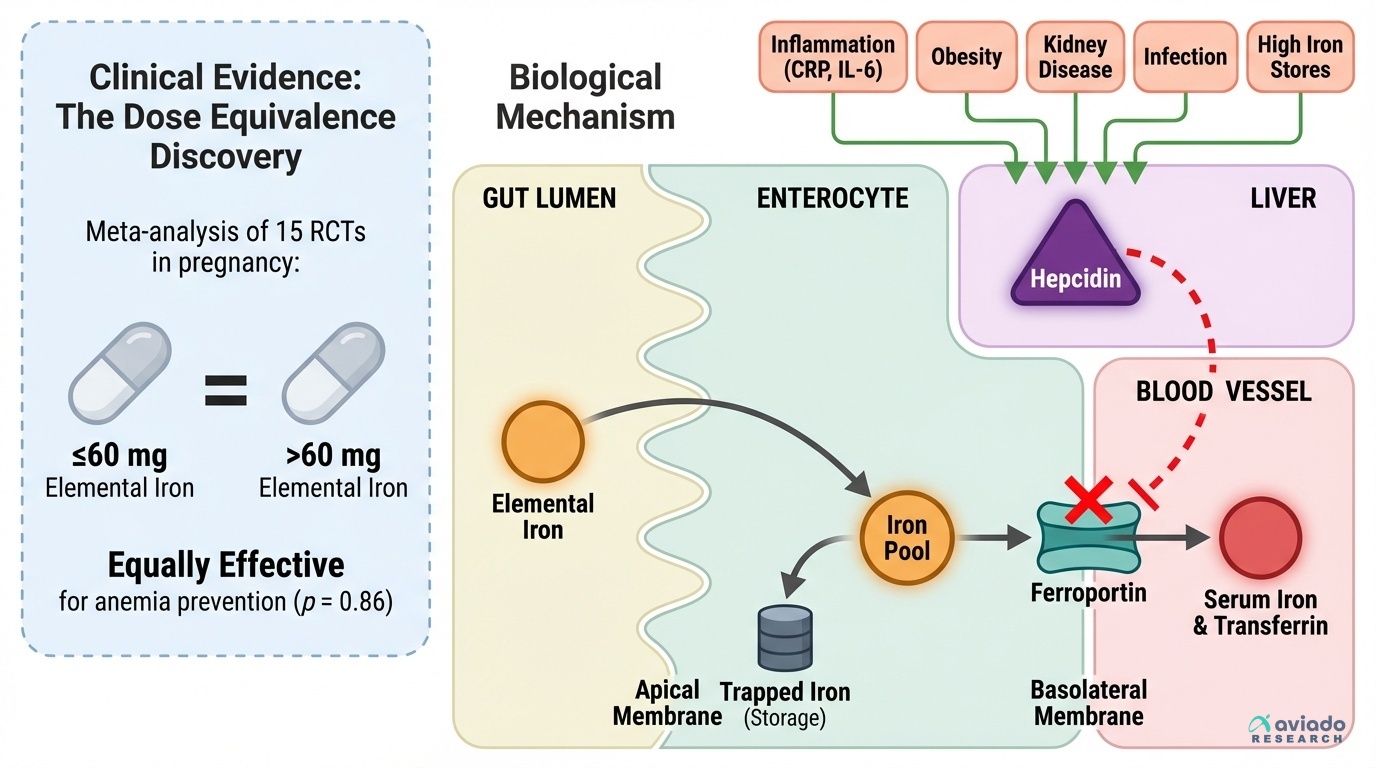
A meta-analysis of 15 randomized trials in pregnancy found that ≤60 mg elemental iron per day worked as well as >60 mg for anemia prevention (p=0.86). This points to a threshold. Once you hit about 60 mg, more iron may add side effects, not benefits.

So what decides if any dose works? Your gut has a “gate.” Hepcidin controls it. If hepcidin is high, your body absorbs little iron.

Hepcidin: Your Body's Iron Gatekeeper

Hepcidin changes how you should think about iron. Your liver makes this hormone. It controls ferroportin, the main iron exporter in the gut and in storage cells.

When hepcidin rises, ferroportin shuts down. Iron stays trapped in gut cells and storage cells. Less iron reaches your blood. This can happen even when you swallow large doses.

Hepcidin can rise with inflammation, infection, kidney disease, and high iron stores. It also changes during the day. This helps explain why the same iron plan helps one person but fails another. If your labs do not improve on iron, high hepcidin is a likely reason.

The Inflammation-Iron Deficiency Connection

Inflammation can cause iron problems without low iron intake. In this pattern, you may have iron in storage. But your body will not release it.

Obesity is one common driver. Extra fat tissue can raise inflammation signals. Those signals can raise hepcidin. Then iron gets trapped and stays out of the blood.

Kidney disease, heart failure, autoimmune disease, and long infections can do the same. If you keep raising your oral iron dose and nothing changes, the blocker may be inflammation, not the pill strength.

Rethinking Iron Status Monitoring

Many people track ferritin only. That can mislead you. Ferritin is an “acute-phase reactant.” It can rise during inflammation even when usable iron is low.

To see if iron is working, also track serum iron and transferrin saturation (TSAT). These show iron that is available for your cells right now.

A large RCT in heart failure (n=2,951) found serum iron levels and their 6-month changes were more strongly tied to function, hemoglobin, and prognosis than ferritin. That supports using dynamic markers, not storage alone.

A practical panel includes ferritin, serum iron, TSAT, and TIBC. If inflammation is likely, add CRP (and sometimes IL-6) to help interpret the results.

Practical Implications for Supplementation

Start simple. For many people, 60 mg elemental iron daily is enough. Example label math: 325 mg ferrous sulfate is about 65 mg elemental iron.

Take iron away from calcium supplements, tea, and coffee. Many people absorb more on an empty stomach. But food may help if nausea hits.

If you take iron as directed and labs do not improve, do not just double the dose. Ask your clinician to look for inflammation and causes of blood loss. If oral iron fails and iron deficiency is clear, IV iron may work better because it bypasses the gut “gate.”

Why Your Iron Supplement Dose May Not Matter—But Your Hepcidin Level Does

Why Your Iron Supplement Dose May Not Matter—But Your Hepcidin Level Does

How your body's iron gatekeeper determines whether any dose works at all

Diagram glossary
CRP:
A blood test marker used to detect and measure inflammation in the body.
ferroportin:
The primary iron exporter protein located in the gut and storage cells.
IL-6:
A marker of inflammation that can be tested if iron levels do not rise.

Track this in your stack

See how iron relates to your health goals, compare it against evidence tiers, and monitor changes in your biomarkers over time.

Open Aviado

Conclusions

The key lesson is simple. More iron is not always better. Evidence in pregnancy shows ≤60 mg elemental iron daily can work as well as higher doses. Whether you improve may depend more on hepcidin than on dose. If your labs do not move after 8–12 weeks, look for inflammation or ongoing blood loss instead of just taking more pills.

Limitations

The strongest dose-comparison evidence comes from pregnancy trials, so other groups may differ. Hepcidin tests are not widely available, so many people must infer high hepcidin from inflammation markers and poor response. Serum iron and TSAT can vary by time of day and recent meals, so repeat testing and consistent timing help. This article is educational and does not replace medical care, especially in pregnancy, kidney disease, or suspected bleeding.

Sources (5)

1

Iron Deficiency in Adults: A Review

Cappellini MD et al.. JAMA, 2024.

PMID: 40159291
2

Oral iron supplementation: new formulations, old questions

Girelli D et al.. Blood, 2024.

PMID: 38618666
5

Hepcidin-Ferroportin Interaction Controls Systemic Iron Homeostasis

Nemeth E et al.. International Journal of Molecular Sciences, 2021.

PMID: 34204327
11

Cellular Iron Metabolism and Regulation

Wang J et al.. Nutrients, 2019.

PMID: 31456203
12

AGA Clinical Practice Update on Management of Iron Deficiency Anemia: Expert Review

Akhuemonkhan E et al.. Gastroenterology, 2024.

PMID: 38864796