
Preliminary Evidence
Ldl CholesterolHeart HealthImmune System

Why Your LDL Target Should Be Personal, Not Universal

New research reveals individual factors that determine optimal cholesterol levels

4 min read2 peer-reviewed sourcesUpdated Mar 24, 2026

Executive Summary

A surprising fact: one LDL goal does not fit everyone. Most people chase one “good” number. But your age and risk change what “good” means.

This means you need a target that fits you. Your best LDL level depends on your full risk picture. That includes family history, ApoB, Lp(a), and inflammation.

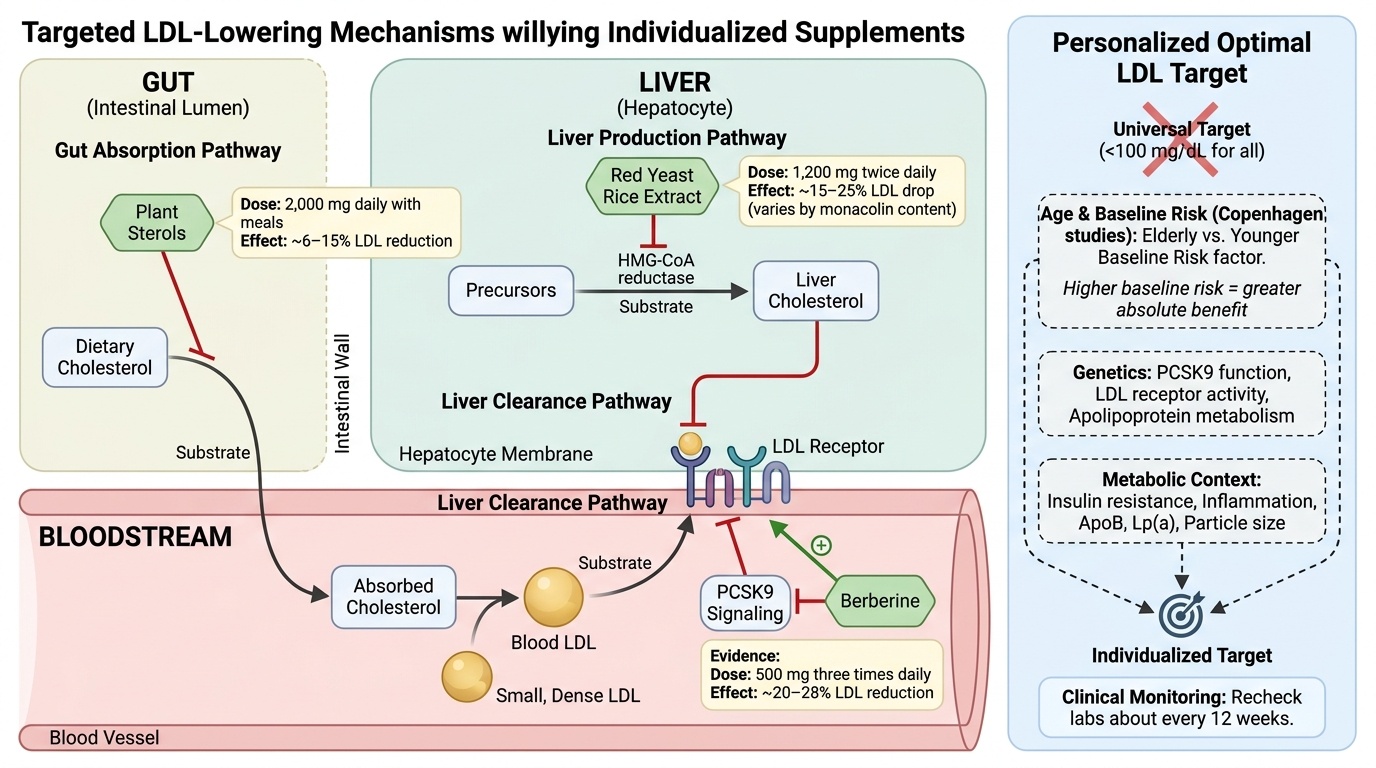
You can match supplements to your pattern. Plant sterols: 2,000 mg daily with meals. Red yeast rice extract: 1,200 mg twice daily. Berberine: 500 mg three times daily. Recheck labs about every 12 weeks.
Key Terms to Know

Plant sterols
Compounds that lower LDL by blocking some cholesterol absorption in your gut.
Red yeast rice extract
A fermented rice supplement that can lower LDL by reducing liver cholesterol production.
LDL Cholesterol (calc)
LDL cholesterol, the "bad cholesterol" that deposits in artery walls. elevated LDL is the primary driver of atherosclerosis and heart disease.
Personal LDL target
An LDL goal set from your total risk, not a single universal cutoff.
HMG-CoA reductase
A liver enzyme that controls how much cholesterol your body makes.
Apolipoprotein B
Apolipoprotein B, the protein component of atherogenic particles. Desirable <90 mg/dL (risk-dependent).
Berberine
A plant compound that can lower LDL and may improve insulin sensitivity.
HMG
A molecule whose associated enzyme, HMG-CoA reductase, is targeted to lower cholesterol production.
insulin
A pancreatic hormone essential for regulating carbohydrate and fat metabolism in the body.
LDL
Low-density lipoprotein is a blood particle that transports cholesterol to cells and tissues.

The Flaw in Universal LDL Targets

The current medical approach treats LDL cholesterol as if all patients were identical, typically aiming for levels below 100 mg/dL regardless of individual circumstances. This standardized approach emerged from large population studies but fails to account for the significant variation in how different people respond to and benefit from cholesterol reduction [7].

Recent evidence from Copenhagen researchers demonstrates that while LDL cholesterol remains a consistent risk factor across all age groups, the absolute benefit of lowering it varies dramatically based on individual characteristics. In elderly patients, the relationship between LDL levels and cardiovascular events follows the same relative pattern as in younger adults, but the baseline risk is higher, meaning even modest reductions can prevent more events [7].

The problem with universal targets becomes clear when examining individual risk profiles. A 40-year-old with no other risk factors might need minimal LDL reduction to achieve optimal protection, while a 70-year-old with multiple risk factors could benefit from more aggressive lowering. Yet standard guidelines often apply the same numerical target to both patients, missing opportunities for personalized optimization.

Individual Factors That Modify Optimal LDL Levels

Age represents one of the most significant modifiers of optimal LDL targets. The Copenhagen studies revealed that elderly patients experience higher absolute benefits from LDL reduction due to their elevated baseline cardiovascular risk, even though the relative risk reduction remains consistent across age groups [7]. This means that a 75-year-old might benefit from achieving LDL levels of 70 mg/dL, while a 45-year-old with similar relative risk factors might achieve equivalent protection at 90 mg/dL.

Genetic factors also play a crucial role in determining individual LDL targets. Patients with genetic variants affecting PCSK9 function, LDL receptor activity, or apolipoprotein metabolism may require different approaches to achieve optimal cardiovascular protection. Some individuals are naturally efficient at clearing LDL cholesterol, while others struggle with elevated levels despite similar lifestyle factors.

Metabolic context further modifies optimal targets. Patients with insulin resistance, inflammatory conditions, or altered lipid particle composition may need more aggressive LDL lowering to achieve the same cardiovascular benefit as metabolically healthy individuals. The presence of small, dense LDL particles—which are more atherogenic than larger particles—can influence the level of LDL reduction needed for protection.

Modern Therapeutic Options for Personalized LDL Management

Personalized LDL plans work best when each tool matches your main driver of high LDL. Some people make more cholesterol in the liver. Others absorb more from the gut. A smaller group has higher particle risk, even at “ok” LDL.

Red yeast rice extract targets cholesterol production in the liver by inhibiting HMG-CoA reductase. Typical study dosing is 1,200 mg twice daily. Many trials show about a 15–25% LDL drop, but results vary by product and monacolin content.

Plant sterols target absorption. At 2,000 mg daily with meals, studies often show about a 6–15% LDL reduction. This approach fits people whose diet and gut absorption play a bigger role.

Berberine supports LDL lowering through multiple pathways, including effects on LDL-receptor activity and PCSK9 signaling. A common studied dose is 500 mg three times daily. Trials often report around a 20–28% LDL reduction, with added benefits for insulin resistance markers in some groups.

Implementing Personalized LDL Strategies

Personal LDL work starts with a risk snapshot, not one lab number. Use age, family history, blood pressure pattern, smoking status, waist size, and metabolic markers. Then pick an LDL target that matches your risk.

Add markers that sharpen your plan. ApoB helps you track particle number. Lp(a) can reveal hidden genetic risk. hsCRP can show inflammation that raises risk even when LDL looks “fine.”

Build a simple combo that matches your driver. If absorption seems high, use plant sterols plus soluble fiber. If metabolic risk is high, consider berberine plus lifestyle steps that lower insulin resistance. If you need a stronger production-focused push, consider red yeast rice extract.

Track and adjust with data. Recheck LDL, ApoB, and triglycerides about every 12 weeks when changing your plan. Once stable, test quarterly so you can hold the gains and fine-tune doses.

Why Your LDL Target Should Be Personal, Not Universal

Why Your LDL Target Should Be Personal, Not Universal

New research reveals individual factors that determine optimal cholesterol levels

Diagram glossary
Berberine:
A plant-derived compound used as a dietary supplement to improve metabolic and cholesterol profiles.
HMG:
A molecule whose associated enzyme, HMG-CoA reductase, is targeted to lower cholesterol production.
insulin:
A pancreatic hormone essential for regulating carbohydrate and fat metabolism in the body.
LDL:
Low-density lipoprotein is a blood particle that transports cholesterol to cells and tissues.
monacolin:
A naturally occurring statin-like compound found in red yeast rice that lowers cholesterol.
PCSK9:
An enzyme that binds to LDL receptors, targeted by drugs to lower blood cholesterol.

Track this in your stack

See how ldl_cholesterol relates to your health goals, compare it against evidence tiers, and monitor changes in your biomarkers over time.

Open Aviado

Conclusions

Your LDL goal should fit your risk, not a universal cutoff. Age, genetics, particle count (ApoB), Lp(a), and inflammation can all shift what “optimal” means for you. The most useful plan matches the tool to your main LDL driver—absorption, production, or metabolic risk—then tracks results and adjusts. With options like plant sterols, red yeast rice extract, and berberine, you can build a more precise LDL strategy than a one-number target.

Limitations

Evidence for “personal LDL targets” is still evolving. Many findings come from observational research and post-hoc analyses, not trials that assign people to different LDL goals. Supplement studies also vary by product quality, dose, and study length, so LDL changes can differ from one brand and person to another. Finally, advanced markers like ApoB, Lp(a), and LDL particle tests are not always available, which can limit how personalized a plan can be.

Sources (2)

7

[Elderly benefit from lower LDL-cholesterol]

Authors not specified. Journal not specified, 2021.

PMID: 33768516
8

[Therapeutic options to reduce LDL-cholesterol beyond statins]

Authors not specified. Journal not specified, 2022.

PMID: 35915886