
Preliminary Evidence
CortisolHormone BalanceSleep & Recovery

Your Cortisol Rhythm Is a Fingerprint — And Most People Are Reading It Wrong

Why timing matters more than levels when measuring your stress hormone

4 min read9 peer-reviewed sourcesUpdated Mar 23, 2026

Executive Summary

The surprising truth is cortisol is not one number. It is a daily rhythm. Most people test once. They panic. But the time of day can fool you.

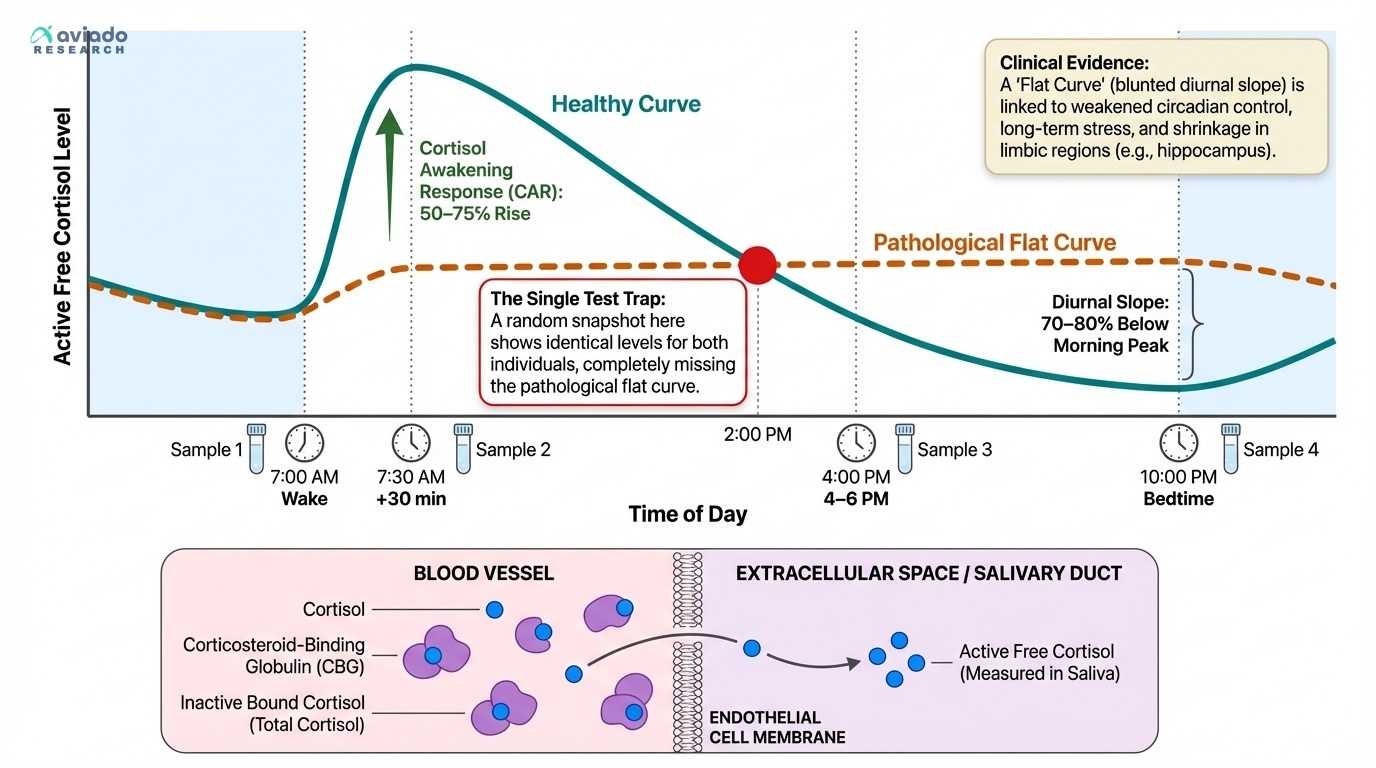
This means you should measure your pattern. Not a single value. Your healthy day looks like this. High after waking. Then it falls all day. If it stays high at night, your sleep can suffer.

Use a 4-point saliva test in one day. Sample at wake time, then 30 minutes later. Sample again at 4–6 PM. Sample again at bedtime. Aim for a 50–75% rise after waking. Aim for bedtime levels 70–80% below your morning peak.
Key Terms to Know

Hair cortisol
A lab test using a small hair sample to estimate average cortisol exposure over about 2–3 months.
Cortisol Awakening Response (CAR)
The jump in cortisol after you wake. Often measured at wake time and 30 minutes later.
Late-night salivary cortisol
A bedtime saliva measure. Higher-than-expected levels can align with insomnia and a “wired at night” pattern.
Salivary cortisol
Cortisol measured in saliva. It mainly reflects free (active) cortisol and can be collected at home.
HPA Axis
The body's central stress response system connecting the brain to adrenal glands. Chronic activation leads to elevated stress hormones and negative health effects.
Corticosteroid-binding globulin (CBG)
A blood protein that binds most cortisol. Higher CBG can make total cortisol look high while free cortisol stays normal.
Diurnal cortisol slope
How fast cortisol drops from morning to night. A flatter slope can signal dysregulation.
CBG
Corticosteroid-binding globulin is a blood protein that binds cortisol, limiting its active tissue exposure.
estrogen
A hormone whose fluctuating levels can shift the amount of corticosteroid-binding globulin in blood.
HPA
The hypothalamic-pituitary-adrenal axis is a bodily system that ramps up daily cortisol production.

The Timing Problem: Why Single Cortisol Tests Miss the Point

Cortisol runs on a strong body clock. In healthy people, it is highest soon after waking and lowest near bedtime [1]. That swing can be several-fold within the same day. So a single test is easy to misread.

The key early feature is the cortisol awakening response. After you wake, cortisol should rise quickly. Most people show a clear increase within 30 minutes [1][4]. Researchers track this rise because it reflects how the HPA axis ramps up for the day.

But most routine testing ignores the clock. A random blood draw cannot show your daily curve. It can label a normal morning peak as “high.” Or it can miss a night-time elevation that matters for sleep. To understand cortisol, you must measure it over time, not once [3].

The 5% Problem: Why Total Cortisol Labs Can Be Meaningless

Most blood tests report total cortisol. But much of that cortisol is not free to act. In blood, cortisol binds to proteins, mainly corticosteroid-binding globulin (CBG). Only the unbound part is active at tissues [15].

This can confuse results. Two people can share the same total cortisol number. Yet they can have different free cortisol exposure because their CBG differs. CBG can shift with estrogen states (like pregnancy or oral contraceptives), inflammation, liver status, and some medicines [15].

Salivary cortisol avoids much of this problem. Free cortisol can enter saliva, but bound cortisol cannot. So saliva testing better reflects the active fraction that reaches cells [3][5].

The Flat Curve Problem: When Low Cortisol Is Actually Worse

“High cortisol” is not the whole story. The daily pattern often matters more than the peak. Researchers often focus on the diurnal slope, meaning how much cortisol falls from morning to night.

In older adults, flatter daily cortisol patterns have been linked with worse brain structure. In one study, people with less daily decline showed more shrinkage in limbic regions, including the hippocampus [14]. This pattern can appear even when single time-point cortisol values look “normal.”

A flat curve is common in long-term stress and some mood disorders. Instead of a strong morning rise and steady fall, cortisol stays too even across the day. That suggests circadian control has weakened, not that cortisol is “fine” [6].

Measuring Your Cortisol Fingerprint: A Practical Protocol

To map your cortisol pattern, collect multiple samples in one day. A common research approach uses four saliva samples: (1) immediately on waking, (2) 30 minutes after waking, (3) late afternoon (about 4–6 PM), and (4) at bedtime [1][4].

To reduce errors, keep collection consistent. For at least 30 minutes before each sample, avoid food, alcohol, nicotine, and tooth brushing. Water is usually fine. Try to sample on a typical day, not during illness or after travel. If you want a steadier picture, repeat the same four points on 2–3 days.

When you review results, look for shape first. You want a clear rise after waking, then a steady drop. A persistently high bedtime value or little drop across the day suggests a flatter slope that may be worth addressing with sleep timing, light exposure, and stress load.

Hair Cortisol: The 90-Day Average Solution

Saliva shows your day-to-day rhythm. Hair cortisol answers a different question: your average cortisol exposure over past weeks. As hair grows, cortisol is deposited into the hair shaft. A short segment close to the scalp can reflect roughly the prior 1–3 months, depending on hair length and lab method [9].

Hair testing reduces “snapshot” noise. It is less affected by the exact wake time, one bad night of sleep, or one unusually stressful day. That makes it useful for tracking chronic exposure over time.

Hair cortisol cannot show your daily curve. It will not tell you if evenings are high or mornings are blunted. But it can help flag sustained high or low exposure that a single-day saliva profile might miss [9].

Your Cortisol Rhythm Is a Fingerprint — And Most People Are Reading It Wrong

Your Cortisol Rhythm Is a Fingerprint — And Most People Are Reading It Wrong

Why timing matters more than levels when measuring your stress hormone

Diagram glossary
CBG:
Corticosteroid-binding globulin is a blood protein that binds cortisol, limiting its active tissue exposure.
estrogen:
A hormone whose fluctuating levels can shift the amount of corticosteroid-binding globulin in blood.
HPA:
The hypothalamic-pituitary-adrenal axis is a bodily system that ramps up daily cortisol production.

Track this in your stack

See how cortisol relates to your health goals, compare it against evidence tiers, and monitor changes in your biomarkers over time.

Open Aviado

Conclusions

Cortisol works like a schedule, not a score. The most useful question is not “Is my cortisol high?” It is “Does my cortisol rise after waking and fall by bedtime?” Use multi-time-point saliva testing to see your daily shape. Add hair cortisol if you need a longer view of chronic exposure. Treat results as pattern data, then target sleep timing, light, and daily stress load to shift the curve.

Limitations

Cortisol patterns vary by age, sex, genetics, shift work, sleep timing, and medications (including steroids and estrogen-containing contraceptives). Many studies report group averages, so your “normal” may differ. Home saliva tests can be thrown off by timing mistakes, food, nicotine, tooth brushing, and poor sleep the prior night. Hair cortisol can be affected by hair treatments, hair growth differences, and lab methods, and it cannot show morning-versus-night timing problems. These tests do not diagnose medical disease; unusual results should be reviewed with a clinician, especially if symptoms suggest adrenal or pituitary disorders.

Sources (9)

1

Salivary cortisol as a biomarker in stress research

Hellhammer DH et al.. Psychoneuroendocrinology, 2009.

PMID: 19095358
3

Salivary cortisol and cortisone in the clinical setting

Raff H et al.. Current Opinion in Endocrinology & Diabetes and Obesity, 2017.

PMID: 28375882
4

Cortisol Detection Methods and the Hormone's Role in Evaluating Circadian Rhythm Disruption

Chen Y et al.. International Journal of Molecular Sciences, 2024.

PMID: 41009704
5

Measuring cortisol in human psychobiological studies

Kirschbaum C et al.. Psychoneuroendocrinology, 2007.

PMID: 17055006
6

Early life stress and cortisol: A meta-analysis

Hunter AL et al.. Psychoneuroendocrinology, 2018.

PMID: 29289660
9

Clinical applications of cortisol measurements in hair

Stalder T et al.. Psychoneuroendocrinology, 2015.

PMID: 25924811
10

Basal cortisol levels and the relationship with clinical symptoms in multiple sclerosis: a systematic review

Pereira VH et al.. Brain and Behavior, 2018.

PMID: 30365626
14

Cortisol relates to regional limbic system structure in older but not younger adults

Stafford J et al.. NeuroImage, 2019.

PMID: 30453123
15

Corticosteroid-binding globulin: modulating mechanisms of bioavailability of cortisol and its clinical implications

Nenke MA et al.. Clinical Endocrinology, 2016.

PMID: 26522460