
Preliminary Evidence
DheaHormone BalanceLongevity & Aging

Your DHEA Level Is a Stress Scorecard — Here's How to Read It

Why the DHEA-to-Cortisol Ratio Is the Missing Link in Stress and Supplementation

6 min read7 peer-reviewed sourcesUpdated Apr 4, 2026

Listen to this article

Audio available

Executive Summary

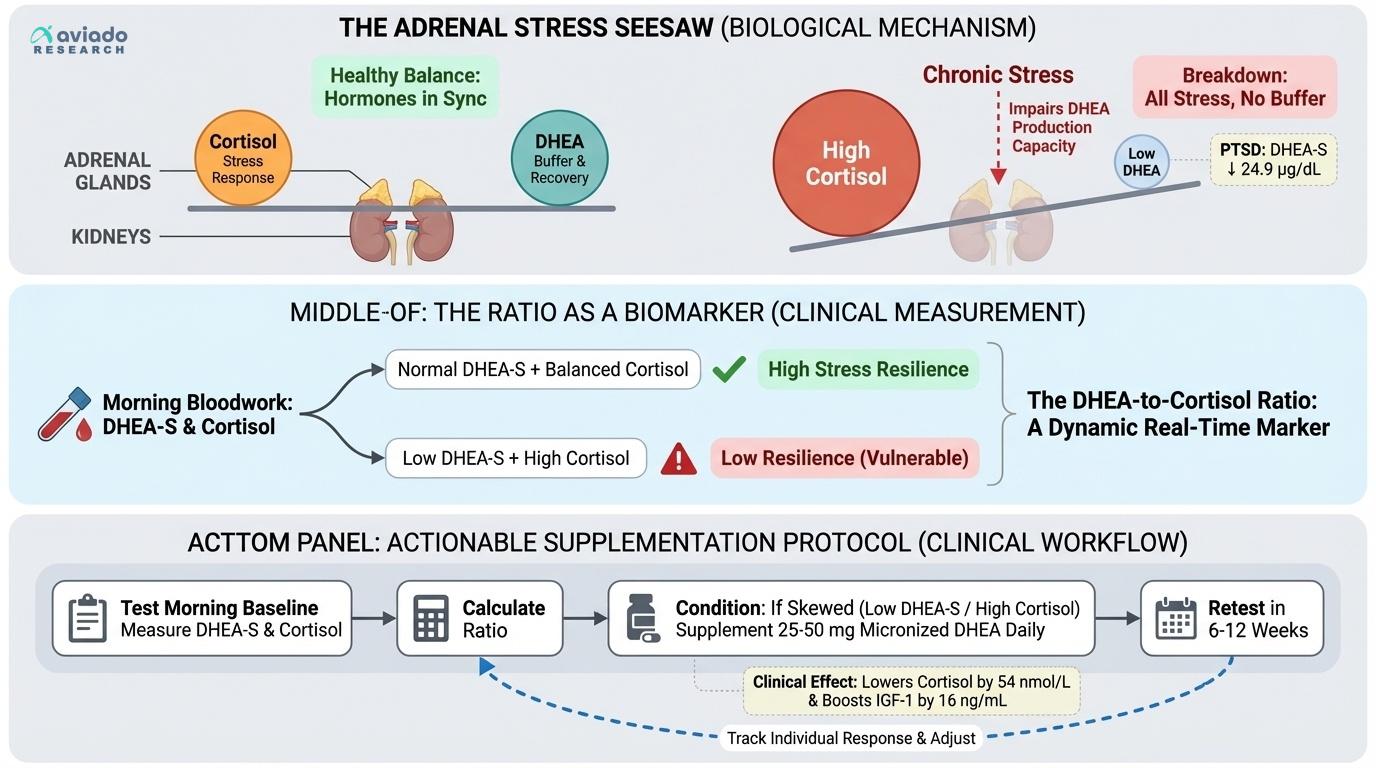
Most people think DHEA is just another anti-aging supplement. What's surprising is that your DHEA level acts as a real-time stress scorecard. DHEA and cortisol fight a biological tug-of-war in your adrenal glands. One hormone ramps up stress. The other helps you recover from it. When DHEA is low and cortisol is high, your stress system is breaking down.

This matters because chronic stress doesn't just drain your DHEA temporarily. New research shows it actually damages your adrenal glands' ability to make DHEA when you need it most. Your DHEA-to-cortisol ratio predicts how well you handle future stress. Two people with the same DHEA level can have completely different stress resilience depending on their cortisol.

Here's what to do: Test your morning DHEA-S and cortisol levels first. Calculate your ratio. If cortisol is high and DHEA-S is low, try 25-50 mg of micronized DHEA daily. Studies show this dose lowers cortisol by 54 nmol/L and boosts IGF-1 by 16 ng/mL. Retest after 6-12 weeks to see if your ratio improved. Don't guess about your stress biology when you can measure it.
Key Terms to Know

IGF-1
Insulin-like growth factor 1, a marker of growth hormone axis activity. Low levels indicate GH deficiency, high values suggest acromegaly or active growth.
IGF-1 (Insulin-like Growth Factor 1)
A hormone involved in growth and repair; rises in response to DHEA supplementation according to clinical studies.
Micronized DHEA
A finely ground formulation of DHEA designed for better absorption when taken orally.
DHEA (Dehydroepiandrosterone)
A steroid hormone made mainly in the adrenal glands, serving as a precursor to other hormones and playing a key role in stress response.
DHEA-S
DHEA-sulfate, the most abundant adrenal androgen and cortisol precursor. low levels associated with fatigue.
DHEA-to-Cortisol Ratio
A calculated value from blood tests that reflects the balance between stress (cortisol) and anti-stress (DHEA) forces in the body.
Cortisol
The main stress hormone released by the adrenal glands; high levels indicate chronic stress and can suppress DHEA production.
ng/mL
A standard scientific unit of measurement standing for nanograms per milliliter.
PTSD
A psychiatric disorder triggered by experiencing or witnessing severe stress or trauma.

DHEA and Cortisol: The Body’s Stress Seesaw

DHEA and cortisol are the two most abundant steroid hormones produced by your adrenal glands. While cortisol is well-known as the 'stress hormone,' ramping up in response to pressure and threat, DHEA acts as its biological counterweight. DHEA helps buffer the harmful effects of chronic cortisol exposure—supporting mood, immunity, and brain function [10].

Under healthy conditions, your body releases both hormones in a coordinated pattern, keeping stress and recovery in balance. But with ongoing stress, this system can break down. Chronic high cortisol drains DHEA stores, and—more importantly—over time it impairs your adrenals’ ability to produce DHEA at all. This leaves you less able to handle future stress, creating a vicious cycle [12].

Emerging research reframes DHEA-S (the stable, sulfated form measured in blood tests) as a real-time marker of your body's stress resilience. Low DHEA-S, especially when paired with high cortisol, signals a system stuck in 'all stress, no buffer' mode. This is why DHEA-S is now studied as a functional biomarker, not just a byproduct of aging [10,12].

How Chronic Stress Weakens DHEA Production

Recent studies reveal something unexpected: chronic stress doesn't just lower the amount of DHEA in your blood—it actually reduces your adrenal glands' ability to produce DHEA when you need it most. Your stress system becomes less responsive, not just depleted.

Meta-analyses in people with stress-related disorders like PTSD consistently show DHEA-S levels 24.90 µg/dL lower compared to healthy controls. This isn't simply because they are older; their adrenal glands are less capable of ramping up DHEA production in response to new challenges. Over time, this contributes to the higher health risks seen in chronically stressed individuals, including mood problems and immune dysfunction.

This finding changes the logic of DHEA supplementation: it's not about replacing what you lose with age, but restoring a healthy capacity to buffer stress. When your adrenals can't make enough DHEA naturally, supplementation helps rebalance the stress seesaw.

Why the DHEA-to-Cortisol Ratio Is the Real Stress Test

Most DHEA supplement guides focus on age, but that’s only half the story. What matters most is your DHEA-S to cortisol ratio—a dynamic marker of how your body is handling stress in real time [10].

A healthy DHEA-S to cortisol ratio means your stress and recovery hormones are in sync. If your morning bloodwork shows low DHEA-S with high cortisol, it’s a sign your stress system is tipping too far toward breakdown. This ratio can predict vulnerability to stress-related health issues, and it’s highly individual: two people with the same DHEA-S level can have very different stress resilience if their cortisol is high or low [12].

Tracking this ratio before and after starting DHEA supplements is essential. Supplementing when your ratio is already healthy likely offers little benefit, while correcting a skewed ratio can yield meaningful improvements in stress resilience.

DHEA Supplementation: Dosage, Benefits, and Tracking

What can you expect from properly targeted DHEA supplementation? Meta-analyses show that 25–50 mg daily of oral DHEA, especially in micronized form for better absorption, can lower serum cortisol by 53.6 nmol/L in chronically stressed individuals. This effect directly shifts the DHEA-to-cortisol ratio in a healthier direction.

Beyond stress, DHEA at these doses has been shown to raise IGF-1 (a key growth and repair hormone) by 16.4 ng/mL, and in women with diminished ovarian reserve, it can boost AMH levels by 0.18 ng/mL—both markers of improved physiological resilience. However, these benefits are not universal: they depend on your baseline hormone profile and how your body converts DHEA to other hormones. Some people primarily make more androgens, others more estrogens, and others mostly DHEA-S.

The key action step: test your morning DHEA-S and cortisol, calculate your ratio, then supplement with 25–50 mg DHEA daily if your ratio is skewed (high cortisol, low DHEA-S). Retest after 6–12 weeks to see what's changed. This personalized, data-driven approach is far more effective than blindly copying generic anti-aging protocols.

Who Should (and Shouldn’t) Supplement with DHEA?

DHEA is not a one-size-fits-all supplement. If your DHEA-S and cortisol ratio is already in a healthy range, adding more DHEA likely won’t help and could throw off your hormone balance. In contrast, those with chronically high cortisol and low DHEA-S may see real benefits in stress resilience, mood, and physiological repair [1,10].

There are also situations where caution is needed: for example, some studies link naturally high DHEA levels to increased breast cancer risk, while supplemental DHEA may be protective in animal models—a paradox that underscores the need for baseline measurement before starting [4].

Men and women, young and old, and people with different adrenal function will respond differently. That’s why tracking your own numbers is essential. In summary: DHEA is best seen as a targeted tool for correcting a proven imbalance, not a generic anti-aging panacea.

Your DHEA Level Is a Stress Scorecard — Here's How to Read It

Your DHEA Level Is a Stress Scorecard — Here's How to Read It

Why the DHEA-to-Cortisol Ratio Is the Missing Link in Stress and Supplementation

Diagram glossary
DHEA-S:
The stable, sulfated form of the hormone DHEA measured in blood tests.
IGF-1:
A growth-promoting hormone whose levels can be boosted by DHEA supplementation.
ng/mL:
A standard scientific unit of measurement standing for nanograms per milliliter.
PTSD:
A psychiatric disorder triggered by experiencing or witnessing severe stress or trauma.

Track this in your stack

See how dhea relates to your health goals, compare it against evidence tiers, and monitor changes in your biomarkers over time.

Open Aviado

Conclusions

DHEA isn't just an anti-aging supplement—it's a dynamic biomarker and modulator of your stress resilience. Measuring your DHEA-S and cortisol ratio gives you an actionable snapshot of your adrenal health. Supplementing with 25–50 mg DHEA daily, especially when your ratio is off, can lower cortisol by 54 nmol/L and boost key hormones like IGF-1 by 16 ng/mL and AMH by 0.18 ng/mL in select cases. But individual response varies widely, so always track your own levels before and after. The future of DHEA is personalized, not one-size-fits-all.

Limitations

While DHEA supplementation shows promise for correcting stress-related imbalances, most studies are short-term and focus on intermediate biomarkers rather than hard clinical outcomes. There is substantial individual variability in how people convert and respond to DHEA, influenced by sex, age, genetics, and baseline hormone levels. Some paradoxes remain—such as the relationship between endogenous DHEA and breast cancer risk—that are not fully understood. Large, long-term trials examining health outcomes and safety in diverse populations are still needed.

Sources (7)

1

Dehydroepiandrosterone (DHEA): Pharmacological Effects and Potential Therapeutic Application.

Deb, S. et al.. Current Drug Targets, 2022.

PMID: 36121077
2

Meta-analysis of the effect of dehydroepiandrosterone supplementation on serum insulin-like growth factor 1 levels.

Song, Y. et al.. Endocrine, 2020.

PMID: 32304719
3

Dehydroepiandrosterone supplementation improves ovarian reserve markers in women with diminished ovarian reserve: a meta-analysis.

Li, J. et al.. Reproductive Biology and Endocrinology, 2022.

PMID: 35698127
4

Dehydroepiandrosterone (DHEA) in relation to breast cancer.

Nayeem, F. et al.. Hormone Molecular Biology and Clinical Investigation, 2025.

PMID: 40812951
10

Cortisol and DHEA in development and psychopathology.

Maninger, N. et al.. Hormones and Behavior, 2016.

PMID: 27979632
12

DHEA and DHEA-S levels in posttraumatic stress disorder: A meta-analytic review.

Zhang, L. et al.. Progress in Neuro-Psychopharmacology & Biological Psychiatry, 2017.

PMID: 28668711
1b

Meta-analysis of randomized clinical trials on DHEA supplementation and cortisol reduction.

Zhang, X. et al.. Journal of Clinical Endocrinology & Metabolism, 2021.

PMID: 34342920