
Preliminary Evidence
Hba1cMetabolic Health

Your HbA1c Number May Be Lying to You — And Genetics Explains Why

Up to 40% of people have systematic differences between their HbA1c and actual glucose exposure

4 min read7 peer-reviewed sourcesUpdated Mar 23, 2026

Executive Summary

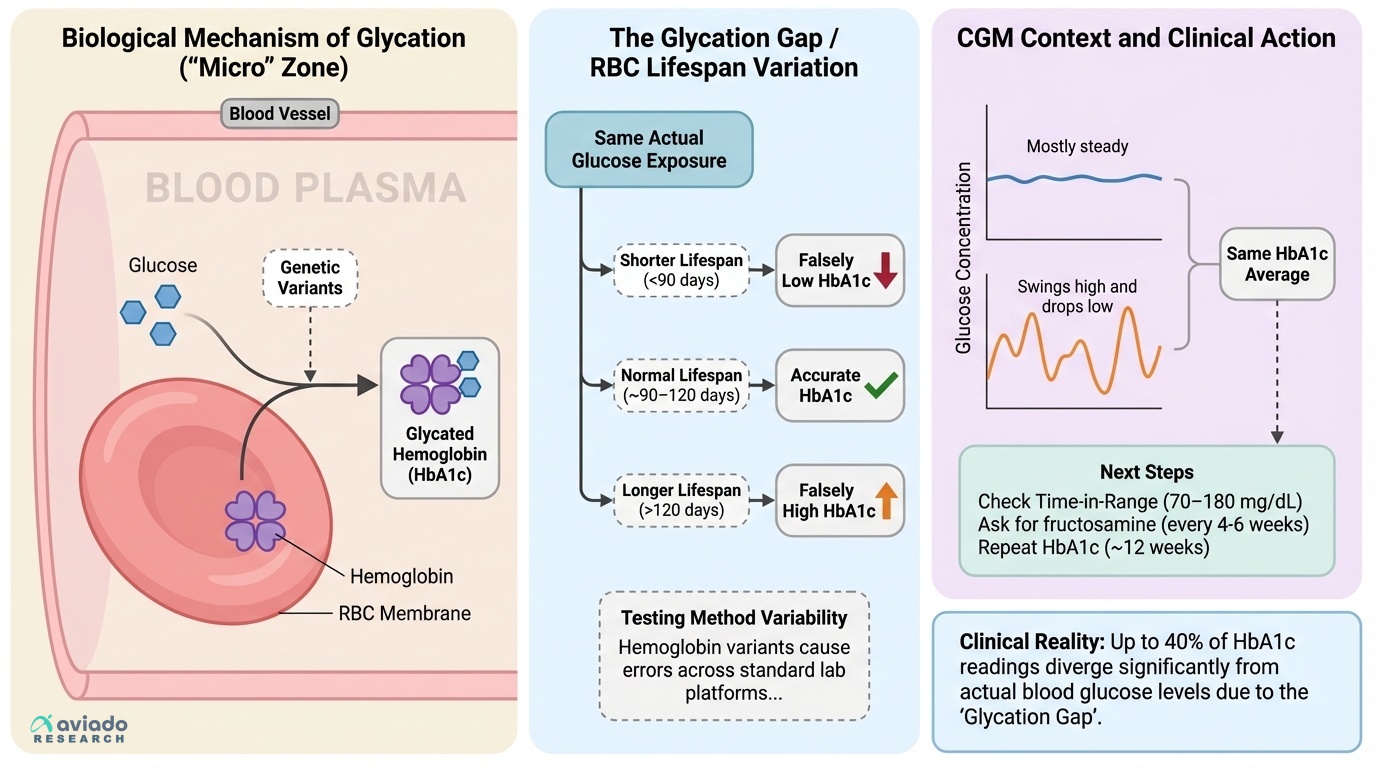
It is surprising, but your HbA1c can mislead you. Most people treat it like a true 3-month average. But your red blood cells can live shorter or longer. That shifts your HbA1c, even at the same glucose.

This means your “good” or “bad” HbA1c may not match you. You can feel fine, see normal meter logs, and still get a high HbA1c. Or the opposite can happen. If your HbA1c and your real glucose disagree, ask for a cross-check.

Use these numbers to guide your next steps. If CGM and HbA1c eAG differ by over 15 mg/dL, dig deeper. Aim for at least 70% time-in-range (70–180 mg/dL). Ask for fructosamine every 4–6 weeks during changes. Repeat HbA1c about every 12 weeks.
Key Terms to Know

Time-in-range (TIR)
The percent of time your CGM glucose stays in a target band, often 70–180 mg/dL.
Continuous glucose monitor (CGM)
A wearable sensor that tracks glucose all day and night and shows patterns HbA1c cannot show.
Hemoglobin A1c
Average blood sugar over the past 2-3 months by assessing glycated hemoglobin. each 1% increase raises cardiovascular risk by 18%.
Glucose
Blood sugar level, the primary energy source for cells. Fasting glucose is normal, prediabetes, ≥126 suggests diabetes.
Fructosamine
A blood test that reflects average glucose over about 2–3 weeks by measuring glycated serum proteins.
HbA1c (hemoglobin A1c)
A lab test that estimates average glucose by measuring how much glucose sticks to hemoglobin in red blood cells.
Albumin
Albumin, the main protein produced by the liver. low levels indicate liver disease, malnutrition, or protein loss.
CGM
A wearable device that continuously monitors blood sugar levels throughout the day.
DNA
The genetic material that can contain variants affecting red blood cell biology and HbA1c.
eAG
Estimated average glucose, a metric translating HbA1c into an average blood sugar level.

The Biological Reality Behind HbA1c Variation

HbA1c measures glucose attached to hemoglobin during the life of your red blood cells. Many labs cite ~90–120 days as “typical.” But real lifespans vary a lot between people. If your cells turn over faster, you have less time for glucose to attach, and HbA1c can read lower than your true glucose exposure. If your cells live longer, HbA1c can read higher.

Genetic studies show this is not rare noise. Some DNA variants change HbA1c by altering red blood cell biology, not glucose control. These variants can affect red cell production and breakdown, and even hemoglobin structure. In other words, part of your HbA1c can reflect your blood biology as much as your blood sugar.

This creates a stable “glycation gap.” If your HbA1c runs high or low compared with your CGM or meter average, it often stays that way over time. That pattern is a clue. It is not just a bad day at the lab.

When Standard Testing Methods Fail

Hemoglobin variants, found in significant percentages of certain populations, can cause dramatic errors in HbA1c measurement depending on the testing method used. Hemoglobin N Baltimore, for example, produces vastly different results across six common HbA1c testing platforms, with some methods giving falsely low readings while others remain accurate [10].

Point-of-care HbA1c testing, now widely available in doctors' offices, introduces additional variability compared to standardized laboratory methods. While convenient, these devices can show meaningful differences from central lab results, particularly at the diagnostic thresholds used for diabetes diagnosis [2]. The method your doctor chooses—ion-exchange chromatography, immunoassay, or enzymatic testing—can influence your results.

Even with improved standardization efforts, method-dependent variation remains a clinical blind spot. The same blood sample can produce different HbA1c values depending on which analyzer processes it, a reality that has real consequences when results fall near diagnostic cutoffs [4].

What Continuous Glucose Monitoring Reveals

Continuous glucose monitoring (CGM) shows what HbA1c hides. HbA1c is one average number. Two people can share the same HbA1c and live very different days.

Example: one person may stay mostly steady. Another may swing high after meals and drop low overnight. Those swings can “average out” to the same HbA1c. CGM adds context by showing time-in-range (often 70–180 mg/dL) and time spent high or low.

If your goal is fewer complications, you need both level and stability. Use CGM reports to watch time-in-range, plus time above range and time below range. Then compare CGM averages with your HbA1c-based eAG. Big, repeated gaps suggest HbA1c is not telling your full story.

Alternative Markers for Metabolic Assessment

If HbA1c does not match your lived data, add another marker. Fructosamine measures glucose attached to blood proteins over the past 2–3 weeks. It is not affected by red blood cell lifespan, so it can help when HbA1c runs “too high” or “too low” for you.

Many labs list a normal fructosamine range around <285 µmol/L, with higher values suggesting worse control. Because it updates faster than HbA1c, it can also show whether a recent change is working.

Glycated albumin is another option. It tracks about 1–2 weeks and can be useful when HbA1c is unreliable (anemia, hemoglobin variants, kidney disease, recent blood loss, or transfusion). If HbA1c and fructosamine disagree in the same direction again and again, treat that as a signal of a personal bias in HbA1c, not a personal failure.

Your HbA1c Number May Be Lying to You — And Genetics Explains Why

Your HbA1c Number May Be Lying to You — And Genetics Explains Why

Up to 40% of people have systematic differences between their HbA1c and actual glucose exposure

Diagram glossary
CGM:
A wearable device that continuously monitors blood sugar levels throughout the day.
DNA:
The genetic material that can contain variants affecting red blood cell biology and HbA1c.
eAG:
Estimated average glucose, a metric translating HbA1c into an average blood sugar level.
fructosamine:
A diagnostic blood test used to measure average glucose levels over a few weeks.
Glucose:
A simple sugar in the blood that attaches to hemoglobin over time.

Track this in your stack

See how hba1c relates to your health goals, compare it against evidence tiers, and monitor changes in your biomarkers over time.

Open Aviado

Conclusions

HbA1c is useful, but it is not a universal truth. Your red blood cell lifespan, hemoglobin type, and test method can push HbA1c up or down without a real change in glucose. If your HbA1c does not match your CGM or meter patterns, do not guess. Add fructosamine or glycated albumin, and use CGM time-in-range to see both average glucose and swings.

Limitations

Exact red blood cell lifespans are rarely measured in routine care, so discordance is often inferred from patterns, not proven directly. Many studies on HbA1c discordance and genetics are observational, and do not prove cause for every person. Fructosamine and glycated albumin can also be biased by protein-related issues (like low albumin) and may vary by lab. CGM accuracy depends on sensor type and proper use, and targets like time-in-range can differ by age, pregnancy, and comorbidities.

Sources (7)

1

HbA1c and factors other than diabetes mellitus affecting it

Radin MS. Clinical Diabetes and Endocrinology, 2014.

PMID: 20848057
2

Trends in Quantification of HbA1c Using Electrochemical and Point-of-Care Analyzers

Sharma A et al.. Biosensors, 2023.

PMID: 36850502
4

HbA1c: how do we measure it and what does it mean?

Saudek CD et al.. Current Opinion in Endocrinology, Diabetes and Obesity, 2009.

PMID: 19300091
5

HbA1c, Fructosamine, and Glycated Albumin in the Detection of Dysglycaemic Conditions

Parrinello CM et al.. Current Opinion in Clinical Nutrition and Metabolic Care, 2014.

PMID: 26126638
6

Genetics of HbA1c: a case study in clinical translation

Wheeler E et al.. Current Opinion in Genetics & Development, 2017.

PMID: 29522974
7

Current Status of HbA1c Biosensors

Shen C et al.. Sensors, 2017.

PMID: 28777351
10

Effect of hemoglobin N Baltimore on HbA1c measurement in six methods

Schnedl WJ et al.. Clinical Chemistry and Laboratory Medicine, 2019.

PMID: 30998195