
Preliminary Evidence
HomocysteineMetabolic Health

Your Homocysteine Level Is a Personal Report Card on Your Methylation Genetics — Here's How to Read It

Why two people with identical diets and supplements can have wildly different homocysteine levels

5 min read8 peer-reviewed sourcesUpdated Mar 23, 2026

Executive Summary

The surprising truth is that homocysteine is not “just diet.” Most people think a high number means you lack B vitamins. Then they take folic acid and hope it drops. But two people can eat the same way and get opposite results.

What this means for you is simple. Your homocysteine is a signal. It shows how well your genes run the methylation cycle. Variants in MTHFR, MTR, and MTRR can change your response. So you may need different forms of B vitamins.

Start with a fasting homocysteine test. If you supplement, use methylfolate 400–800 mcg daily. Add methylcobalamin (B12) 1,000 mcg daily. Add P-5-P (active B6) 25–50 mg daily. If your level stays high, add betaine (TMG) 500–1,000 mg twice daily. Retest in 8–12 weeks.
Key Terms to Know

MTHFR (C677T, A1298C)
Common gene variants that can reduce your ability to make active folate (5-MTHF). This can raise homocysteine in some people.
MTR and MTRR
Genes that help use vitamin B12 to remethylate homocysteine back to methionine. Variants can change how well B12-based remethylation works.
Homocysteine
Homocysteine, an amino acid metabolite influenced by B vitamins. elevated levels damage blood vessels and increase cardiovascular and dementia risk.
Methylcobalamin
An active form of vitamin B12 used in the MTR reaction. It can be more directly usable than cyanocobalamin for some people.
Folic acid vs methylfolate (5-MTHF)
Folic acid is a synthetic form that must be converted. Methylfolate (5-MTHF) is the active form and can bypass MTHFR limits.
Betaine (TMG) and the BHMT pathway
Betaine, also called trimethylglycine (TMG), supports an alternate liver pathway (BHMT) that remethylates homocysteine without folate/B12.
Pyridoxal-5'-phosphate (P-5-P)
The active form of vitamin B6. It supports the “transsulfuration” route that helps clear homocysteine.
adenosylmethionine
A primary methyl donor molecule involved in cellular methylation reactions.
B12
An essential vitamin required for remethylating homocysteine back into methionine.
B6
An essential vitamin whose active form helps metabolize homocysteine.

The Genetic Wild Card in Homocysteine Metabolism

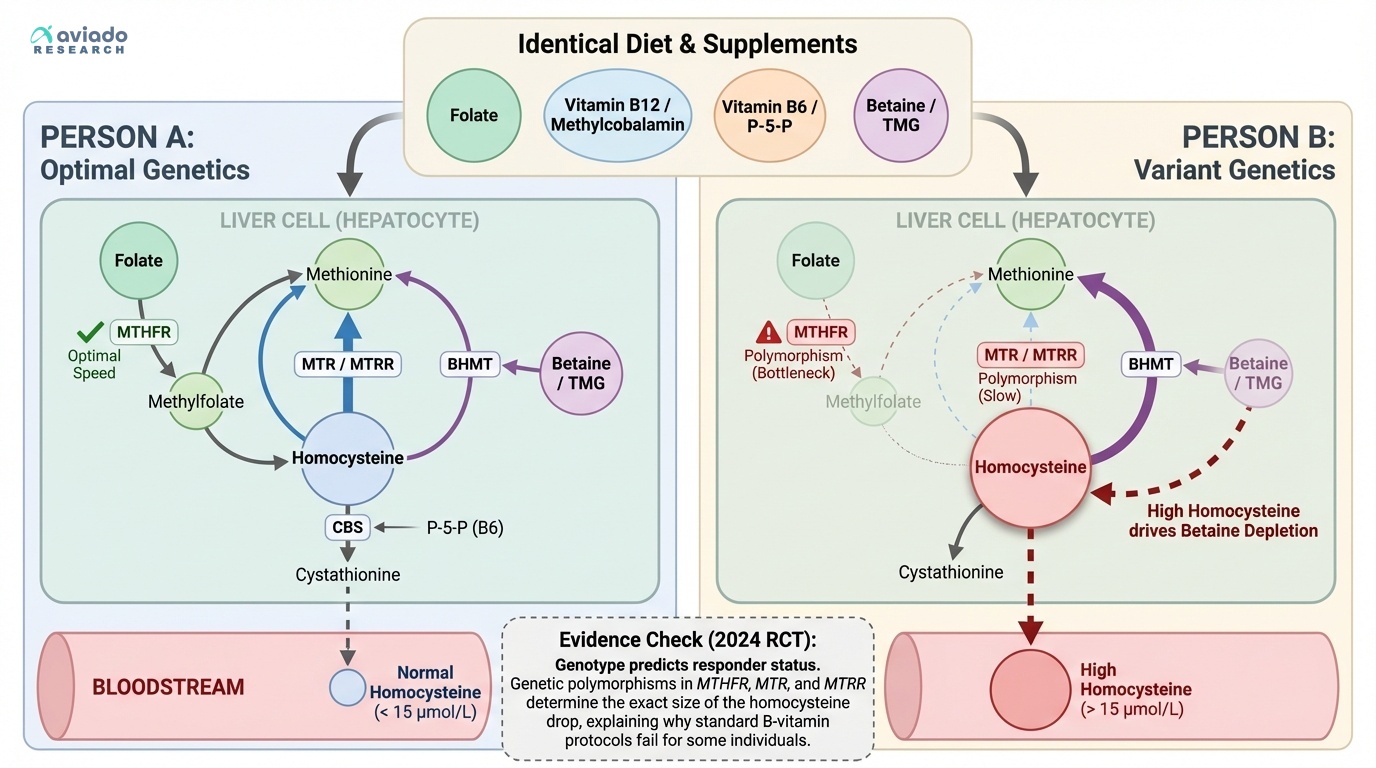
Homocysteine control depends on several enzymes, and your genes help set the “speed” of each one. The best-known gene is MTHFR (methylenetetrahydrofolate reductase). But MTR (methionine synthase) and MTRR (methionine synthase reductase) also matter because they drive the B12-dependent step that remethylates homocysteine back to methionine [1].

A 2024 randomized controlled trial tested a targeted stack of methylfolate, pyridoxal-5'-phosphate (P-5-P), and methylcobalamin, and then compared responses across genetic variants [15]. The key takeaway was not that the vitamins “work” in general. It was that the size of the homocysteine drop depended on the person’s polymorphisms. In other words, your genotype can predict whether a standard plan helps you, helps you a little, or barely moves the number.

This also explains a common frustration in real life. Some people take folic acid for months and see little change. If the bottleneck is upstream (like reduced MTHFR activity) or downstream (like MTR/MTRR efficiency), the form and pathway support matter more than the label dose. Genetics, age, and sex then layer on top and shape your overall methylation throughput [13].

Why 'Normal' May Not Be Optimal for You

Most labs flag homocysteine above 15 µmol/L as “high,” but that cutoff can miss meaningful effects. In a 2023 study in fertility care, homocysteine levels tracked with the number of failed IVF cycles even when results stayed within the lab reference range [12]. That pattern suggests risk can rise step-by-step, not only after you cross a single “abnormal” line.

Your blood homocysteine also reflects which tissue pathways do most of the work. A large share of circulating homocysteine comes from liver methionine metabolism. In the liver, betaine homocysteine methyltransferase (BHMT) provides an alternate remethylation route that does not rely on folate or B12 [7]. So a “normal” folate and B12 intake does not guarantee a low homocysteine if the BHMT side is strained.

If your goal is optimization, not just avoiding a flagged lab value, you may need a tighter target and a more complete plan. That means measuring homocysteine, correcting the B-vitamin side, and addressing the betaine-BHMT pathway when needed.

The Forgotten Betaine Connection

Many homocysteine plans focus only on folate, B12, and B6. That misses a major backup system: the betaine-BHMT pathway. In the liver, BHMT can remethylate homocysteine using betaine (trimethylglycine, TMG) instead of folate and B12 [7]. This route becomes more important when the folate/B12 route runs slowly.

There is also a “catch.” High homocysteine can drive betaine depletion [14]. As homocysteine rises, the body draws down betaine to process it through BHMT. Less betaine can then mean less capacity to clear homocysteine through this route. That feedback loop helps explain why some people plateau on B vitamins alone.

BHMT activity is tightly tied to liver methyl balance. In liver disease states, disruption of BHMT-dependent remethylation links to broader methylation stress, including S-adenosylmethionine (SAM) imbalance [8]. For readers who do not respond to active B vitamins, adding betaine (TMG) is a practical next lever to test and verify with repeat labs.

Personalized Supplementation Based on Your Genetics

If you want to lower homocysteine, the most reliable approach is “test, treat, retest.” The 2024 trial supports using active forms—methylfolate, P-5-P, and methylcobalamin—and it shows that the benefit can vary by genotype [15]. That is why two people can take “the same B complex” and see different results.

If you have an MTHFR variant, methylfolate often makes more sense than folic acid because it supplies the active form directly. Likewise, methylcobalamin supports the B12-dependent remethylation step, and P-5-P supports the B6-dependent clearance route.

You can personalize in two ways. Option one is genetic testing (MTHFR C677T/A1298C, and ideally MTR/MTRR) to predict likely bottlenecks. Option two is response testing: start with active forms, then recheck homocysteine after 8–12 weeks. If the number does not move enough, add betaine (TMG) and retest. Either way, your lab result is your scoreboard.

Your Homocysteine Level Is a Personal Report Card on Your Methylation Genetics — Here's How to Read It

Your Homocysteine Level Is a Personal Report Card on Your Methylation Genetics — Here's How to Read It

Why two people with identical diets and supplements can have wildly different homocysteine levels

Diagram glossary
adenosylmethionine:
A primary methyl donor molecule involved in cellular methylation reactions.
B12:
An essential vitamin required for remethylating homocysteine back into methionine.
B6:
An essential vitamin whose active form helps metabolize homocysteine.
BHMT:
An enzyme that uses betaine to convert homocysteine into methionine.
DNA:
The molecule that carries genetic instructions for development and functioning.
Homocysteine:
An amino acid whose elevated levels indicate impaired methylation cycle function.
IVF:
A medical procedure where an egg is fertilized by sperm outside the body.
MTHFR/MTR:
Key genes and enzymes that regulate folate metabolism and homocysteine remethylation.
MTR/MTRR:
Genes and enzymes driving the B12-dependent step that remethylates homocysteine to methionine.
P-5-P:
Pyridoxal-5'-phosphate, the biologically active form of vitamin B6.
SAM:
S-adenosylmethionine, the principal methyl donor in cellular metabolic pathways.
TMG:
Trimethylglycine, or betaine, a compound that provides methyl groups to reduce homocysteine.

Track this in your stack

See how homocysteine relates to your health goals, compare it against evidence tiers, and monitor changes in your biomarkers over time.

Open Aviado

Conclusions

Homocysteine is not just a “B-vitamin number.” It is a live signal of how your methylation pathways are running, shaped by your genetics and your nutrient forms. If your goal is to improve the number, use a test-and-verify plan: check fasting homocysteine, use active B vitamins first, and then support the betaine-BHMT pathway if you plateau. Treat the lab reference range as a screening tool, not a personal target, and let your repeat results guide your next step.

Limitations

Evidence for genotype-guided homocysteine treatment is promising but still limited. Many studies link homocysteine to outcomes, but lowering homocysteine does not always prove improved clinical endpoints in every population. The 2024 genotype-stratified findings need replication and clearer effect sizes by variant. “Optimal” targets likely differ by condition (cardiovascular, neurological, fertility) and are not settled. Betaine data also skew toward clinical or liver-focused settings, so dosing and long-term effects in generally healthy people are less certain. This article is educational and does not replace individualized medical care, especially for pregnancy planning or known B12 deficiency.

Sources (8)

1

Molecular genetics of homocysteine metabolism

Finkelstein JD. Journal of Nutrition, 2000.

PMID: 10681651
7

Betaine homocysteine S-methyltransferase: just a regulator of homocysteine metabolism?

Slow S et al.. Cellular and Molecular Life Sciences, 2006.

PMID: 17086380
8

Betaine homocysteine methyltransferase (BHMT)-dependent remethylation pathway in human healthy and tumoral liver

Avila MA et al.. Hepatology, 2013.

PMID: 23449526
10

Disorders of homocysteine metabolism

Mudd SH et al.. American Journal of Medical Genetics, 1997.

PMID: 9211199
12

Homocysteine serum levels correlate with the number of failed IVF cycles even when within normal range

Dobrivojević M et al.. Journal of Assisted Reproduction and Genetics, 2023.

PMID: 37037915
13

Neuro-fuzzy model of homocysteine metabolism

Singh K et al.. Computer Methods and Programs in Biomedicine, 2018.

PMID: 29321350
14

High homocysteine induces betaine depletion

Slow S et al.. Cardiovascular Research, 2015.

PMID: 26182429
15

Effect of Methylfolate, Pyridoxal-5'-Phosphate, and Methylcobalamin on homocysteine levels in individuals with genetic polymorphisms

Rodriguez-Melendez R et al.. Nutrients, 2024.

PMID: 38892484