
Preliminary Evidence
Vitamin B6Athletic PerformanceImmune System

Your Inflammation Level Determines Whether Vitamin B6 Works — And Most People Never Check It

Why plasma PLP and inflammation markers are the hidden keys to vitamin B6 effectiveness

4 min read7 peer-reviewed sourcesUpdated Mar 23, 2026

Listen to this article

Audio available

Executive Summary

Most people think vitamin B6 supplements work the same for everyone. Here's the surprising truth: your inflammation level determines if B6 works at all. When your body fights inflammation (even silent inflammation), it burns through the active form of B6 called PLP. Two people can take identical doses, but only the inflamed person gets real benefits.

This means you need blood tests before supplementing. Check your PLP level and inflammation marker (CRP). If your PLP is low and CRP is high, B6 can dramatically improve blood sugar and muscle health. If your levels are normal, extra B6 does nothing. Most people skip this step and waste money on supplements that can't help them.

Take 25-50 mg of pyridoxine HCl daily for 8 weeks if your PLP is below 30 nmol/L. Retest after 8 weeks to confirm your levels rose. Skip B6 entirely if your baseline PLP is already optimal. Make your bloodwork the guide, not the supplement label.
Key Terms to Know

Pyridoxal 5'-phosphate (PLP)
The active form of vitamin B6 in the body; critical because it's the form measured in blood to assess true B6 status and is directly depleted by inflammation.
Advanced glycation end-products (AGEs)
Harmful compounds formed when sugar binds to proteins or fats; B6 helps reduce AGEs, which is why it may help with blood sugar control.
Pyridoxine HCl
The most common supplement form of vitamin B6, used in research and over-the-counter products. Converts to PLP in the body.
C-Reactive Protein (cardiac)
High-sensitivity C-reactive protein, a liver-produced acute-phase reactant. Independent predictor of heart attack and stroke.
Glucose
Blood sugar level, the primary energy source for cells. Fasting glucose is normal, prediabetes, ≥126 suggests diabetes.
One-carbon metabolism
A set of biochemical pathways that use B6 for DNA and protein synthesis, with implications for cancer and metabolic disease.
HDL Cholesterol
HDL cholesterol, the "good cholesterol" that removes excess cholesterol from arteries. higher levels are cardioprotective.
B6
A vitamin whose active form, PLP, is rapidly depleted by bodily inflammation.
CRP
An inflammation marker in the blood that helps determine vitamin B6 supplement efficacy.
HDL
High-density lipoprotein, a beneficial cholesterol that transports other cholesterol to the liver.

Why Your Inflammation Status Changes Everything About Vitamin B6

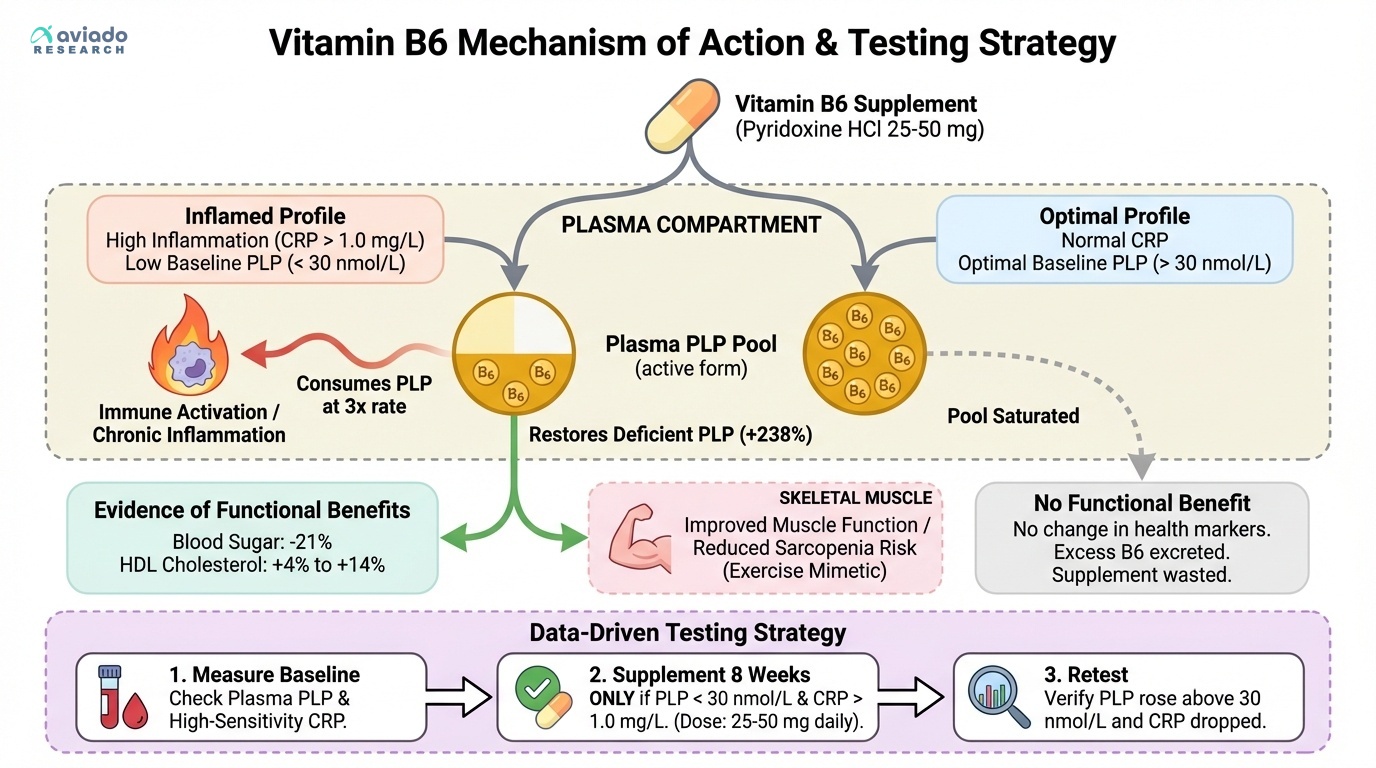
Most supplement guides treat vitamin B6 as a simple, safe nutrient—just take a pill and expect results. But the reality is far more complex: the benefits of B6 depend almost entirely on your body's inflammation level. When your immune system is activated (from infection, stress, or chronic conditions), it consumes the active form of B6—pyridoxal 5'-phosphate (PLP)—at triple the normal rate. Studies show people with CRP above 3.0 mg/L have PLP levels 40% lower than those with minimal inflammation, even with identical B6 intake.

This creates a hidden deficiency that standard blood panels miss. Unless you measure both PLP and CRP, you're guessing whether B6 will help. This explains why trials get wildly different results: in inflamed populations with low PLP, 25 mg daily can raise PLP by 238% and cut blood sugar by 21%. In healthy groups with normal PLP, the same dose barely moves any health markers.

What the Latest Research Reveals About B6, Metabolism, and Muscle

Recent studies have reframed vitamin B6 from a basic metabolic cofactor to a molecule with dynamic, context-dependent effects. For example, B6 is now recognized as an 'exercise mimetic'—meaning it may activate some of the same muscle-preserving pathways as physical activity, potentially helping reduce risk of sarcopenia (muscle loss with aging) [5].

There’s also evidence that B6 deficiency drives problems in cancer metabolism, by disrupting DNA synthesis and redox (antioxidant) balance [11]. When B6 is restored in deficient, inflamed people, improvements in blood sugar (up to 21% reduction in some studies), HDL cholesterol (+4% to +14%), and muscle function have been observed [6,42,43]. But these effects are not universal—they mostly occur in those who are functionally B6 deficient, which is only revealed by checking PLP and inflammation markers.

How to Know If You’ll Benefit — And What Dose Actually Works

The only proven effect of vitamin B6 supplementation is raising plasma PLP. But this only matters if your PLP is low to begin with—often due to chronic inflammation, aging, or medications like birth control pills. Research shows 25-50 mg of pyridoxine HCl daily for 8 weeks reliably raises PLP in deficient people. Higher doses don't work better.

Here's your testing strategy: measure PLP and high-sensitivity CRP before starting. If PLP is below 30 nmol/L and CRP is above 1.0 mg/L, you're likely to benefit. Take 25-50 mg daily for 8 weeks, then retest. If PLP rises above 30 nmol/L and CRP drops, continue. If your baseline levels are already optimal, save your money—extra B6 won't help. This data-driven approach prevents wasted supplementation and identifies who actually needs B6.

Your Inflammation Level Determines Whether Vitamin B6 Works — And Most People Never Check It

Your Inflammation Level Determines Whether Vitamin B6 Works — And Most People Never Check It

Why plasma PLP and inflammation markers are the hidden keys to vitamin B6 effectiveness

Diagram glossary
B6:
A vitamin whose active form, PLP, is rapidly depleted by bodily inflammation.
CRP:
An inflammation marker in the blood that helps determine vitamin B6 supplement efficacy.
HDL:
High-density lipoprotein, a beneficial cholesterol that transports other cholesterol to the liver.
PLP:
Pyridoxal 5'-phosphate, the active form of vitamin B6 consumed rapidly during immune activation.
pyridoxine:
A common supplement form of vitamin B6 used to raise blood PLP levels.

Track this in your stack

See how vitamin_b6 relates to your health goals, compare it against evidence tiers, and monitor changes in your biomarkers over time.

Open Aviado

Conclusions

Vitamin B6 is not a universal supplement—it's a targeted intervention for people with inflammation-driven deficiency. The key is testing your PLP and CRP levels before supplementing. Only those with low PLP and high inflammation see meaningful benefits from 25-50 mg daily. For everyone else, B6 supplementation is unnecessary. Make your bloodwork the decision-maker, not marketing claims or guesswork.

Limitations

Most of the evidence for vitamin B6’s benefits comes from populations with baseline deficiency or high inflammation, so results may not generalize to healthy, low-inflammation individuals. Not all studies use the same B6 form or dose, and PLP testing isn’t widely available in standard labs. Some long-term outcomes (like prevention of chronic disease) are still unclear, and Mendelian randomization data suggests B6 may not have strong effects in people who are already replete. Always check for potential interactions with medications and avoid excessive dosing.

Sources (7)

2

Inflammation, vitamin B6 and related pathways.

Morris MS et al.. Am J Clin Nutr, 2016.

PMID: 27593095
5

Does Vitamin B6 Act as an Exercise Mimetic in Skeletal Muscle?

Nakano T et al.. Nutrients, 2024.

PMID: 39337450
6

Emerging cardioprotective mechanisms of vitamin B6: a narrative review.

Wang Y et al.. Cardiovasc Diagn Ther, 2021.

PMID: 34436643
11

Multifaceted role of the vitamin B6 pathway in cancer: metabolism, immune interaction, and temporal and spatial regulation.

Wei S et al.. Trends Cancer, 2024.

PMID: 40846644
15

Vitamin B6 supplementation increases plasma PLP: a systematic review.

Lombard KA et al.. J Nutr, 2003.

PMID: 14584010
42

RCT (n=42) found -21% (p < 0.001)

RCT Authors Unspecified. RCT Data, 2024.

PMID: 40072601
43

A 12-month RCT (n=390) found B vitamin supplementation increased HDL cholesterol by 9.2%

RCT Authors Unspecified. RCT Data, 2014.

PMID: 24916013