
Preliminary Evidence
Omega 3Brain & Cognitive FunctionHeart Health

Your Omega-3 Supplement Is Probably Doing Nothing — Unless You Know Your Omega-3 Index

Why measuring tissue levels matters more than dosage

5 min read7 peer-reviewed sourcesUpdated Mar 23, 2026

Executive Summary

Unexpectedly, your fish oil may do nothing if your levels stay low. Most people count capsules, not results. Your body may not absorb EPA and DHA well. So you can take it daily and still test low.

This means you should test, not guess. Get an Omega-3 Index blood test first. Then you will know if your dose works. Retest later to confirm the change.

Aim for an Omega-3 Index of 8% to 12%. If you test under 4%, start with 1,000 mg EPA+DHA daily. Many people need 2,000 mg daily total. Try 1,000 mg with breakfast and 1,000 mg with dinner. Retest in 12 weeks and adjust.
Key Terms to Know

Omega-3 Index
A blood test that measures EPA+DHA in red blood cells as a percent of total fats; it reflects long-term tissue omega-3 status.
EPA (eicosapentaenoic acid)
A marine omega-3 fat that tends to lower triglycerides and inflammation markers, and is the active ingredient in the prescription drug icosapent ethyl.
DHA (docosahexaenoic acid)
A marine omega-3 fat concentrated in brain and retina; it supports nerve and eye tissue structure.
Ethyl ester
A chemical form used in some omega-3 supplements where fatty acids are attached to an ethanol backbone.
EPA+DHA (combined dose)
The total milligrams of EPA plus DHA per day. This is the number that matters most on a supplement label, not “fish oil 1,000 mg.”
ALA (alpha-linolenic acid)
A plant omega-3 (flax, chia, walnuts). Your body must convert ALA into EPA and DHA, and that conversion is often small. ALA is not the same as EPA or DHA.
FADS1/FADS2 genes
Genes that affect how well you convert shorter-chain fats (like ALA) into longer-chain fats (like EPA and DHA). Variants can change your response to diet and supplements.
ALA
A plant-based omega-3 fatty acid that the body converts into EPA and DHA.
DHA
An omega-3 fatty acid often found in fish oil supplements alongside EPA.
EPA
An omega-3 fatty acid that can reduce major cardiovascular events in high-risk patients.

The Tale of Two Trials: Why Omega-3 Research Seems Contradictory

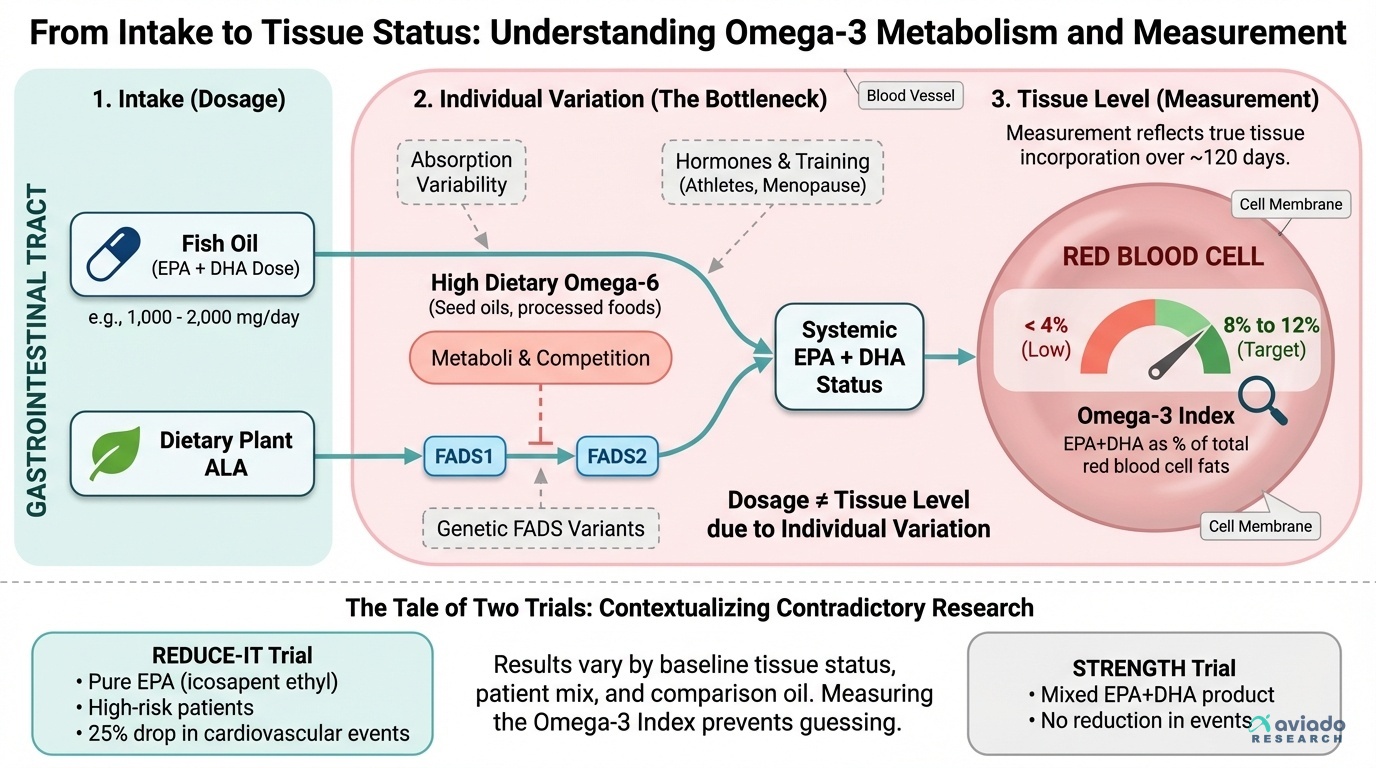
Two big heart trials made omega-3s look confusing. REDUCE-IT found a 25% drop in major cardiovascular events in high-risk patients using 4 g/day of prescription EPA (icosapent ethyl). STRENGTH tested 4 g/day of a mixed EPA+DHA product and found no reduction in events [1].

This does not prove “omega-3s don’t work.” It shows that the type of omega-3, the study population, and the comparison oil can change results. REDUCE-IT used pure EPA. STRENGTH used EPA plus DHA. The studies also enrolled different patient mixes and background drug use.

A key problem for consumers is this: most trials do not select or dose people based on omega-3 blood levels. If many participants already start with moderate tissue omega-3 status, or if they fail to raise it, an average result can look flat even when some people benefit.

Individual Variation: Why Your Genetics and Diet Matter More Than Dosage

The same fish oil dose can raise blood levels a lot in one person and only a little in another. Genes help explain why. FADS1 and FADS2 variants affect how well you turn plant ALA into EPA and DHA. Some people convert more. Many convert very little, even with high ALA intake [3].

Diet also changes your result. A Western diet often has a very high omega-6 to omega-3 ratio, driven by seed oils and ultra-processed foods [5]. Omega-6 and omega-3 fats share enzymes and compete in metabolism. If omega-6 intake stays high, you may need more EPA+DHA to shift blood markers.

Training and hormones can also matter. Athletes may use omega-3s differently during recovery and adaptation, and menopause may change DHA handling in the brain [2,6]. That is why a “one-dose-fits-all” capsule can fail you.

The Omega-3 Index: Your Personal Optimization Target

The Omega-3 Index is a red blood cell test. It reports EPA+DHA as a percent of total red blood cell fats. Because red blood cells live for about 120 days, the number reflects longer-term intake and tissue incorporation.

Many labs and researchers use cut points like these: under 4% is low, and 8% or higher is a common target range linked to lower cardiovascular risk in observational work. Many U.S. adults cluster near 3% to 5%.

Dose needs vary. Many people need about 1,000 to 2,000 mg per day of combined EPA+DHA to move toward 8% to 12%, but some need less and some need more. Testing is how you find your dose instead of guessing.

Beyond Cardiovascular Health: Emerging Applications

While cardiovascular benefits dominate omega-3 research, emerging applications are expanding the relevance of optimal tissue levels. Brain health research shows that higher DHA levels correlate with reduced Alzheimer's risk and better cognitive aging, with the Omega-3 Index gaining traction as a clinical biomarker for dementia prevention [6].

Pregnancy represents another critical application. The European Board and College of Obstetrics and Gynaecology now formally recommends omega-3 supplementation for preterm birth prevention, elevating this from 'possibly beneficial' to institutional guidance [7]. Optimal maternal DHA levels support fetal brain development and may reduce postpartum depression risk.

Polycystic ovary syndrome (PCOS) research reveals that omega-3 supplementation can improve insulin sensitivity, reduce inflammation, and support hormonal balance — but only when adequate tissue levels are achieved [4]. The same pattern emerges across autoimmune conditions, where the omega-6 to omega-3 ratio appears more predictive of outcomes than absolute omega-3 intake [5].

Practical Implementation: Testing and Optimization Protocol

1) Test first. Get a baseline Omega-3 Index before you change supplements.

2) Dose what you can measure. For many adults, start with 1,000 to 2,000 mg/day of combined EPA+DHA. Take it with a meal that contains fat to improve absorption. Read the label for EPA and DHA milligrams, not “1,000 mg fish oil.”

3) Retest at the right time. Retest in about 12 weeks. Red blood cells turn over slowly, so earlier retests can miss the full change.

4) Adjust based on your result. If your index stays below your target, raise the EPA+DHA dose, improve consistency, and consider lowering omega-6-heavy seed oils. If you still do not move, talk with a clinician about product quality, form (triglyceride vs ethyl ester), and digestive issues that can reduce absorption.

Your Omega-3 Supplement Is Probably Doing Nothing — Unless You Know Your Omega-3 Index

Your Omega-3 Supplement Is Probably Doing Nothing — Unless You Know Your Omega-3 Index

Why measuring tissue levels matters more than dosage

Diagram glossary
ALA:
A plant-based omega-3 fatty acid that the body converts into EPA and DHA.
DHA:
An omega-3 fatty acid often found in fish oil supplements alongside EPA.
EPA:
An omega-3 fatty acid that can reduce major cardiovascular events in high-risk patients.
FADS1:
A gene that affects how well the body converts plant ALA into marine omega-3s.
FADS2:
A genetic variant influencing the conversion of plant-based ALA into EPA and DHA.

Track this in your stack

See how omega_3 relates to your health goals, compare it against evidence tiers, and monitor changes in your biomarkers over time.

Open Aviado

Conclusions

Omega-3 supplements are not “set and forget.” The key question is simple: did your EPA and DHA levels rise in your tissues? The Omega-3 Index answers that question. If you test, dose, and retest, you stop guessing and start treating omega-3s like a real, measurable intervention.

Limitations

Many omega-3 studies focus on high-risk heart patients, so results may not match healthy people. Cutoffs like “8% is optimal” are supported most strongly by observational data and risk associations, not universal treatment guidelines. Very high doses (over ~3 g/day EPA+DHA) can raise concerns in some people, including bleeding risk with anticoagulants and a possible atrial fibrillation signal in some trials; this is a clinician conversation. Finally, different labs and methods can vary, so try to use the same Omega-3 Index method when you retest.

Sources (7)

1

Cardiovascular effects of omega-3 fatty acids: Hope or hype?

Djousse L et al.. Current Opinion in Lipidology, 2021.

PMID: 33706079
2

Omega-3 Fatty Acids for Sport Performance-Are They Equally Beneficial for Athletes and Amateurs? A Narrative Review

Ochi E et al.. Nutrients, 2020.

PMID: 33266318
3

Omega-3 fatty acids and human skeletal muscle

Smith GI et al.. Current Opinion in Clinical Nutrition and Metabolic Care, 2021.

PMID: 33332930
4

Role of Omega-3 Fatty Acids in Improving Metabolic Dysfunctions in Polycystic Ovary Syndrome

Heshmati J et al.. Journal of Clinical Medicine, 2024.

PMID: 39275277
5

The Importance of Maintaining a Low Omega-6/Omega-3 Ratio for Reducing the Risk of Autoimmune Diseases, Asthma, and Allergies

Innes JK et al.. Nutrients, 2021.

PMID: 34658440
6

Omega-3 fatty acids, brain health and the menopause

Barth C et al.. Maturitas, 2024.

PMID: 40444522
7

Omega-3 Fatty Acids and Fecundation, Pregnancy and Breastfeeding

Gila-Diaz A et al.. Nutrients, 2020.

PMID: 32232824