
Preliminary Evidence
SeleniumMetabolic Health

Your Selenium Level Is Either Too Low or Too High — and Standard Dosing Can't Tell You Which

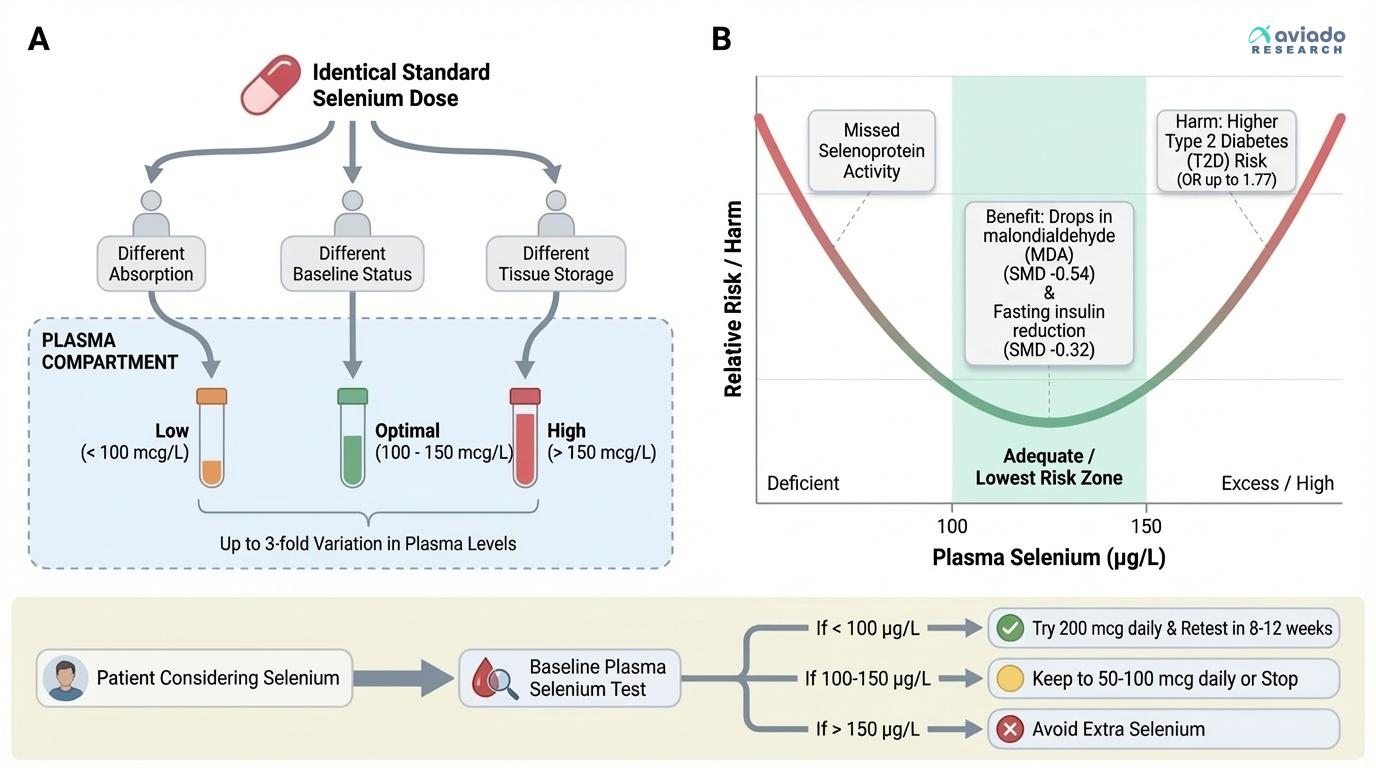
New dose-response data reveals 3-fold variation in blood levels between people taking identical selenium doses

4 min read3 peer-reviewed sourcesUpdated Apr 4, 2026

Executive Summary

The surprising part about selenium is this: the same dose can push you too low or too high. Most people take a “standard” pill and assume it fits. But selenium has a tight safe range. Your blood level can swing a lot.

What this means for you is simple. You need your selenium level first. A blood test tells you if you need it. It also tells you if you should skip it. This cuts your risk and boosts your odds of benefit.

Use numbers, not guesses. If your plasma selenium is under 100 mcg/L, try 200 mcg daily. Retest in 8 to 12 weeks. If you land near 100 to 150 mcg/L, keep to 50 to 100 mcg daily or stop. If you are over 150 mcg/L, avoid extra selenium. One Brazil nut can add 70 to 90 mcg.
Key Terms to Know

Whole-blood selenium
Selenium measured in whole blood (plasma plus blood cells). It may reflect longer-term intake than plasma alone.
TPO antibodies (TPOAb)
Thyroid peroxidase antibodies. High levels can be seen in Hashimoto’s thyroiditis and are sometimes tracked during selenium use.
Plasma selenium
Selenium measured in the liquid part of your blood, reported as mcg/L. It helps show if you are low, optimal, or high.
U-shaped risk curve
A pattern where both low and high selenium levels link to higher risk, with the lowest risk in the middle range.
Meta-Analysis
A statistical technique combining results from multiple studies to find overall patterns.
Glutathione peroxidase (GPx)
An antioxidant enzyme that depends on selenium. GPx activity can act as a functional marker of selenium status.
Malondialdehyde (MDA)
A blood marker of oxidative damage. Lower MDA often means less oxidative stress.
insulin
A pancreatic hormone that regulates blood glucose levels and metabolism.
L
A standard metric unit of volume used to measure liquids such as blood plasma.
mcg
A metric unit of mass equal to one millionth of a gram.

The Individual Response Problem: Why Standard Dosing Fails

The big issue with selenium is not the “right dose.” It is your response to that dose. In one dose-ranging dataset, people taking 300 mcg per day ended up with plasma selenium as low as 158 mcg/L and as high as 276 mcg/L [1]. That is a 118 mcg/L spread from the same intake.

This gap likely comes from real biology. People differ in absorption, baseline status, and how selenium gets stored in tissues. That makes common advice like “take 200 mcg daily” a blunt tool. For some people, it helps. For others, it overshoots.

Selenium also has less room for error than many nutrients. Benefit and harm sit closer together. So the same “standard” capsule can be too little for one person and too much for another [7].

The U-Shaped Risk: When More Isn't Better

Selenium shows a U-shaped pattern. Low and high levels can both look bad. In large population data, higher selenium status has been linked with higher type 2 diabetes risk. One report noted an odds ratio up to 1.77 in the highest group versus the reference range [1].

Many researchers place the lowest-risk zone around 100 to 150 mcg/L of plasma selenium. Below that, you may miss key selenoprotein activity. Above that, risk markers can move the wrong direction.

You also cannot “feel” your way to the right level. Signs like fatigue can happen at both ends. The practical fix is measurement: use a plasma selenium test to see where you start and where you end up [9].

Proven Benefits Within the Optimal Range

Selenium works best when it brings you into a better range, not when it simply raises your number. Controlled trials and meta-analyses show changes in metabolic and antioxidant markers, but results are not always consistent.

On insulin markers, one meta-analysis of 25 RCTs (n=1,600) found fasting insulin fell (SMD -0.32) [1]. But another meta-analysis (n=656) reported no significant effect on fasting insulin versus placebo [1]. The most consistent takeaway is that baseline status and dose likely drive who benefits.

On oxidative stress, findings are stronger. Meta-analyses report meaningful drops in malondialdehyde (MDA), a lipid damage marker. One analysis of 13 controlled trials found MDA decreased with an SMD of -0.54 (95% CI: -0.78 to -0.30) [1].

Testing and Dosing: The Precision Approach

A precision approach fixes selenium’s main problem: uncertainty. Start with a blood test, then match your dose to your level. Plasma selenium tests are widely available and often cost about $50 to $100.

If your plasma selenium is below 100 mcg/L, supplementation is more likely to help. A common starting point is 100 to 200 mcg per day of selenomethionine. Recheck your level after 8 to 12 weeks to see your personal rise.

If you test around 100 to 150 mcg/L, you may not need a full-dose supplement. If you still choose to supplement, keep it modest, such as 50 to 100 mcg per day, and avoid stacking multiple products.

If you are above 150 mcg/L, avoid adding more selenium. Instead, review high-selenium inputs. Brazil nuts are a top source and can contain about 70 to 90 mcg per nut, so a daily habit can add up fast.

Treat selenium like a “measure, adjust, recheck” supplement. That keeps you in the beneficial middle and away from both extremes [1][7].

Your Selenium Level Is Either Too Low or Too High — and Standard Dosing Can't Tell You Which

Your Selenium Level Is Either Too Low or Too High — and Standard Dosing Can't Tell You Which

New dose-response data reveals 3-fold variation in blood levels between people taking identical selenium doses

Diagram glossary
insulin:
A pancreatic hormone that regulates blood glucose levels and metabolism.
L:
A standard metric unit of volume used to measure liquids such as blood plasma.
mcg:
A metric unit of mass equal to one millionth of a gram.
MDA:
A compound serving as a widely used biomarker for oxidative stress and lipid peroxidation.
T2D:
A chronic metabolic disease characterized by insulin resistance and elevated blood glucose levels.

Track this in your stack

See how selenium relates to your health goals, compare it against evidence tiers, and monitor changes in your biomarkers over time.

Open Aviado

Conclusions

Selenium is a supplement where testing earns its keep. People can see very different blood levels from the same dose, and the best outcomes tend to sit in a middle range. If you measure plasma selenium first, you can choose a dose that fits your starting point, then confirm the result with a retest. That turns selenium from a guess into a controlled, trackable tool for antioxidant and metabolic support.

Limitations

Many selenium trials enroll people who start out low, so results may not translate to selenium-replete readers. Some outcomes (like insulin markers) show mixed meta-analysis results, suggesting baseline status, dose, and study length matter. “Optimal” plasma ranges (often cited near 100–150 mcg/L) are practical targets, not fixed cutoffs for every person. Lab methods and reference ranges can vary, so trends over time in the same lab are often more informative than a single number.

Sources (3)

1

Effects and Impact of Selenium on Human Health, A Review

Various Authors. PubMed, 2024.

PMID: 39795109
7

Selenium and brain aging: A comprehensive review with a focus on hippocampal neurogenesis

Various Authors. PubMed, 2024.

PMID: 40946974
9

Voyage of selenium from environment to life: Beneficial or toxic?

Various Authors. PubMed, 2022.

PMID: 35976011