Preliminary Evidence
TestosteroneHormone Balance

Your Testosterone Number Is Lying to You: Why Free vs. Total T Is the Difference Between Optimized and Overlooked

The binding protein SHBG—not testosterone itself—may determine whether you respond to therapy or training

4 min read8 peer-reviewed sourcesUpdated Mar 23, 2026

Executive Summary

The surprising truth is your total testosterone can look fine. Yet your body may still feel low. Most labs stop at one number. They miss SHBG, which can trap testosterone.

Here is what this means for you. Test free T and SHBG with total T. If SHBG is high, less T reaches cells. If SHBG is low, total T can look low.

Use clear targets and timelines. Ask for morning labs, 7–10 AM. Recheck after 8–12 weeks of changes. On TRT, check hematocrit every 12 weeks first year.

Key Terms to Know

SHBG (Sex Hormone-Binding Globulin)
A blood protein that tightly binds testosterone. Higher SHBG usually means lower free T.
Albumin-Bound Testosterone
Testosterone loosely attached to albumin. It can break free and be used.
Sex Hormone Binding Globulin
SHBG, a protein that binds and inactivates sex hormones. high levels reduce free testosterone, low levels increase it.
Total Testosterone
Total testosterone, the primary male sex hormone influencing muscle, bone, and libido. low levels cause fatigue, low libido, and muscle loss.
Hematocrit
The percentage of blood volume occupied by red blood cells. low hematocrit indicates anemia, while high values may signal dehydration or polycythemia.
Free Testosterone
Bioavailable testosterone not bound to sex hormone binding globulin.
Hemoglobin
The oxygen-carrying protein in red blood cells. low hemoglobin causes fatigue and indicates anemia, while elevated levels may increase blood viscosity.
adipose
Body tissue specialized in storing energy as fat.
androgen
A type of hormone, such as testosterone, that controls male physical characteristics.
aromatase
An enzyme responsible for converting androgens like testosterone into estrogens.

The Free Hormone Hypothesis Under Fire

For decades, endocrinologists have operated under the free hormone hypothesis: only unbound testosterone can enter cells and create biological effects. This assumption drives the clinical focus on measuring free testosterone rather than just total testosterone. However, recent research is challenging this fundamental principle [1].

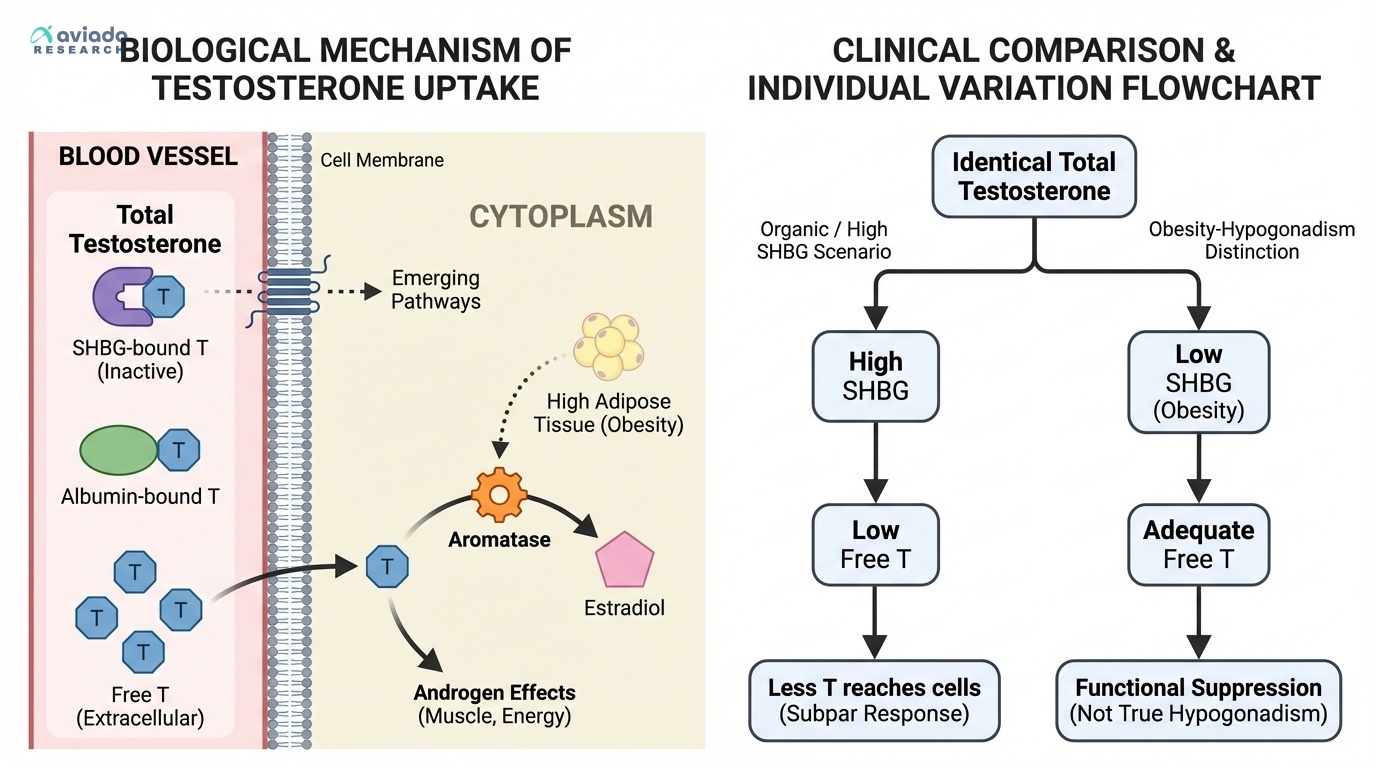
The traditional model suggests that testosterone bound to SHBG is completely inactive, while testosterone bound to albumin can dissociate and become available to tissues. But emerging evidence indicates that SHBG-bound testosterone may have its own biological pathways, and that tissue-specific factors influence hormone uptake in ways that simple blood measurements can't capture.

This reappraisal doesn't invalidate free testosterone testing—it reveals why the same free testosterone level can produce different results in different people. Factors like tissue sensitivity, receptor density, and local enzyme activity create additional layers of variation that explain why some men feel optimal at free testosterone levels that leave others feeling subpar.

Why Identical Numbers Create Different Results

Testosterone doesn't work alone—it functions as a prohormone that converts to estradiol through the aromatase enzyme [2]. This conversion varies dramatically between individuals based on body composition, age, and genetic factors. Men with higher aromatase activity convert more testosterone to estradiol, potentially experiencing different effects from the same testosterone dose.

Body fat percentage particularly influences this conversion, as adipose tissue contains high levels of aromatase. This creates a metabolic feedback loop: men with obesity often show low total testosterone due to increased aromatization and SHBG suppression, but their free testosterone may remain adequate for normal function [3]. Standard reference ranges fail to account for these individual metabolic differences.

The result is that two men with identical lab values can have opposite treatment responses. One may build muscle and improve energy on testosterone replacement therapy, while another experiences minimal benefits or unwanted side effects like mood swings from excessive estradiol conversion.

The Obesity-Hypogonadism Distinction That Changes Everything

Men with obesity present a unique challenge for testosterone interpretation. They frequently show low total testosterone that appears to indicate hypogonadism, but this reduction often represents functional suppression rather than true testicular failure [3]. Their lower SHBG levels mean that free testosterone may remain in the normal range despite suppressed total levels.

This distinction has profound therapeutic implications. True hypogonadism requires lifelong testosterone replacement, while obesity-related testosterone suppression may respond to weight loss and metabolic improvement. Treating functional suppression with testosterone therapy without addressing underlying metabolic issues can worsen insulin resistance and perpetuate the cycle.

The key diagnostic difference lies in the free testosterone and SHBG pattern. Men with obesity typically show low-normal free testosterone with suppressed SHBG, while men with organic hypogonadism show low free testosterone with normal or elevated SHBG. This pattern recognition changes the entire treatment approach.

The Hidden Cardiovascular Variable: Delivery Method

Testosterone can affect your heart health in different ways. The delivery method matters. Oral testosterone goes through your liver first. That can shift blood fats in a bad direction.

A large meta-analysis of 36 RCTs (n=8,480) found oral testosterone increased LDL cholesterol [PMID: 31353194]. In contrast, another meta-analysis in intramuscular testosterone ester users found LDL fell by about 5 mg/dL (95% CI: −8 to −1) [PMID: 11566455]. These are not the same intervention.

TRT also raises red blood cells. A meta-analysis of 51 studies found hemoglobin rose by 0.80 g/dL (95% CI: 0.45 to 1.14) [PMID: 20525906]. This rise often shows up early in treatment. You need routine hemoglobin and hematocrit checks. High values can raise clot risk in some men.

What the Research Shows About Muscle and Performance

Testosterone can increase lean mass. Meta-analyses show consistent gains. One meta-analysis of 29 RCTs (n=1,083) found fat-free mass rose by 1.6 kg. That is about a 2.7% increase from baseline (95% CI: 1.1% to 4.4%) [PMID: 16117815].

The men who gain most often start low. But lab numbers still do not predict results well. Free T changes usually track response better than total T.

Your results also depend on SHBG and aromatase. Higher SHBG can keep free T low at the same dose. Higher aromatase can raise estradiol at the same dose. Both can change how you feel and perform.

Your Testosterone Number Is Lying to You: Why Free vs. Total T Is the Difference Between Optimized and Overlooked

Your Testosterone Number Is Lying to You: Why Free vs. Total T Is the Difference Between Optimized and Overlooked

The binding protein SHBG—not testosterone itself—may determine whether you respond to therapy or training

Diagram glossary
adipose:
Body tissue specialized in storing energy as fat.
androgen:
A type of hormone, such as testosterone, that controls male physical characteristics.
aromatase:
An enzyme responsible for converting androgens like testosterone into estrogens.
insulin:
A hormone produced by the pancreas that regulates blood glucose levels.
SHBG:
A protein that binds sex hormones in the blood, regulating their biological availability.
TRT:
Testosterone replacement therapy is a medical treatment to restore healthy testosterone levels.

Track this in your stack

See how testosterone relates to your health goals, compare it against evidence tiers, and monitor changes in your biomarkers over time.

Open Aviado

Conclusions

Total testosterone is only one clue. SHBG can hide what your tissues can use. Free and bioavailable testosterone better match real effects. If you have obesity, low total T may reflect low SHBG, not testis failure. If you use TRT, your delivery method and blood counts matter for safety. Test smart, then act on the full pattern.

Limitations

Free testosterone testing is not perfect. Different lab methods can give different results. Many studies do not measure SHBG, so cause and effect stays unclear. Lipid and heart-risk data also vary by dose, route, and study quality. Obesity-related low testosterone has no single agreed cutoff, so doctors must use the full clinical picture.

Sources (8)

1

Testosterone replacement therapy and cardiovascular disease

Kloner RA et al.. Nature Reviews Cardiology, 2022.

PMID: 34999717
2

Metabolic Messengers: testosterone

Handelsman DJ. Nature Metabolism, 2024.

PMID: 41514077
3

Approach to the Patient: Low Testosterone Concentrations in Men With Obesity

Bhasin S et al.. Journal of Clinical Endocrinology & Metabolism, 2024.

PMID: 40052430
4

A Reappraisal of Testosterone's Binding in Circulation: Physiological and Clinical Implications

Goldman AL et al.. Endocrine Reviews, 2017.

PMID: 28673039
5

Meta-analysis of testosterone therapy effects on hemoglobin

Fernández-Balsells MM et al.. Journal of Clinical Endocrinology & Metabolism, 2010.

PMID: 20525906
6

Testosterone treatment and muscle mass: systematic review and meta-analysis

Skinner JW et al.. Journal of Clinical Medicine, 2018.

PMID: 25139126
7

Effects of testosterone replacement therapy on body composition: a systematic review and meta-analysis

Corona G et al.. Andrology, 2021.

PMID: 16117815
8

Effects of Testosterone Supplementation for 3 Years on Muscle Performance and Physical Function in Older Men

Bhasin S et al.. Journal of Clinical Endocrinology & Metabolism, 2017.

PMID: 27754805