
Preliminary Evidence
Vitamin CImmune SystemMetabolic Health

Your Vitamin C Response Is Determined by Your Baseline: The Biomarker You Need to Check First

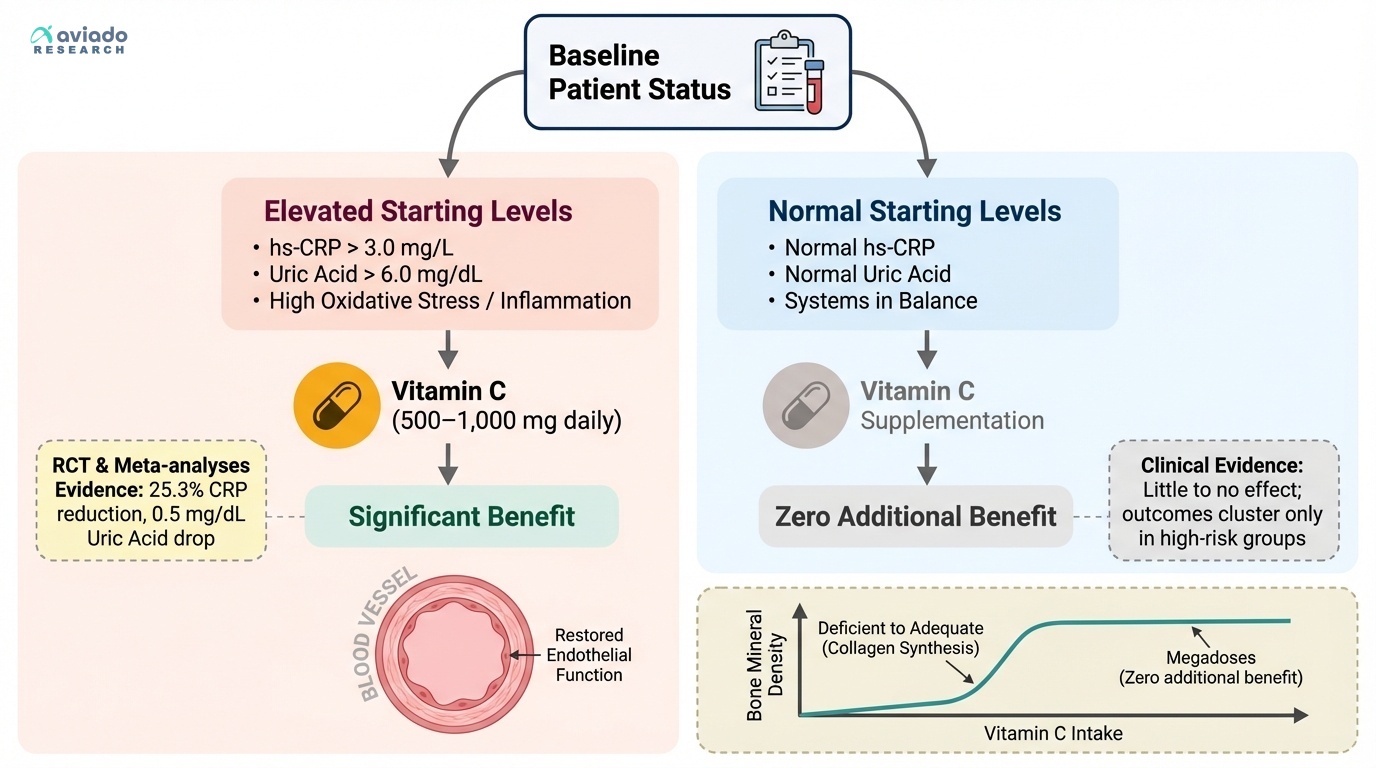
Meta-analyses reveal 25% CRP reduction and 0.5 mg/dL uric acid drop—but only in people with elevated starting levels

4 min read9 peer-reviewed sourcesUpdated Mar 23, 2026

Executive Summary

The surprising truth is vitamin C only helps some people. Most people take it daily and expect a boost. But if your labs are normal, nothing changes.

This means you should check your baseline first. Look at hs-CRP, uric acid, and glucose. If they are high, vitamin C may help you. If they are normal, save your money.

If your hs-CRP is over 3 mg/L, try 500–1,000 mg daily. If your uric acid is over 6.0 mg/dL, try 500 mg daily. Retest your labs in 8–12 weeks. Split doses like 500 mg twice daily if needed.
Key Terms to Know

Bone Mineral Density (BMD)
A scan-based measure of bone strength, often at the hip or spine. Lower BMD means higher fracture risk.
Endothelial Function
How well your blood vessel lining makes nitric oxide and relaxes arteries. Poor function raises heart risk.
C-Reactive Protein (cardiac)
High-sensitivity C-reactive protein, a liver-produced acute-phase reactant. Independent predictor of heart attack and stroke.
Baseline
Your starting lab value before you take a supplement. It often predicts if you will respond.
Uric Acid
Uric acid, the end product of purine metabolism. elevated levels cause gout attacks and correlate with metabolic syndrome.
Lipid Panel
Blood tests for total cholesterol, LDL, HDL, and triglycerides. Used to estimate heart risk.
Triglycerides
Triglycerides, the primary fat storage molecule in blood. elevated levels indicate metabolic dysfunction and increase cardiovascular risk.
CRP
A liver-produced protein that indicates levels of systemic inflammation in the body.
glucose
A simple sugar that acts as the primary energy source for living cells.
L
A metric unit of volume commonly used to measure liquid concentrations.

The Baseline Effect: Why Your Starting Point Determines Everything

Your results from vitamin C depend on your baseline labs. Dose and brand matter less than your starting point. In a 396-person randomized trial, vitamin C lowered CRP by 25.3% in people who started high. It had little to no effect when CRP started normal [1].

This “baseline effect” shows up in other outcomes too. Meta-analyses of randomized trials report lower uric acid after vitamin C, with typical drops around 0.35–0.5 mg/dL. The biggest changes tend to occur when starting uric acid is higher (around or above 6.0 mg/dL) [2]. Lipid improvements also cluster in higher-risk groups, such as people with high cholesterol or diabetes, not people with normal lipids [3].

Why this happens is simple. Vitamin C helps most when your body is under strain. That can mean higher inflammation, oxidative stress, or low intake. When your systems are already in balance, extra vitamin C has little work to do.

Cardiovascular Benefits: The Inflammation Connection

Vitamin C's cardiovascular effects follow the same baseline-dependent pattern seen with inflammatory markers. A meta-analysis of randomized controlled trials found that vitamin C supplementation at 500-2000 mg daily improved endothelial function, but primarily in populations with existing cardiovascular risk factors or elevated oxidative stress [4]. The effect size was modest but statistically significant, with a standardized mean difference of 0.25.

The most dramatic cardiovascular effects occur during acute inflammatory states. A crossover trial using high-dose intravenous vitamin C demonstrated that it could completely restore endothelium-dependent vasodilation that had been impaired by lipopolysaccharide-induced inflammation [5]. While this represents an extreme experimental condition, it illustrates vitamin C's potential when the cardiovascular system is under oxidative stress.

For practical application, people with elevated CRP levels above 3.0 mg/L, existing cardiovascular disease, or metabolic syndrome are most likely to see cardiovascular benefits from vitamin C supplementation. Those with optimal cardiovascular health markers may see minimal additional benefit, though the safety profile makes supplementation low-risk even in healthy populations.

Bone Health: The Collagen Connection

Vitamin C's role in bone health operates through a different mechanism than its antioxidant effects—collagen synthesis. This creates a threshold effect where adequate vitamin C is essential for maintaining bone density, but excess amounts don't necessarily provide additional benefits. Multiple meta-analyses have found positive associations between dietary vitamin C intake and bone mineral density at both the lumbar spine and femoral neck [6][7].

The most compelling evidence comes from longitudinal studies showing that people in the lowest tertile of vitamin C intake (7-57 mg daily) lost bone density at twice the rate of those with higher intakes [8]. Women in the lowest intake group lost bone mineral density at 0.65% per year compared to 0.30-0.31% in the middle and upper tertiles. This suggests a threshold effect where meeting basic collagen synthesis needs is critical, but megadoses don't accelerate bone building.

Cross-sectional analysis from a large randomized trial found that each 100 mg increase in vitamin C intake was associated with higher bone mineral density at the femoral neck and total hip [9]. However, this relationship appeared to plateau at moderate intake levels, supporting the threshold model rather than a linear dose-response relationship.

Dosing Strategy: Matching Intervention to Biomarker Status

Use vitamin C like a targeted tool, not a default habit. Start with labs. If your markers are already good, you may not see a measurable change.

If your hs-CRP is elevated (often defined as above 3.0 mg/L for higher cardiovascular risk), studies commonly use 500–1,000 mg per day to improve inflammation-related markers. Take it with food if it upsets your stomach.

For uric acid, meta-analyses of randomized trials support 500 mg per day for modest lowering (about 0.35–0.5 mg/dL on average) [2]. Bigger doses do not reliably give bigger drops.

If you use higher intakes (such as 1,000–2,000 mg per day), split the dose (for example, 500 mg twice daily). This can fit vitamin C’s short blood half-life and limited absorption. Retest labs in 8–12 weeks and decide based on your results.

Your Vitamin C Response Is Determined by Your Baseline: The Biomarker You Need to Check First

Your Vitamin C Response Is Determined by Your Baseline: The Biomarker You Need to Check First

Meta-analyses reveal 25% CRP reduction and 0.5 mg/dL uric acid drop—but only in people with elevated starting levels

Diagram glossary
CRP:
A liver-produced protein that indicates levels of systemic inflammation in the body.
disease:
An abnormal condition that impairs normal bodily structure or function.
glucose:
A simple sugar that acts as the primary energy source for living cells.
L:
A metric unit of volume commonly used to measure liquid concentrations.
lipopolysaccharide:
A toxic molecule found in the outer membrane of Gram-negative bacteria.
mg:
A metric unit of mass equal to one-thousandth of a gram.

Track this in your stack

See how vitamin_c relates to your health goals, compare it against evidence tiers, and monitor changes in your biomarkers over time.

Open Aviado

Conclusions

Vitamin C is not a guaranteed upgrade for everyone. It works best when your baseline markers show a problem to fix. If your hs-CRP or uric acid is high, 500–1,000 mg per day may lead to measurable improvements. If your labs are already in range, food sources of vitamin C are usually enough. The smartest move is simple: test, supplement with a clear goal, then retest.

Limitations

Many vitamin C trials focus on higher-risk or clinical groups, so results may not fully apply to healthy people with strong diets. “High” and “optimal” cutoffs can vary by lab, age, and health status, and not all studies use the same thresholds. Some findings come from observational nutrition studies, which can be biased by overall diet quality and lifestyle. Higher oral doses can cause GI upset, and long-term use at very high intakes is less studied; people with kidney stone risk or iron overload should discuss dosing with a clinician.

Sources (9)

1

Vitamin C supplementation and C-reactive protein: a randomized controlled trial

Block G et al.. American Journal of Clinical Nutrition, 2009.

PMID: 18952164
2

Vitamin C supplementation and serum uric acid: A meta-analysis of randomized controlled trials

Juraschek SP et al.. Arthritis Care & Research, 2021.

PMID: 34280483
3

Effects of vitamin C supplementation on lipid profile: a meta-analysis of randomized controlled trials

McRae MP. Archives of Medical Science, 2008.

PMID: 19674720
4

Vitamin C supplementation and endothelial function: a systematic review and meta-analysis

Ashor AW et al.. Nutrients, 2015.

PMID: 25919436
5

High-dose vitamin C restores endothelial function in acute inflammation

Pleiner J et al.. Circulation, 2014.

PMID: 24512733
6

Dietary vitamin C intake and bone mineral density: a systematic review and meta-analysis

Malmir H et al.. British Journal of Nutrition, 2020.

PMID: 32117042
7

Association between dietary vitamin C intake and bone mineral density: a meta-analysis

Sahni S et al.. Osteoporosis International, 2018.

PMID: 29644950
8

Vitamin C intake and bone mineral density in postmenopausal women

Hall SL et al.. Journal of Bone and Mineral Research, 2003.

PMID: 12730762
9

Vitamin C supplementation and bone mineral density in postmenopausal women

Morton DJ et al.. American Journal of Clinical Nutrition, 1999.

PMID: 9701620