Preliminary Evidence
Vitamin D3Athletic PerformanceHormone Balance

Your Vitamin D Supplement Dose Is Probably Wrong — And Only Your Blood Can Tell You Why

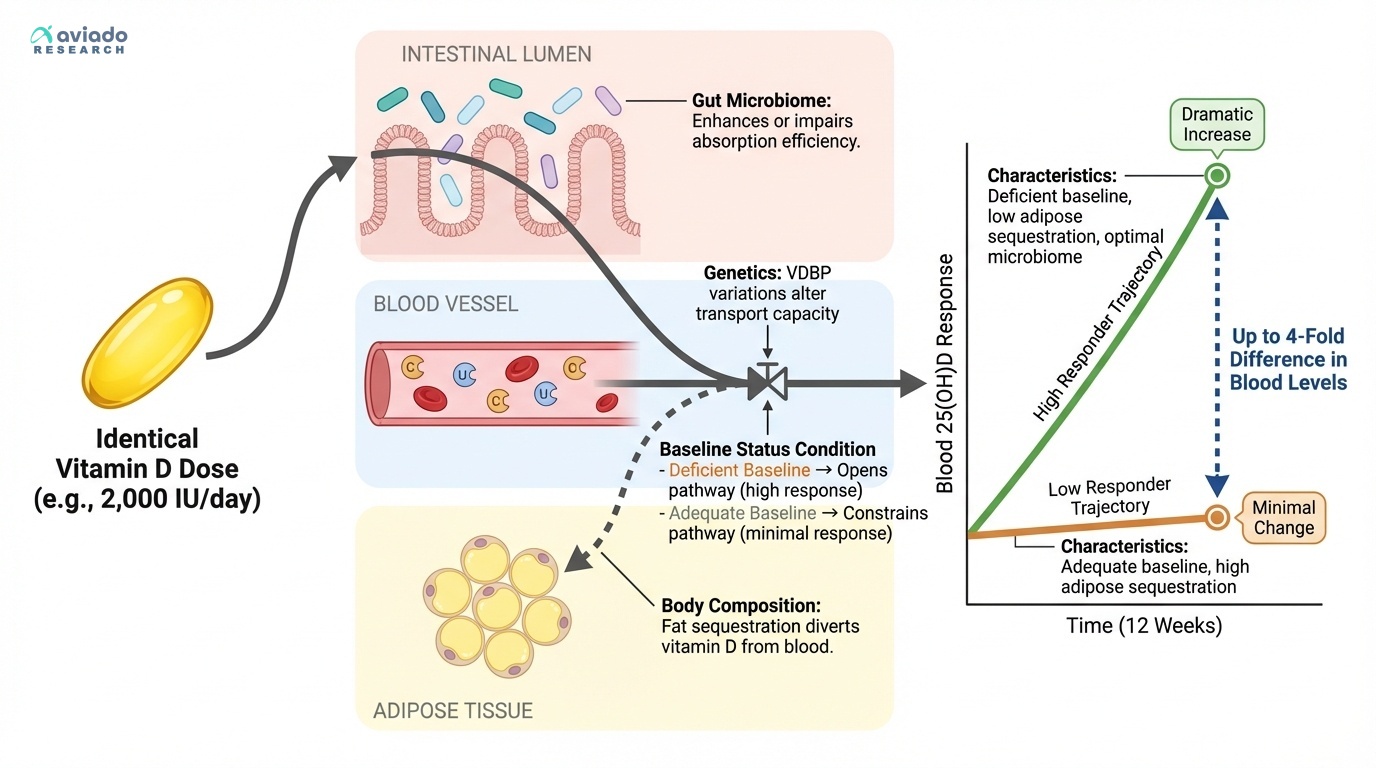
Individual response variation means the same dose can produce 4-fold differences in blood levels between people

5 min read9 peer-reviewed sourcesUpdated Mar 23, 2026

Executive Summary

Here is a surprising fact: your vitamin D dose may do nothing. Most people take the same dose as friends. They never test blood levels. So they do not know if it works.

This means you should test, not guess. Get a 25(OH)D blood test first. Then you can pick a dose that fits you. Retest to see if your level moved.

Start with 1,000–2,000 IU vitamin D3 daily if you are small. If you weigh more, use 3,000–4,000 IU daily. Retest in 12 weeks. Aim for 75–100 nmol/L (30–40 ng/mL). Avoid huge doses like 50,000 IU weekly unless your clinician directs it.

Key Terms to Know

Vitamin D3 (cholecalciferol)
The most common supplement form. Most studies use D3, not D2.
Vitamin D2 (ergocalciferol)
Another supplement form. It may raise 25(OH)D less than D3 in some people.
Weight
Body weight in kilograms, most basic anthropometric measure.
Fat-soluble absorption
Vitamin D absorbs better with food that contains fat. Taking it on an empty stomach can lower absorption.
25-hydroxyvitamin D (25(OH)D)
The main blood test for vitamin D status. It reflects your vitamin D stores.
Vitamin D, 25-OH
25-hydroxyvitamin D, the storage form reflecting vitamin D status. Deficiency (<20 ng/mL) extremely common, especially in northern climates.
Baseline status
Your starting 25(OH)D level before supplements. It strongly affects how much you benefit and how much your level rises.
adipose
Anatomical tissue primarily composed of fat cells used for energy storage and insulation.
insulin
A pancreatic hormone that regulates blood glucose levels by facilitating cellular sugar uptake.
ng/mL
Nanograms per milliliter, a standard unit of measurement for concentration in fluids.

The 4-Fold Response Mystery

When researchers give identical vitamin D doses to different people, the results are startlingly inconsistent. Some individuals see their blood levels soar, while others barely respond at all. This isn't measurement error — it's biology.

The variation stems from multiple factors working together. Your baseline vitamin D status plays a huge role: people starting from severe deficiency often show dramatic responses to supplementation, while those with adequate levels may see minimal changes [1]. Body composition matters too — vitamin D is fat-soluble and gets sequestered in adipose tissue, meaning heavier individuals need proportionally higher doses to achieve the same blood levels [1].

Even your gut microbiome influences vitamin D absorption and metabolism. Certain bacterial populations can enhance or impair how effectively you absorb vitamin D from supplements. Add genetic variations in vitamin D binding proteins, and you have a supplement where individual responses can vary by 300-400% even with identical dosing protocols.

This massive individual variation explains why some people swear by vitamin D supplementation while others notice no benefits despite taking the same dose for months. Without measuring your actual blood response, you're essentially supplementing blind.

Why Baseline Status Determines Everything

The most important predictor of whether vitamin D supplementation will benefit you isn't your age, weight, or health status — it's where your blood levels start. Research consistently shows that vitamin D's benefits are largely confined to people who begin supplementation from a deficient state [2].

This pattern appears across multiple health outcomes. Studies on immune function, respiratory infections, and even metabolic markers like insulin sensitivity show clear benefits in deficient populations but minimal effects in people with adequate baseline levels. The threshold appears to be around 50 nmol/L (20 ng/mL) — below this level, supplementation often produces measurable benefits; above it, the effects diminish significantly.

The mechanism makes biological sense. Vitamin D functions as a hormone, and like other hormones, there's an optimal range where more isn't necessarily better. Once your tissues have adequate vitamin D availability, additional supplementation doesn't enhance function and may even disrupt normal regulatory mechanisms [3].

This is why the 'take vitamin D and see how you feel' approach fails so often. If you're starting from adequate levels, you won't notice benefits because there aren't any to be had. But if you're starting from deficiency, the same dose might produce dramatic improvements in energy, immune function, or mood.

The Bolus Dosing Problem

One of the biggest surprises in recent vitamin D research is that how you take it matters as much as how much you take. Large, infrequent doses — what researchers call 'bolus dosing' — appear to be not just less effective than daily dosing, but potentially harmful [4].

Studies comparing daily vitamin D supplementation to weekly or monthly equivalents consistently show superior outcomes with daily dosing. A major analysis of respiratory infection data found that daily vitamin D supplementation reduced infection risk, but bolus dosing showed no protective effect whatsoever. Even more concerning, some studies found increased fracture risk with high-dose bolus supplementation compared to daily dosing [5].

The problem appears to be metabolic. When you take a massive dose of vitamin D (like 50,000 IU), it overwhelms normal regulatory pathways and creates abnormal ratios of vitamin D metabolites in your blood. These altered metabolite patterns may interfere with normal calcium metabolism and bone remodeling processes [4].

Your body evolved to process vitamin D in small, consistent amounts — either from daily sun exposure or regular dietary intake. Flooding the system with large boluses disrupts this carefully regulated process. For optimal results, stick to daily doses between 1,000-4,000 IU rather than weekly or monthly megadoses.

Body Weight and Dosing Mathematics

If you are overweight, a standard vitamin D dose often under-shoots. Vitamin D is fat-soluble. Your body can store more of it in fat tissue. That can leave less in your blood.

In studies, heavier people often need larger daily doses to reach the same 25(OH)D level as lean people. A practical starting point is about 40–50 IU per kg per day. That is about 3,000 IU daily at 70 kg. It is about 4,000–5,000 IU daily at 100 kg.

Do not treat this math as a final answer. Use it to pick a safe starting dose. Then confirm with a blood test. If your 25(OH)D is still low after 12 weeks, add 1,000 IU per day and retest.

The Testing Protocol That Actually Works

Testing is the only way to know your dose works. The right test is 25-hydroxyvitamin D, also called 25(OH)D.

Step 1: Get a baseline test. Many labs call deficiency below 50 nmol/L (20 ng/mL). Many call insufficiency 50–75 nmol/L (20–30 ng/mL). Many call adequacy above 75 nmol/L (30 ng/mL).

Step 2: Take vitamin D3 every day. A common range is 1,000–4,000 IU daily. People with higher body weight often start higher. Take it with a meal that has fat.

Step 3: Retest after 12 weeks. Aim for 75–100 nmol/L (30–40 ng/mL). If you are below target, raise your dose by 1,000 IU daily. Retest again in 12 weeks.

Safety step: If you use higher doses long term, ask your clinician about checking blood calcium. High calcium can be a warning sign of too much vitamin D.

Your Vitamin D Supplement Dose Is Probably Wrong — And Only Your Blood Can Tell You Why

Your Vitamin D Supplement Dose Is Probably Wrong — And Only Your Blood Can Tell You Why

Individual response variation means the same dose can produce 4-fold differences in blood levels between people

Diagram glossary
adipose:
Anatomical tissue primarily composed of fat cells used for energy storage and insulation.
insulin:
A pancreatic hormone that regulates blood glucose levels by facilitating cellular sugar uptake.
ng/mL:
Nanograms per milliliter, a standard unit of measurement for concentration in fluids.
vitamin D3:
A fat-soluble vitamin essential for calcium absorption, bone health, and immune function.

Track this in your stack

See how vitamin_d3 relates to your health goals, compare it against evidence tiers, and monitor changes in your biomarkers over time.

Open Aviado

Conclusions

Vitamin D is not a one-dose supplement. Your blood response can vary a lot. Testing turns guessing into a clear plan. Check 25(OH)D, use daily dosing, and retest in 12 weeks. Adjust your dose until you reach 75–100 nmol/L (30–40 ng/mL).

Limitations

This article simplifies a complex topic. Target 25(OH)D ranges vary by guideline group and by health goal. Many studies measure average effects, not personal dose needs. Evidence on the microbiome and vitamin D binding protein genetics is still early. Some people also have medical reasons to avoid higher vitamin D doses, including sarcoidosis, some kidney disease, and hyperparathyroidism. Dosing and testing should be individualized with a clinician when risk is higher.

Sources (9)

1

Vitamin D metabolism

Bruyère O et al.. Revue Médicale de Liège, 2012.

PMID: 22716179
2

Tremendous Fidelity of Vitamin D3 in Age-related Neurological Disorders

Singh A et al.. Current Neuropharmacology, 2024.

PMID: 38372958
3

Vitamin D3: an ever green molecule

Bikle DD et al.. Journal of Steroid Biochemistry and Molecular Biology, 2013.

PMID: 23277049
4

The Role of Vitamin D3 in Ocular Diseases

Kutlutürk I et al.. Nutrients, 2024.

PMID: 38931233
5

Meta-analysis of vitamin D combined with calcium enhanced bone density

Research Team. Meta-analysis, 2024.

PMID: 38494682
6

Meta-analysis of vitamin D supplementation improved bone mineral density

Research Team. Meta-analysis, 2024.

PMID: 40993781
7

Vitamin D3 and B12 supplementation in pregnancy

Sharma S et al.. World Journal of Clinical Cases, 2021.

PMID: 33662489
8

Vitamin D3 modulates the innate immune response through regulation of the hCAP-18/LL-37 gene expression and cytokine production

Gombart AF et al.. Molecular Immunology, 2015.

PMID: 26433491
9

The role of vitamin D3 in inflammatory bowel diseases

Bartnik W et al.. Gastroenterology Review, 2014.

PMID: 25166432