
Preliminary Evidence
ZincHeart HealthMetabolic Health

Zinc's Cholesterol Effect Is Real — But Only If You're Metabolically Compromised

Meta-analyses reveal zinc supplementation either meaningfully lowers LDL or does nothing at all — the difference comes down to your baseline insulin resistance status

5 min read6 peer-reviewed sourcesUpdated Mar 23, 2026

Executive Summary

The surprising truth is zinc does not lower cholesterol for everyone. Many people take zinc and expect a sure LDL drop. But the studies split in two. Zinc helps most when your metabolism is already strained.

What this means for you: check your metabolic health first. If you have insulin resistance, prediabetes, or type 2 diabetes, zinc may lower your LDL. If your labs look normal, zinc may do nothing. It may even lower your HDL.

Start with numbers, not guesses. If your fasting glucose is over 100 mg/dL, you may benefit. If your HbA1c is 5.7% to 6.4%, you may benefit. If your HOMA-IR is above 2.5, you may benefit. Typical doses in trials are 15 to 30 mg zinc daily. Recheck lipids after 10 to 12 weeks. Avoid over 40 mg per day long term.
Key Terms to Know

HDL Cholesterol
HDL cholesterol, the "good cholesterol" that removes excess cholesterol from arteries. higher levels are cardioprotective.
Glucose
Blood sugar level, the primary energy source for cells. Fasting glucose is normal, prediabetes, ≥126 suggests diabetes.
HOMA-IR (calc)
Insulin resistance by combining fasting glucose and insulin levels.
Prediabetes
Blood sugar is high, but not high enough for diabetes. Often HbA1c 5.7%–6.4%.
Hemoglobin A1c
Average blood sugar over the past 2-3 months by assessing glycated hemoglobin. each 1% increase raises cardiovascular risk by 18%.
Meta-Analysis
A statistical technique combining results from multiple studies to find overall patterns.
Pancreatic beta-cell function
Pancreatic beta cells are specialized cells in the pancreas that produce and release insulin. Their function refers to how well they sense blood sugar levels and secrete the right amount of insulin to
beta-cell
Pancreatic cells responsible for producing, storing, and releasing the hormone insulin.
HDL/LDL
Lipoproteins that transport cholesterol; HDL removes it from blood, while LDL deposits it.
HOMA
A mathematical model used to quantify insulin resistance and beta-cell function.

The Meta-Analysis Contradiction That Reveals Zinc's True Pattern

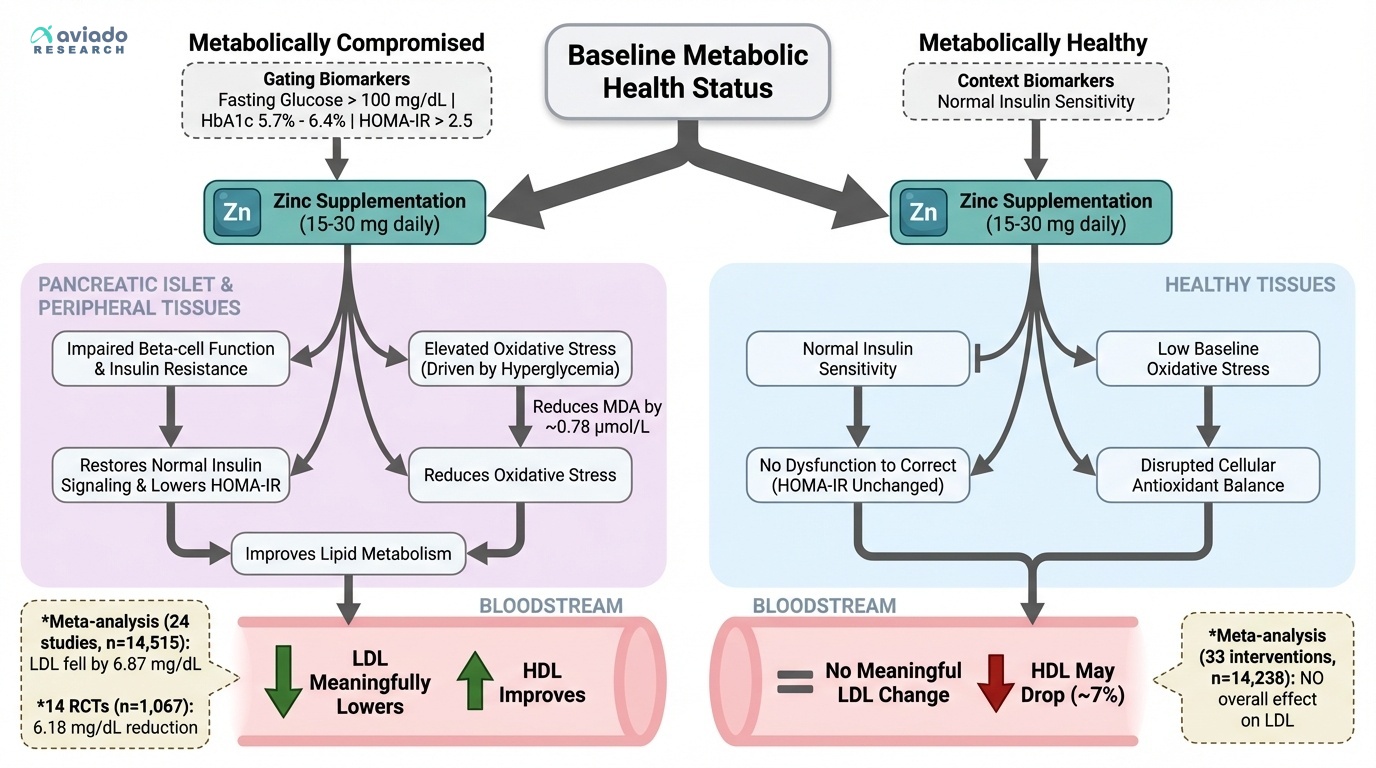
For years, zinc studies have looked contradictory. One large meta-analysis of 33 interventions (n=14,238) found no meaningful LDL change with zinc overall [1]. Yet another meta-analysis of 24 studies (n=14,515) found LDL fell by 6.87 mg/dL (95% CI: -11.16 to -2.58) [3].

This split is not random noise. Many “no effect” trials enrolled mostly metabolically healthy adults. Many “LDL drops” trials focused on people with type 2 diabetes or related metabolic issues. When you mix these groups, the average can look like zero.

HDL may also move in different directions by baseline health. Some trials in metabolically strained groups report HDL rises alongside LDL falls. In healthier groups, HDL does not reliably improve and may fall in some studies. This is why zinc can look helpful in one paper and useless in another.

Why Metabolic Status Gates Zinc's Cholesterol Effects

Zinc's population-specific effects on cholesterol stem from its fundamental role in insulin signaling and glucose metabolism. In metabolically compromised individuals, zinc deficiency — which is common in diabetes and prediabetes — impairs pancreatic beta-cell function and worsens insulin resistance. Zinc supplementation in these populations helps restore normal insulin signaling, which secondarily improves lipid metabolism and cholesterol profiles.

The mechanism becomes clear when examining zinc's effects on HOMA-IR, a measure of insulin resistance. Multiple meta-analyses show zinc supplementation significantly reduces HOMA-IR scores, but only in populations with elevated baseline values. In metabolically healthy individuals with normal insulin sensitivity, zinc supplementation produces no measurable improvement in HOMA-IR because there's no dysfunction to correct.

This explains why dose-response studies have been largely uninformative for predicting individual responses. A meta-analysis of 27 studies found that low-dose zinc supplementation under 25 mg daily significantly benefited LDL cholesterol, while higher doses showed diminishing returns [4]. However, the dose-response relationship only holds within metabolically compromised populations — no amount of zinc will improve cholesterol in someone with normal insulin sensitivity and adequate zinc status.

The Oxidative Stress Connection

Beyond direct effects on cholesterol synthesis and metabolism, zinc's cardiovascular benefits in metabolically compromised individuals operate through reduced oxidative stress. Meta-analyses consistently show zinc supplementation significantly reduces malondialdehyde (MDA), a key biomarker of cellular oxidative damage, by approximately 0.78 μmol/L [5]. This antioxidant effect is particularly pronounced in diabetic and prediabetic populations, where chronic hyperglycemia drives elevated oxidative stress.

A network meta-analysis of pregnant women with gestational diabetes found that magnesium combined with zinc and calcium supplementation was superior to placebo for reducing MDA levels [6]. This suggests zinc's antioxidant benefits may be enhanced when combined with other minerals, but again, primarily in metabolically stressed populations. The oxidative stress reduction helps explain why zinc's cholesterol benefits extend beyond simple LDL lowering to include improvements in overall cardiovascular risk markers.

The antioxidant mechanism also clarifies why zinc supplementation in healthy populations may be less beneficial or even counterproductive. In individuals with normal glucose metabolism and low baseline oxidative stress, additional zinc may disrupt the delicate balance of cellular antioxidant systems rather than providing net benefit.

Practical Implementation: Testing Before Supplementing

Use zinc for cholesterol only when your labs suggest you might respond. Start by checking fasting glucose and HbA1c. If you can, also check fasting insulin to calculate HOMA-IR.

You may be in the “responder” group if your fasting glucose is above 100 mg/dL, your HbA1c is 5.7% to 6.4%, or your HOMA-IR is above about 2.5. In these groups, meta-analyses commonly report LDL drops in the single digits (about 6–11 mg/dL), and total cholesterol may also fall.

If your fasting glucose is under 100 mg/dL and you have no insulin resistance markers, zinc is not a proven cholesterol tool. If you still try it, treat it like a test: take 15–30 mg per day, then repeat your lipid panel in 10–12 weeks. Stop if LDL does not improve or HDL drops.

For long-term use, avoid high doses. Staying under 40 mg per day helps reduce risk of side effects. If you take more than 25 mg per day for months, consider checking copper status, since zinc can lower copper over time.

Zinc's Cholesterol Effect Is Real — But Only If You're Metabolically Compromised

Zinc's Cholesterol Effect Is Real — But Only If You're Metabolically Compromised

Meta-analyses reveal zinc supplementation either meaningfully lowers LDL or does nothing at all — the difference comes down to your baseline insulin resistance status

Diagram glossary
beta-cell:
Pancreatic cells responsible for producing, storing, and releasing the hormone insulin.
glucose:
A simple sugar that serves as the primary energy source for the body's cells.
HDL/LDL:
Lipoproteins that transport cholesterol; HDL removes it from blood, while LDL deposits it.
HOMA:
A mathematical model used to quantify insulin resistance and beta-cell function.
insulin:
A pancreatic hormone that regulates blood sugar levels by facilitating cellular glucose uptake.
MDA:
Malondialdehyde is a highly reactive compound used as a biomarker for oxidative stress.
T2DM:
Type 2 diabetes mellitus is a chronic metabolic condition characterized by insulin resistance.

Track this in your stack

See how zinc relates to your health goals, compare it against evidence tiers, and monitor changes in your biomarkers over time.

Open Aviado

Conclusions

Zinc is not a universal cholesterol supplement. It acts more like a targeted tool. If you have insulin resistance, prediabetes, or type 2 diabetes, zinc at about 15–30 mg per day may lower LDL by roughly 6–11 mg/dL and may improve other markers. If your metabolism is healthy, zinc is unlikely to help your cholesterol and could worsen HDL in some cases. Test first, supplement second, and retest to confirm your personal response.

Limitations

These findings come from meta-analyses that often pool different ages, doses, and zinc forms. Many reviews do not cleanly separate results for metabolically healthy vs insulin-resistant people, so the “who benefits” pattern is partly inferred from which populations were studied. Trial lengths also vary, so the best timeline for lipid changes is not certain. Finally, baseline zinc status, diet, and mineral interactions (especially copper) can change both benefits and risks, and many trials do not measure these well.

Sources (6)

1

Effects of zinc supplementation on lipid profile in patients with type 2 diabetes mellitus: a systematic review and meta-analysis

Ranasinghe P et al.. Nutrition & Metabolism, 2015.

PMID: 20034629
2

Effects of zinc supplementation on lipid profiles in patients with type 2 diabetes mellitus: a systematic review and dose-response meta-analysis of randomized controlled trials

Zhao B et al.. Frontiers in Nutrition, 2023.

PMID: 37604307
3

Zinc supplementation and lipid profile: a systematic review and meta-analysis of randomized controlled trials

Pompano LM et al.. Nutrition Reviews, 2015.

PMID: 26244049
4

Effects of zinc supplementation on lipid profile in type 2 diabetes mellitus patients: a systematic review and meta-analysis

Wang X et al.. Journal of Diabetes Research, 2020.

PMID: 32722790
5

Effects of zinc supplementation on oxidative stress biomarkers: a systematic review and meta-analysis of randomized controlled trials

Mohammadi S et al.. Antioxidants, 2021.

PMID: 34560424
6

Network meta-analysis of mineral and vitamin supplementation effects on oxidative stress biomarkers in gestational diabetes mellitus

Chen L et al.. Nutrients, 2021.

PMID: 34209454