Preliminary Evidence
BerberineGut HealthHeart Health

Berberine Works Through Your Gut Microbiome — Which Is Why It Works Differently for Everyone

Poor bioavailability but strong effects: your gut bacteria determine whether berberine actually works for you

4 min read8 peer-reviewed sourcesUpdated Mar 28, 2026

Listen to this article

10 min listen

Executive Summary

Here is the surprising part: berberine works with low absorption. Most people think you must absorb it to benefit. But your gut bugs can change berberine first.

This means results can vary a lot for you. Your gut bacteria may activate berberine well. Or they may not. Antibiotics and gut issues can blunt effects.

Use 500 mg twice daily with meals. Retest labs after 12 weeks. Track HbA1c, fasting insulin, and HOMA-IR. If no change, stop and reassess.

Key Terms to Know

GLP-1
A gut hormone that helps lower blood sugar and appetite.
HbA1c (Hemoglobin A1c)
Your average blood sugar over about 3 months.
HOMA-IR (calc)
Insulin resistance by combining fasting glucose and insulin levels.
ALT (SGPT)
Alanine aminotransferase enzyme, highly specific to liver cells. elevated in hepatocellular injury from viral hepatitis, fatty liver, or medications.
Berberine
A plant compound used for blood sugar and lipid support.
Gut microbiome
Gut bacteria that can change berberine into active metabolites.
Hemoglobin A1c
Average blood sugar over the past 2-3 months by assessing glycated hemoglobin. each 1% increase raises cardiovascular risk by 18%.
AMPK
AMP-activated protein kinase, a cellular energy sensor and master metabolic regulator.
ATP
Adenosine triphosphate, the primary molecule used to store and transfer energy in cells.
butyrate
A short-chain fatty acid produced by gut microbial fermentation that supports metabolic health.

The Berberine Paradox: Poor Absorption, Strong Effects

Berberine has a strange research profile. After you swallow it, very little reaches your blood. Estimates are often under 5% [9]. That low absorption should mean weak effects.

But clinical trials show the opposite. In meta-analyses, berberine lowers HbA1c by about 0.54% to 0.63% [1][2][3]. It also lowers fasting insulin by about 2.05 to 2.36 units in pooled analyses [2][3]. These are meaningful shifts for metabolic risk.

The best explanation is the gut. Much of berberine stays in your intestines. There, gut bacteria convert it into metabolites your body can absorb better [9][14]. So the “active” dose may depend more on your microbiome than on berberine itself.

How Your Gut Microbiome Activates Berberine

Researchers now think the gut is the main control knob for berberine [9][14]. When berberine reaches your colon, some bacteria transform it into metabolites. These metabolites can cross the gut barrier more easily than berberine itself. That helps explain effects despite low blood levels of the parent compound.

Berberine may also work by changing which microbes grow well. That shift can change gut signals tied to metabolism. One key signal is GLP-1, a hormone made in the gut. Reviews describe pathways where berberine increases GLP-1 secretion through microbiome and bile-acid signaling changes, not by acting like GLP-1 directly [14].

These gut changes can ripple outward. Studies link berberine to improvements in lipids and inflammation markers, alongside glucose markers [1][4]. The take-home point is simple: berberine may act like a microbiome-directed therapy, not a typical “absorbed” supplement.

Why Berberine Works Differently for Different People

People can respond very differently to berberine. In pooled research, insulin-resistance outcomes vary a lot between trials and groups [1][2][5]. Dose alone does not explain the spread.

A likely driver is your starting microbiome. If you recently used antibiotics, or you have chronic gut issues, you may have fewer bacteria that convert berberine into absorbable metabolites [4][9]. With less conversion, you may see smaller lab changes.

Another issue is interactions. Berberine can affect drug transporters and enzymes discussed in pharmacology reviews [9]. That can change exposure to other medicines. If you use prescription diabetes drugs or other narrow-therapeutic-index meds, you should ask your clinician before adding berberine.

Optimizing Berberine Based on Gut Health

Most trials use a simple plan: 500 mg twice daily with meals [1][8]. Meals often reduce nausea, cramping, and diarrhea. They also slow gut transit time, which may increase contact time with microbes.

If you want to know whether it works for you, do not guess. Get baseline labs first. Then repeat the same labs after about 12 weeks. Useful markers include fasting glucose, fasting insulin, HOMA-IR, HbA1c, ApoB, and hsCRP.

Be cautious with “more is better.” Higher doses can raise side effects and interaction risk. If you take metformin or other glucose-lowering drugs, monitor for low blood sugar and GI overlap. Discuss dosing and timing with your clinician, especially if you take multiple meds [8][9].

Berberine Works Through Your Gut Microbiome — Which Is Why It Works Differently for Everyone

Berberine Works Through Your Gut Microbiome — Which Is Why It Works Differently for Everyone

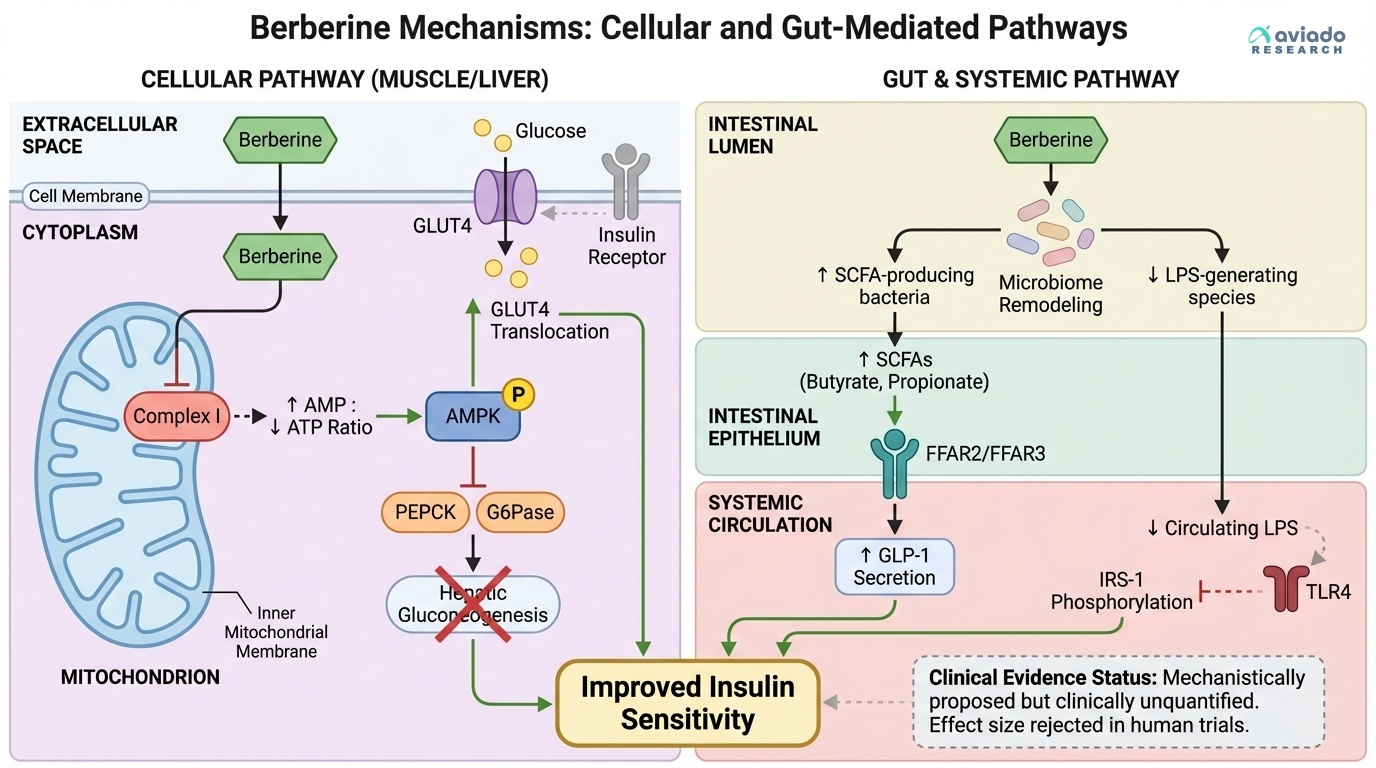
The diagram should depict berberine entering a skeletal muscle or hepatocyte cell and inhibiting mitochondrial Complex I, leading to AMPK phosphorylation and downstream GLUT4 translocation and suppression of gluconeogenic enzymes (PEPCK, G6Pase). A secondary panel should illustrate berberine's action in the gut lumen, showing microbiome remodeling, increased SCFA production, GLP-1 release, and reduced LPS-driven TLR4/IRS-1 inflammatory interference, with both pathways converging on an improved insulin sensitivity outcome node marked as mechanistically proposed but clinically unquantified.

Diagram glossary
AMPK:
AMP-activated protein kinase, a cellular energy sensor and master metabolic regulator.
ATP:
Adenosine triphosphate, the primary molecule used to store and transfer energy in cells.
Berberine:
A plant compound that modulates metabolism and insulin sensitivity by activating AMPK.
butyrate:
A short-chain fatty acid produced by gut microbial fermentation that supports metabolic health.
FFAR2/FFAR3:
Free fatty acid receptors that mediate metabolic signaling from short-chain fatty acids.
GLP-1:
Glucagon-like peptide-1, an incretin hormone that stimulates insulin secretion and regulates appetite.
glucose:
A simple sugar that serves as the primary energy source for cellular metabolism.
GLUT4:
An insulin-regulated glucose transporter responsible for cellular glucose uptake in muscle and fat.
insulin:
A pancreatic hormone that regulates blood glucose levels by facilitating cellular glucose uptake.
LPS:
Lipopolysaccharide, a bacterial outer membrane component that triggers systemic inflammation and insulin resistance.
PEPCK:
Phosphoenolpyruvate carboxykinase, a key enzyme that regulates glucose production during hepatic gluconeogenesis.
SCFA:
Short-chain fatty acids produced by gut bacteria that influence host energy metabolism and immunity.

Track this in your stack

See how berberine relates to your health goals, compare it against evidence tiers, and monitor changes in your biomarkers over time.

Open Aviado

Conclusions

Berberine can improve blood sugar markers even when very little is absorbed. The most likely reason is your gut microbiome. Your bacteria can convert berberine into metabolites your body can use. They may also shift gut signals like GLP-1.

For you, this means two things. First, response is personal. Antibiotics, diet, and gut health can change results. Second, you should track labs, not just how you feel. Use a tested dose, recheck markers at 12 weeks, and reassess if nothing moves.

Limitations

Many studies measure blood sugar outcomes but do not measure microbiome changes. So we still do not know which bacterial strains matter most. There is no validated clinical test that can predict your response to berberine today.

Many trials are short, and brands and formulations vary. Long-term safety data at higher doses is limited. Berberine may interact with some medicines via transporter or enzyme effects described in reviews, but real-world interaction risk is not fully mapped [8][9].

Sources (8)

1

Meta-analysis of the effect and safety of berberine in the treatment of type 2 diabetes mellitus, hyperlipemia and hypertension

Lan J et al.. Journal of Ethnopharmacology, 2015.

PMID: 25498346
2

Effects of berberine on glucose metabolism: a systematic review and meta-analysis

Zhang Y et al.. Frontiers in Endocrinology, 2024.

PMID: 38429794
3

Efficacy of berberine in patients with type 2 diabetes mellitus: a systematic review and meta-analysis

Liang Y et al.. Evidence-Based Complementary and Alternative Medicine, 2021.

PMID: 34956436
4

Effects of Berberine on the Gastrointestinal Microbiota

Habtemariam S. Molecules, 2020.

PMID: 33680978
5

The efficacy of berberine in the treatment of polycystic ovary syndrome with insulin resistance: a meta-analysis

Li C et al.. Reproductive Health, 2021.

PMID: 33981233
8

Berberine and barberry (Berberis vulgaris): A clinical review

Neag MA et al.. Frontiers in Pharmacology, 2018.

PMID: 30637820
9

Berberine pharmacology and the gut microbiota: A hidden therapeutic link

Habtemariam S. Pharmacological Research, 2020.

PMID: 32105754
14

Berberine-induced glucagon-like peptide-1 and its mechanism for controlling type 2 diabetes mellitus: a comprehensive pathway review

Yao Y et al.. Frontiers in Endocrinology, 2023.

PMID: 37921026