
Preliminary Evidence
Coq10Athletic PerformanceHeart Health

CoQ10 Deficiency Is Not One Thing: Why Your Genetics, Statins, and Age Each Create a Different Problem

Understanding your deficiency mechanism determines whether supplementation will actually work

5 min read8 peer-reviewed sourcesUpdated Mar 28, 2026

Listen to this article

11 min listen

Executive Summary

The surprising truth is that CoQ10 deficiency is not one problem. Most people buy a random pill and hope. But low CoQ10 can come from genes, statins, aging, or disease. Each cause acts differently in your body.

This means your best dose depends on your cause. If you take statins, you may lose CoQ10 faster. If you are older, you may make less CoQ10. If you absorb poorly, your blood level may barely move. You can feel no change even with daily pills.

Start with clear steps you can follow. If you take a statin, ask about 100–200 mg ubiquinol daily. If you are over 40, many studies use 300–600 mg daily in better forms. Rare gene disorders may need up to 1,200 mg daily. Take CoQ10 with a fat meal for better uptake.
Key Terms to Know

Ubiquinol
The reduced form of CoQ10; some people, especially older adults, may absorb or use it more easily.
Ubiquinol:ubiquinone ratio
A blood marker that can reflect redox balance and oxidative stress, alongside CoQ10 status.
HMG-CoA reductase
The key enzyme statins block to lower cholesterol; this can also lower CoQ10 production.
Mevalonate pathway
A cell pathway that helps make cholesterol and CoQ10; statins slow this pathway.
Plasma CoQ10
A blood test for CoQ10; it can show if your supplement is raising levels.
Ubiquinone
The oxidized form of CoQ10 found in many supplements; your body can convert it to ubiquinol.
Secondary CoQ10 deficiency
Low CoQ10 caused by factors like statins, aging, or illness rather than genetics.
HMG
An enzyme target (HMG-CoA reductase) inhibited by statin drugs to lower cholesterol.
MCT
Medium-chain triglycerides, a type of dietary fat often used to enhance supplement absorption.
mevalonate
A metabolic pathway responsible for synthesizing both cholesterol and CoQ10 in the body.

The Four Faces of CoQ10 Deficiency

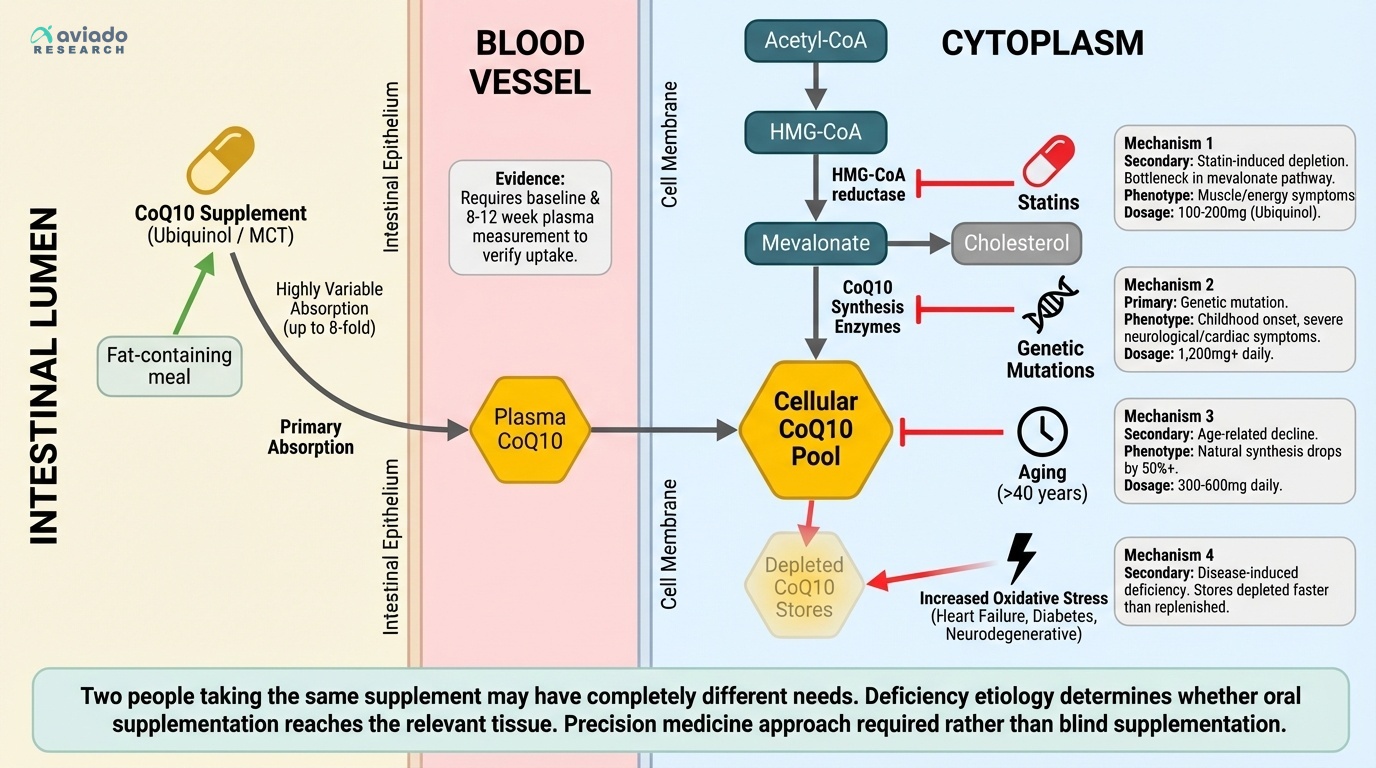
CoQ10 deficiency manifests through four distinct mechanisms, each requiring different therapeutic approaches. Primary deficiencies result from genetic mutations affecting CoQ10 synthesis enzymes, typically presenting in childhood with severe neurological and cardiac symptoms [11]. These rare conditions require high-dose supplementation, often 1,200mg daily or more, under medical supervision.

Secondary deficiencies are far more common and include statin-induced depletion, age-related decline, and disease-associated reduction. Statin drugs block the mevalonate pathway that produces both cholesterol and CoQ10, creating a therapeutic paradox where heart patients taking cardiovascular medications become deficient in a compound essential for heart muscle energy [6]. Age-related deficiency occurs as cellular synthesis capacity declines, particularly after age 40, when natural CoQ10 levels can drop by 50% or more.

Disease-induced deficiency presents in conditions like heart failure, diabetes, and neurodegenerative disorders, where increased oxidative stress depletes CoQ10 stores faster than they can be replenished [5]. Each mechanism affects different tissues preferentially and responds to different supplementation strategies, explaining why blanket recommendations often fail.

Why Statin Users Face a Unique Challenge

Statins create a direct production bottleneck for CoQ10. They inhibit HMG-CoA reductase, a key step in the mevalonate pathway used to make cholesterol and CoQ10 [6]. So even if you eat well, your cells may still make less CoQ10 while you take the drug.

For you, the key issue is muscle and energy symptoms. Statin users commonly report myalgia, cramps, or fatigue. CoQ10 is often studied for this, but benefits vary. One reason is dosing and form choice. Many trials use modest doses and do not measure CoQ10 levels before and after.

If you and your clinician choose to try it, use a plan you can track. Common practice is 100–200 mg per day, often as ubiquinol, taken with food that contains fat [6]. Recheck symptoms and consider checking plasma CoQ10 after 8–12 weeks. If nothing changes, adjust the approach rather than guessing.

The Absorption Problem: Why Identical Doses Create Different Outcomes

CoQ10 results vary because people absorb it very differently. One review reports very large differences in blood levels after the same oral dose, sometimes up to eight-fold [1]. CoQ10 is fat-soluble, so taking it without food can sharply cut absorption.

Form matters because CoQ10 has to dissolve and enter fat transport particles in your gut. Oil-based softgels and newer delivery systems can raise bioavailability versus dry powders [1,14]. Some products use medium-chain triglyceride (MCT) encapsulation to improve uptake in lab and cell models [14].

A practical way to avoid wasted months is to treat it like a measurable trial. Take your dose with a fat-containing meal. If you can, measure plasma CoQ10 before you start and again after 8–12 weeks. If your level barely rises, you may need a different form or a higher dose, not more time.

Tissue-Specific Effects: Heart, Brain, and Beyond

CoQ10 deficiency doesn't affect all tissues equally, creating organ-specific symptoms that require targeted approaches. Cardiac muscle, with its enormous energy demands, shows particular sensitivity to CoQ10 depletion [15]. Heart failure patients often exhibit significantly reduced myocardial CoQ10 levels, though supplementation effectiveness varies depending on the underlying deficiency mechanism [13].

Neurological applications represent an emerging frontier, with research exploring CoQ10's role in neurodegenerative diseases like Parkinson's and Alzheimer's [5]. Brain tissue's high metabolic rate and vulnerability to oxidative stress make it particularly dependent on adequate CoQ10 levels. However, achieving therapeutic brain concentrations requires higher doses than those needed for cardiovascular benefits.

Liver metabolism also depends heavily on CoQ10, particularly for protecting against drug-induced hepatotoxicity [9]. Studies show CoQ10 supplementation can protect against acetaminophen-induced liver injury by enhancing mitochondrial function and cellular cleanup mechanisms. This suggests potential applications beyond the traditional cardiovascular focus, though optimal dosing for different organs remains an active area of research.

Precision Dosing: Matching Supplement to Deficiency Type

Effective CoQ10 supplementation requires matching the dose and form to the specific deficiency mechanism. For statin users, research supports 100-200mg daily of ubiquinol taken with the evening statin dose to counteract drug-induced depletion [6]. The ubiquinol form may be particularly important for this population, as statin-induced changes in cellular metabolism can impair the conversion of ubiquinone to its active form.

Age-related deficiency typically requires higher doses, often 300-600mg daily of enhanced-absorption formulations [1]. Older adults benefit from ubiquinol forms or novel delivery systems that bypass age-related declines in absorption and conversion efficiency. Taking the dose with a fat-containing meal significantly improves uptake.

Genetic deficiencies represent the most challenging scenario, often requiring medical supervision and doses exceeding 1,200mg daily [11]. These patients may need specialized formulations and regular monitoring of plasma levels to ensure adequate tissue delivery. The key insight is that effective CoQ10 therapy starts with understanding why levels are low, not just assuming any supplement will help.

CoQ10 Deficiency Is Not One Thing: Why Your Genetics, Statins, and Age Each Create a Different Problem

CoQ10 Deficiency Is Not One Thing: Why Your Genetics, Statins, and Age Each Create a Different Problem

Understanding your deficiency mechanism determines whether supplementation will actually work

Diagram glossary
HMG:
An enzyme target (HMG-CoA reductase) inhibited by statin drugs to lower cholesterol.
MCT:
Medium-chain triglycerides, a type of dietary fat often used to enhance supplement absorption.
mevalonate:
A metabolic pathway responsible for synthesizing both cholesterol and CoQ10 in the body.
Statin:
A class of lipid-lowering medications that inhibit the synthesis of cholesterol and CoQ10.

Track this in your stack

See how coq10 relates to your health goals, compare it against evidence tiers, and monitor changes in your biomarkers over time.

Open Aviado

Conclusions

CoQ10 supplements work best when they match the reason your level is low. Statins can reduce CoQ10 production, aging can lower your output, and illness can increase your demand. Absorption also varies a lot, so the same capsule can help one person and do little for another. If you use CoQ10, take it with a fat-containing meal and treat it like a tracked trial, not a blind habit.

Limitations

Dose targets and “optimal” plasma ranges are not standardized across labs or studies. Many CoQ10 trials do not measure baseline CoQ10 or confirm that levels rise after dosing, which makes results hard to compare. Some evidence on newer delivery systems comes from lab or healthy-volunteer work, not high-risk patients. People often have overlapping causes (aging plus statins, for example), and research rarely separates these groups cleanly.

Sources (8)

1

Coenzyme Q10 supplementation: Efficacy, safety, and formulation challenges

Rodríguez-Carrizalez AD et al.. Frontiers in Nutrition, 2020.

PMID: 33325173
5

Coenzyme Q10 effects in neurological diseases

Cirilli I et al.. Neuropsychiatric Disease and Treatment, 2022.

PMID: 35199552
6

Comparison of Coenzyme Q10 (Ubiquinone) and Reduced Coenzyme Q10 (Ubiquinol) as Supplement to Prevent Cardiovascular Disease and Reduce Cardiovascular Mortality

Gutierrez-Mariscal FM et al.. Current Cardiology Reviews, 2023.

PMID: 37971634
9

CoQ10 protects against acetaminophen-induced liver injury by enhancing mitophagy

Zhang Y et al.. Toxicology and Applied Pharmacology, 2020.

PMID: 33271250
11

Human CoQ10 deficiencies

Quinzii CM et al.. Mitochondrion, 2007.

PMID: 19096106
13

Evaluation of Coenzyme Q10 (CoQ10) Deficiency and Therapy in Mouse Models of Cardiomyopathy

Wang Y et al.. International Journal of Molecular Sciences, 2023.

PMID: 36668724
14

CoQ10 bioaccessibility and Caco-2 cell uptake improved with novel medium chain triglyceride encapsulation

Liu Z et al.. Food Chemistry, 2024.

PMID: 39449589
15

Role of coenzyme Q10 (CoQ10) in cardiac disease, hypertension and Meniere-like syndrome

Rosenfeldt F et al.. Pharmacology & Therapeutics, 2009.

PMID: 19638284