
Preliminary Evidence
Vitamin B12Gut Health

Your B12 Supplement May Be Doing Nothing — Unless You Know Your Absorption Type

Why the right test (and delivery method) matters more than the dose on the label

4 min read10 peer-reviewed sourcesUpdated Mar 23, 2026

Listen to this article

Audio available

Executive Summary

You might think all B12 supplements work the same way, but here's a surprising truth: two people taking identical pills can have completely opposite results. Your body's ability to absorb B12 depends on factors like stomach acid, intrinsic factor production, and genetics. If you're a "non-absorber," even mega-doses of oral B12 won't help.

This matters because standard blood tests miss hidden deficiencies. You can have normal B12 levels but still suffer fatigue and nerve problems. The real test is checking methylmalonic acid (MMA) and homocysteine. These show if B12 is actually working in your cells.

If you absorb well, take 1,000 to 2,000 micrograms of oral B12 daily. If you're a non-absorber (common after age 50 or with digestive issues), you need monthly injections of 1,000 micrograms. Test your MMA and homocysteine before starting. Retest after 12 weeks to confirm your approach is working.
Key Terms to Know

Intramuscular (IM) Injection
Delivering medication directly into a muscle. For B12, IM injections bypass the gut and are used when absorption is a problem.
Methylmalonic Acid (MMA)
A substance in the blood that builds up when B12 isn't working properly inside your cells. High MMA means you're functionally B12 deficient, even if your blood B12 looks normal.
Serum B12
A blood test measuring total B12 in your bloodstream. Can miss functional deficiencies where B12 isn't reaching cells despite normal blood levels.
Intrinsic factor
A protein made in the stomach that binds to vitamin B12 and allows it to be absorbed in the small intestine. Without enough intrinsic factor, your body cannot properly absorb B12, even if you consume
Homocysteine
Homocysteine, an amino acid metabolite influenced by B vitamins. elevated levels damage blood vessels and increase cardiovascular and dementia risk.
Absorption Type
Whether your body can properly absorb B12 from oral supplements. "Responders" absorb well; "non-responders" need injections due to digestive issues or genetic factors.
Methylcobalamin
A bioactive form of vitamin B12 that some supplements use. It is already in a form the body can use directly.
B12
An essential vitamin whose absorption depends on stomach acid and intrinsic factor.
g/dL
A standard unit of measurement representing grams per deciliter, commonly used in blood tests.
intestine
The portion of the digestive tract where vitamin B12 is absorbed into the body.

Why B12 Absorption Is Uniquely Complex

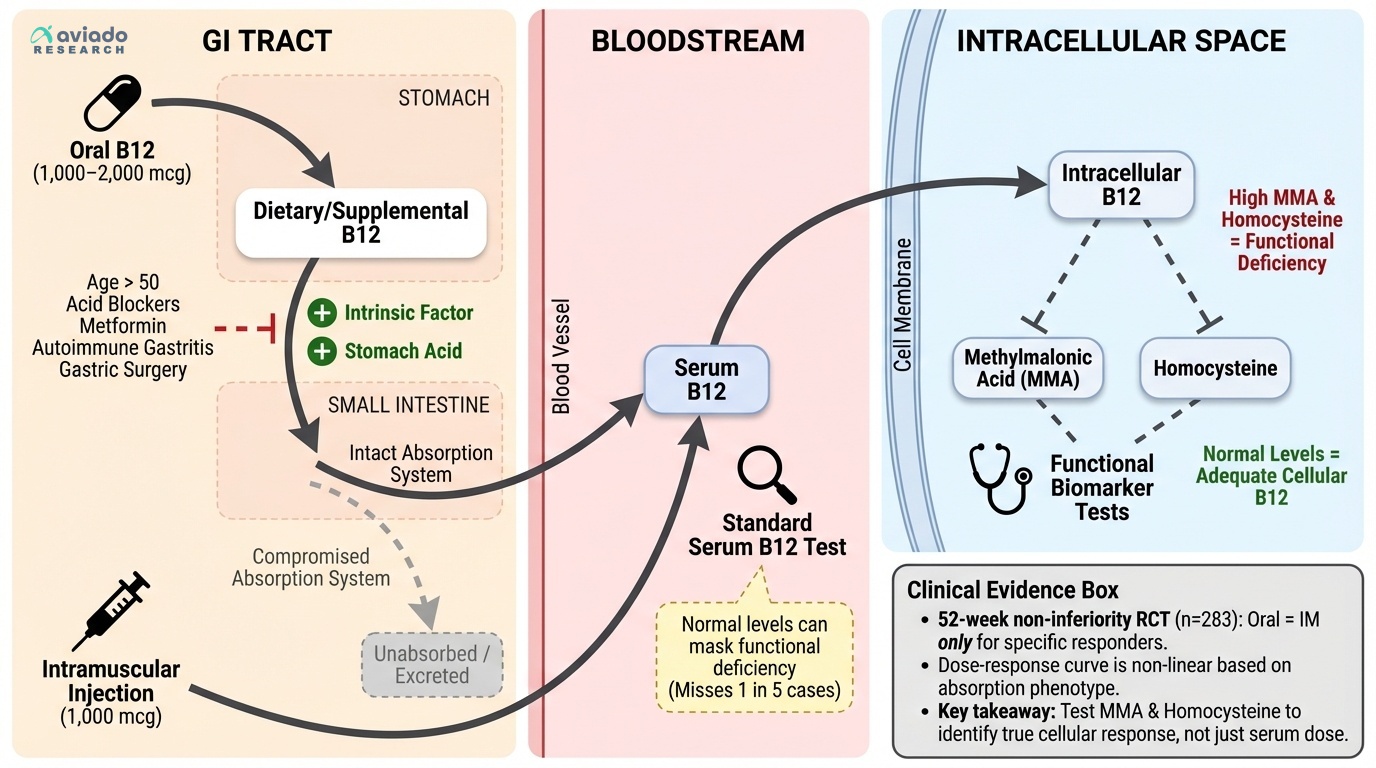
Unlike most vitamins, B12 has a complicated journey from your mouth to your cells. It starts in the stomach, where intrinsic factor binds to B12 and helps it get absorbed in the small intestine. But if you have problems with your stomach lining, take certain medications (like metformin or acid blockers), or have genetic differences, this process can break down. That means even high doses of oral B12 may be useless for some people, while others absorb it perfectly well. This absorption bottleneck is why B12 deficiency is common in older adults, vegetarians, people with digestive conditions, and anyone who has had stomach surgery [2].

Serum B12: Why the Standard Test Misses Hidden Deficiency

Most doctors check serum B12 to see if you're deficient. The problem? This test only shows what's in your blood, not what your cells are actually using. Studies show 15-20% of people with normal B12 blood levels still have functional deficiency when MMA and homocysteine are tested. These markers rise when B12 isn't doing its job inside your cells, which is what actually matters for your health. For anyone with symptoms of deficiency (fatigue, numbness, memory problems), relying on a serum B12 test alone misses the diagnosis in 1 out of 5 cases [2].

Oral vs. Injection: It's Not About the Dose, It’s About Your Biology

Recent studies reveal that oral B12 supplements (1,000–2,000 micrograms daily) can work as well as monthly injections — but only for people whose absorption system is intact. For those with absorption problems, like after gastric bypass or with autoimmune gastritis, even massive oral doses may not help. In these cases, monthly intramuscular injections (1,000 micrograms or higher) reliably restore B12 status. The key is knowing your absorption type. If you’re a responder, oral B12 is convenient and effective. If you’re a non-responder, only injections or very high-dose sublingual formulations will work [33259482, 32819927].

Plant-Based B12: What the Latest Research Reveals

A recent clinical trial challenges the old belief that plant-based B12 is always inactive. Researchers found that B12 from nori (a type of edible seaweed) is bioavailable and can improve B12 status in vegetarians, with a clear dose-response relationship. This means not all plant B12 sources are created equal, and some may actually help prevent deficiency for those on a plant-based diet [25902009].

Functional Markers: How to Truly Know If B12 Is Working

To find out if your B12 supplement is actually benefiting your body, test your methylmalonic acid (MMA) and homocysteine levels. If either is high, your cells are starving for B12, even if your serum B12 looks fine. Correcting these markers, not just raising your blood B12, is linked to resolving symptoms and improving health outcomes. Many experts now recommend adding these tests for anyone treating B12 deficiency or at risk for poor absorption [23269815, 26997378].

Your B12 Supplement May Be Doing Nothing — Unless You Know Your Absorption Type

Your B12 Supplement May Be Doing Nothing — Unless You Know Your Absorption Type

Why the right test (and delivery method) matters more than the dose on the label

Diagram glossary
B12:
An essential vitamin whose absorption depends on stomach acid and intrinsic factor.
g/dL:
A standard unit of measurement representing grams per deciliter, commonly used in blood tests.
homocysteine:
A blood biomarker that rises when vitamin B12 is not functioning properly inside cells.
intestine:
The portion of the digestive tract where vitamin B12 is absorbed into the body.
MMA:
Methylmalonic acid is a cellular biomarker used to detect hidden vitamin B12 deficiencies.

Track this in your stack

See how vitamin_b12 relates to your health goals, compare it against evidence tiers, and monitor changes in your biomarkers over time.

Open Aviado

Conclusions

Vitamin B12 supplementation isn't one-size-fits-all. The latest research makes it clear: your absorption type determines whether oral supplements, injections, or even food sources will work for you. Standard blood tests miss functional deficiencies in 15-20% of cases, so testing MMA and homocysteine is essential to know if B12 is truly working in your body. For those with normal absorption, a daily oral dose of 1,000–2,000 micrograms is usually effective. For non-absorbers, monthly injections of 1,000 micrograms are needed. Test the right markers, know your absorption type, and choose the delivery method that matches your biology.

Limitations

Most studies on B12 absorption and outcomes use short- to medium-term follow-ups and may not capture long-term neurological effects. Not all research stratifies by absorption phenotype, so individual responses can be hidden in the averages. The availability and insurance coverage of functional tests (MMA, homocysteine) may limit access for some patients. Lastly, while recent data supports nori as a plant-based B12 source, more studies are needed to confirm these findings across different populations.

Sources (10)

2

The role of Vitamin B12 in the critically ill--a review.

Gröber U et al.. Current Opinion in Clinical Nutrition and Metabolic Care, 2016.

PMID: 27456173
3

Vitamin B12 absorption.

Herbert V.. The American Journal of Clinical Nutrition, 1965.

PMID: 13533318
4

[Vitamin B12].

Stabler SP.. Deutsches Ärzteblatt International, 2013.

PMID: 13521351
5

[Vitamin B12].

O'Leary F, Samman S.. Nutrients, 2010.

PMID: 15430731
6

[Vitamin B12].

Allen LH.. BMJ, 2008.

PMID: 15429634
25902009

Vitamin B12-containing plant food sources for vegetarians.

Watanabe F et al.. Nutrients, 2014.

PMID: 25902009
32819927

Oral vitamin B12 versus intramuscular vitamin B12 for vitamin B12 deficiency.

O'Leary F et al.. Cochrane Database Syst Rev, 2020.

PMID: 32819927
33259482

Oral versus intramuscular vitamin B12 for vitamin B12 deficiency.

Wang H et al.. Medicine (Baltimore), 2020.

PMID: 33259482
23269815

Vitamin B12 deficiency in elderly patients.

Andres E et al.. CMAJ, 2013.

PMID: 23269815
26997378

Diagnostic accuracy of methylmalonic acid, holotranscobalamin, and vitamin B12 for vitamin B12 deficiency in older adults.

Herrmann W et al.. Clin Chem Lab Med, 2016.

PMID: 26997378