
Preliminary Evidence
SulforaphaneGut HealthHeart Health

Your Broccoli Sprouts May Be Doing Nothing: The Hidden Enzyme Problem That Splits Sulforaphane Users Into Winners and Losers

4 min read4 peer-reviewed sourcesUpdated Mar 23, 2026

Listen to this article

Audio available

Executive Summary

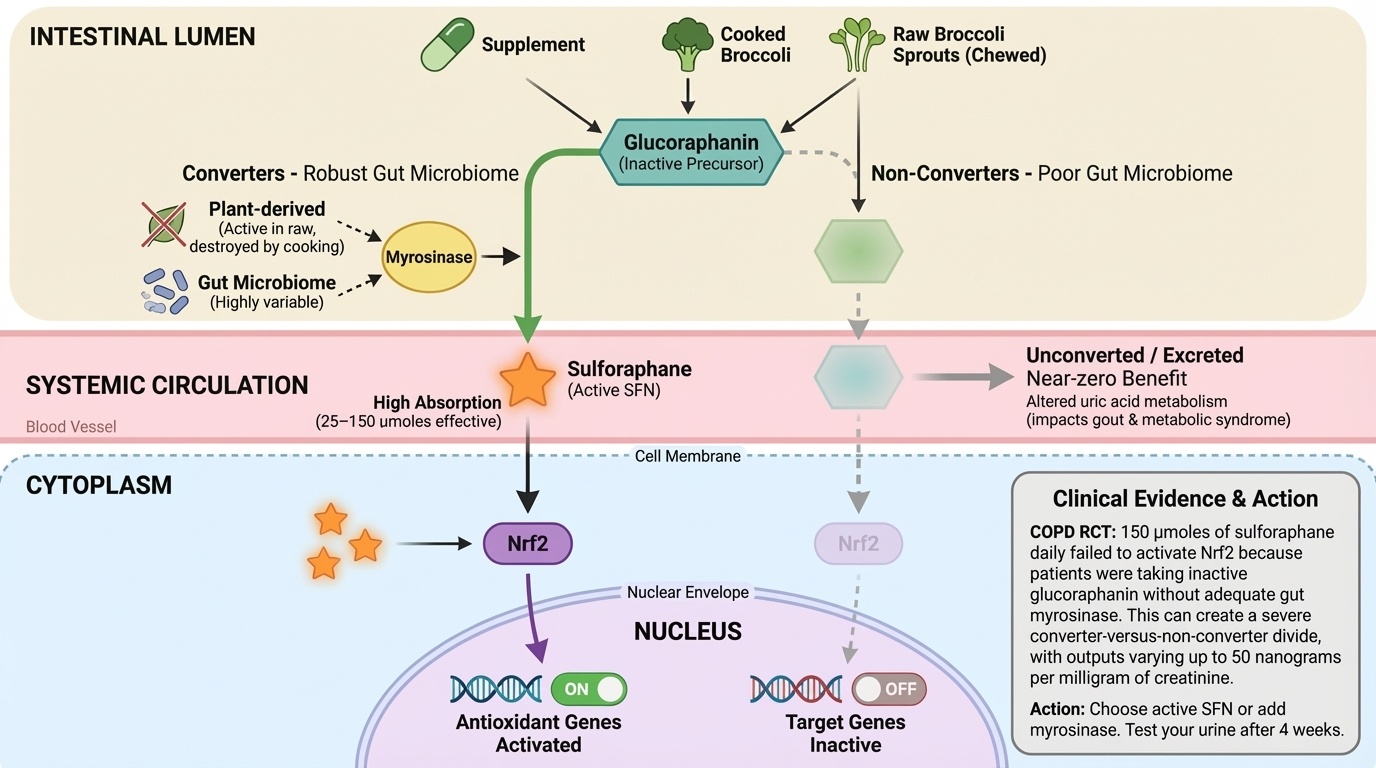
Here's something surprising: most people taking broccoli sprout supplements get almost zero active sulforaphane. The problem is an enzyme called myrosinase. Without it, your body can't convert the inactive stuff in broccoli (glucoraphanin) into the active compound that actually helps you.

This matters because myrosinase gets destroyed by cooking and processing. Most supplements don't include it. Your gut bacteria might do the job instead, but that varies wildly between people. Two people can take identical supplements and get completely different results—sometimes ten times apart in blood levels.

To get real benefits, you need 25 to 150 micromoles of active sulforaphane daily. Choose supplements that contain actual sulforaphane (not just glucoraphanin) or ones that add myrosinase enzyme. Fresh broccoli sprouts work if you chew them raw. Test your urine after 4 weeks to see if it's working—don't just hope.
Key Terms to Know

IL-6
A branded sulforaphane product family name used to identify a specific extract or formulation in research and supplement labels.
Converter vs Non-converter
Whether your gut bacteria can convert glucoraphanin to sulforaphane when myrosinase is absent—varies dramatically between people.
Nrf2 Pathway
A master switch for cellular antioxidant defenses.
Sulforaphane
The active compound in broccoli that provides health benefits—but broccoli doesn't contain it directly, only the inactive precursor.
Glucoraphanin
The inactive precursor stored in broccoli that must be converted by myrosinase into active sulforaphane.
Myrosinase
The enzyme that converts inactive glucoraphanin into active sulforaphane—destroyed by heat and missing from most supplements.
Oxidative Stress
Cellular damage caused by reactive oxygen species (free radicals) overwhelming antioxidant defenses.
COPD
A chronic inflammatory lung disease that causes obstructed airflow from the lungs.
creatinine
A chemical waste product generated from muscle metabolism and excreted by the kidneys.
SFN
An active compound derived from glucoraphanin in cruciferous vegetables like broccoli.

The Sulforaphane Conversion Problem: Why Most People Get Less Than They Think

Sulforaphane gets credit as the powerhouse compound in broccoli sprouts, but here's what supplement labels don't tell you: broccoli contains zero sulforaphane. Instead, it stores glucoraphanin, an inactive precursor that needs the enzyme myrosinase to become active sulforaphane. This conversion happens when you chew raw broccoli or when your gut bacteria do the work—but myrosinase dies from heat and processing.

Most supplements contain only glucoraphanin powder with no myrosinase. If your gut bacteria can't pick up the slack, you absorb almost nothing. Clinical studies using 25 to 150 micromoles daily—the research-backed range—often fail because people aren't actually getting active sulforaphane despite taking the "right" dose. Your expensive broccoli sprout capsules might be delivering near-zero benefit.

Why Your Gut Microbiome Makes or Breaks Sulforaphane’s Effects

When myrosinase is missing, only certain gut bacteria can convert glucoraphanin to sulforaphane. But gut microbiomes vary dramatically between people. Studies show conversion rates differ by more than tenfold—one person might produce 50 nanograms per milligram of creatinine while another produces less than 5 from identical doses.

This creates two types of people: converters and non-converters. Converters get strong Nrf2 activation and measurable health benefits. Non-converters waste their money. Recent antibiotic use, digestive issues, or poor gut health all reduce conversion capacity. Your microbiome doesn't just affect activation—it also influences how sulforaphane affects uric acid metabolism, impacting conditions like gout and metabolic syndrome.

Clinical Trials: Why Standard Sulforaphane Doses Often Fail to Deliver

Human trials reveal why sulforaphane supplements often disappoint. A controlled study of 89 COPD patients found that even 150 micromoles daily—the upper end of research doses—failed to activate Nrf2 genes or improve antioxidant markers after 4 weeks. The problem wasn't insufficient dosing. The problem was poor conversion and absorption.

This pattern repeats across studies: some participants respond dramatically while others show zero benefit from identical protocols. The split isn't random—it reflects whether active sulforaphane actually reaches their cells. Standard supplement forms that contain only glucoraphanin create this converter-versus-non-converter divide, making sulforaphane benefits unpredictable for most users.

What Actually Works: Forms and Dosing for Reliable Sulforaphane Benefits

To guarantee sulforaphane benefits, you need guaranteed conversion. Fresh broccoli sprouts chewed raw provide both glucoraphanin and active myrosinase—but they're perishable and inconsistent. Advanced supplements now offer two better options: stabilized active sulforaphane (skipping conversion entirely) or glucoraphanin combined with active myrosinase enzyme.

Research-backed doses for neuroprotection and metabolic benefits range from 25 to 150 micromoles daily. But form matters more than dose. A 25-micromole supplement with active sulforaphane beats a 150-micromole glucoraphanin powder without myrosinase. Look for labels specifying "active sulforaphane" or "with myrosinase." If it only lists glucoraphanin content, you're gambling on your gut bacteria.

Personalizing Sulforaphane: Testing, Tracking, and Optimizing Your Response

Given all this variability, the only way to know if sulforaphane is working for you is to test and track your response. This might mean using supplements with active sulforaphane, eating raw broccoli sprouts, or even checking for Nrf2 activation through specialized lab tests if you’re optimizing for specific health outcomes.

If you have digestive issues, food intolerances, or have taken antibiotics recently, your gut microbiome may be less able to convert glucoraphanin—making direct sulforaphane or myrosinase-containing supplements a smarter choice. Personalizing your approach—by matching supplement form to your biology, and (if possible) tracking outcomes—turns sulforaphane from an uncertain shot in the dark to a reliably optimized tool for health.

Your Broccoli Sprouts May Be Doing Nothing: The Hidden Enzyme Problem That Splits Sulforaphane Users Into Winners and Losers

Your Broccoli Sprouts May Be Doing Nothing: The Hidden Enzyme Problem That Splits Sulforaphane Users Into Winners and Losers

Sulforaphane only becomes active when glucoraphanin meets myrosinase — an enzyme that exists in the plant but is destroyed by cooking, and in your gut microbiome but varies wildly between individuals. This means two people eating identical broccoli supplements could be getting doses that differ by an order of magnitude, and neither would know it. This angle passes every test: it's specific to sulforaphane's unique glucoraphanin→myrosinase→sulforaphane conversion pathway (swap test: 'magnesium has a hidden enzyme conversion problem' — nonsense), it challenges the assumption that taking a sulforaphane supplement means you're getting sulforaphane (obvious test: fails — most people don't know this), and it gives readers a concrete action: test your response, choose the right form (active SFN vs. glucoraphanin), and track Nrf2-linked biomarkers. The COPD RCT finding that 25–150 μmoles of sulforaphane daily failed to activate Nrf2 target genes in a clinical population is the smoking gun — either the dose was wrong, the form was wrong, or those patients were non-converters. That ambiguity IS the story.

Diagram glossary
COPD:
A chronic inflammatory lung disease that causes obstructed airflow from the lungs.
creatinine:
A chemical waste product generated from muscle metabolism and excreted by the kidneys.
myrosinase:
An enzyme that converts the inactive precursor glucoraphanin into active sulforaphane.
SFN:
An active compound derived from glucoraphanin in cruciferous vegetables like broccoli.

Track this in your stack

See how sulforaphane relates to your health goals, compare it against evidence tiers, and monitor changes in your biomarkers over time.

Open Aviado

Conclusions

Sulforaphane's benefits are real, but most people never get them because they're taking the wrong form. Without myrosinase enzyme, glucoraphanin stays inactive regardless of dose. Success depends on using supplements with active sulforaphane or added myrosinase, not hoping your gut bacteria will do the conversion. Test your urine metabolites after 4 weeks to confirm absorption—it's the only way to know if you're a converter or wasting your money.

Limitations

Current clinical evidence for sulforaphane’s effects in humans is mixed, largely due to differences in supplement forms, preparation methods, and individual conversion capacity. Most trials do not directly measure sulforaphane absorption or Nrf2 activation in each participant, making it hard to know who actually received a therapeutic dose. Research in specific conditions (such as neurological or metabolic diseases) is promising but not yet definitive, and there’s no standard lab test for sulforaphane status outside of research settings. More studies are needed to clarify optimal dosing, best delivery forms, and practical ways to personalize supplementation.

Sources (4)

1

Isothiocyanate from Broccoli, Sulforaphane, and Its Properties.

Yagishita Y et al.. Molecules, 2019.

PMID: 30372361
2

Broccoli or Sulforaphane: Is It the Source or Dose That Matters?

Egner PA et al.. Molecules, 2019.

PMID: 31590459
3

Sulforaphane-driven reprogramming of gut microbiome and metabolome ameliorates the progression of hyperuricemia.

Fan D et al.. Food Funct, 2022.

PMID: 36371056
4

A 4-week RCT (n=89) found sulforaphane at doses of 25-150 μmoles daily did not stimulate Nrf2 target gene expression or affect antioxidant levels in COPD patients.

Wise RA et al.. Free Radic Biol Med, 2016.

PMID: 27832073